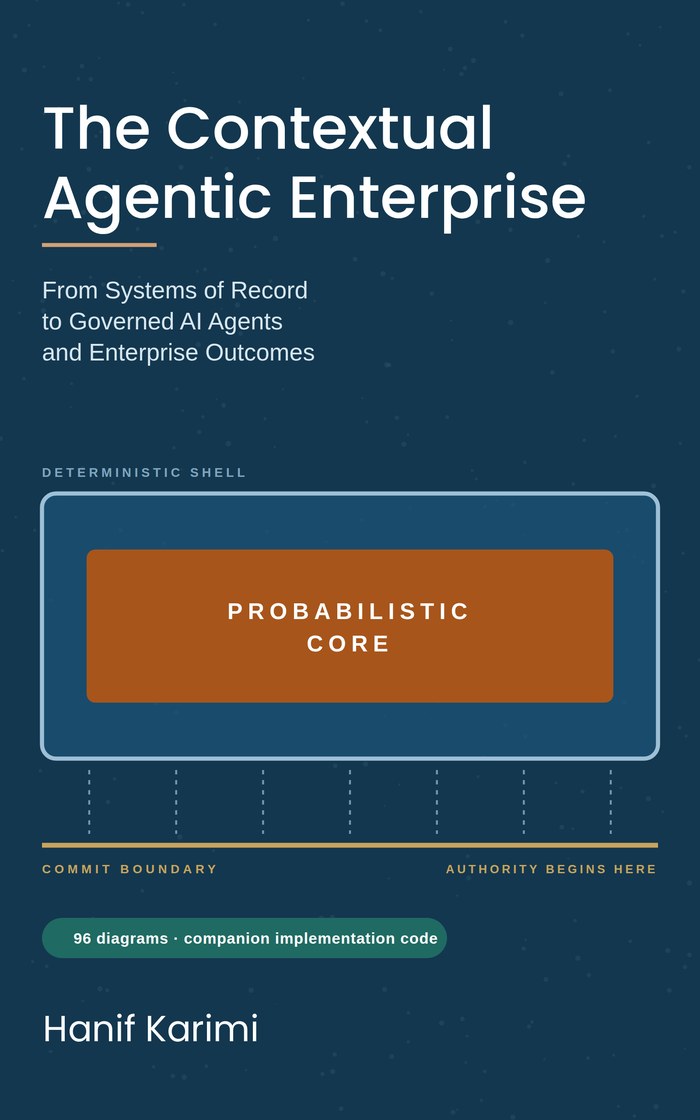
Available nowPaperback and kindle
The Contextual Agentic Enterprise
From systems of record to governed AI agents and enterprise outcomes
Most enterprise AI stalls after the demonstration. This book is about what comes next: designing the context, authority, controls and evidence that let an agent take part in real work.
- Give agents the organisation's own context to act on, not documents retrieved and hoped for.
- Grant, scope and revoke authority explicitly, with controls that do not depend on the model behaving well.
- Produce the evidence a reviewer needs as a by-product of the work, not an afterthought.
The Introduction in full and the opening pages of two chapters, in your browser. No sign-up and no email address.
Who it is for
- Enterprise and solution architects designing agent systems that touch systems of record
- Engineering leaders responsible for what those systems do in production
- AI governance, risk and assurance practitioners who have to review them
- Platform and security engineers implementing the boundaries
What you will learn
- Design a contextual substrate an agent can act on, rather than retrieving documents and hoping
- Model authority explicitly — granted, scoped, delegated and revocable — instead of implying it in a prompt
- Apply Zero Trust principles to agent actions, including the write path
- Produce evidence as a by-product of agent work, so assurance is not archaeology
- Place human oversight where it can still change the outcome
- Reason about the economics without the denominator sleight of hand
From the Introduction
The opening section of the Introduction, unchanged, from the free sample. © Contextual Agentic. All rights reserved.
I did not begin writing this book because enterprises lacked another artificial-intelligence platform, reference diagram or governance checklist. I began writing it because, across more than two decades of architecture, software engineering, delivery leadership, security and transformation work, I repeatedly encountered the same underlying problem:
Enterprises possess enormous amounts of data, knowledge, process history and technical capability, yet struggle to assemble the right context, evidence and authority at the moment a consequential decision must be made.
The technologies changed. Monolithic applications gave way to services, cloud platforms, data lakes, machine-learning systems and, eventually, generative AI. The architectural difficulty remained.
Information was fragmented across systems. Business meaning was embedded in code, documents, meetings and the experience of a small number of specialists. Decisions were recorded without the evidence that justified them. Delivery systems reported activity without reliably connecting it to intended outcomes. Models produced predictions without sufficient operational context. Governance often existed as policy outside the systems expected to enforce it.
Generative AI initially appeared to offer a solution. Large language models could search, summarise, explain and generate content across previously disconnected information. But the introduction of agents changed the architectural problem again.
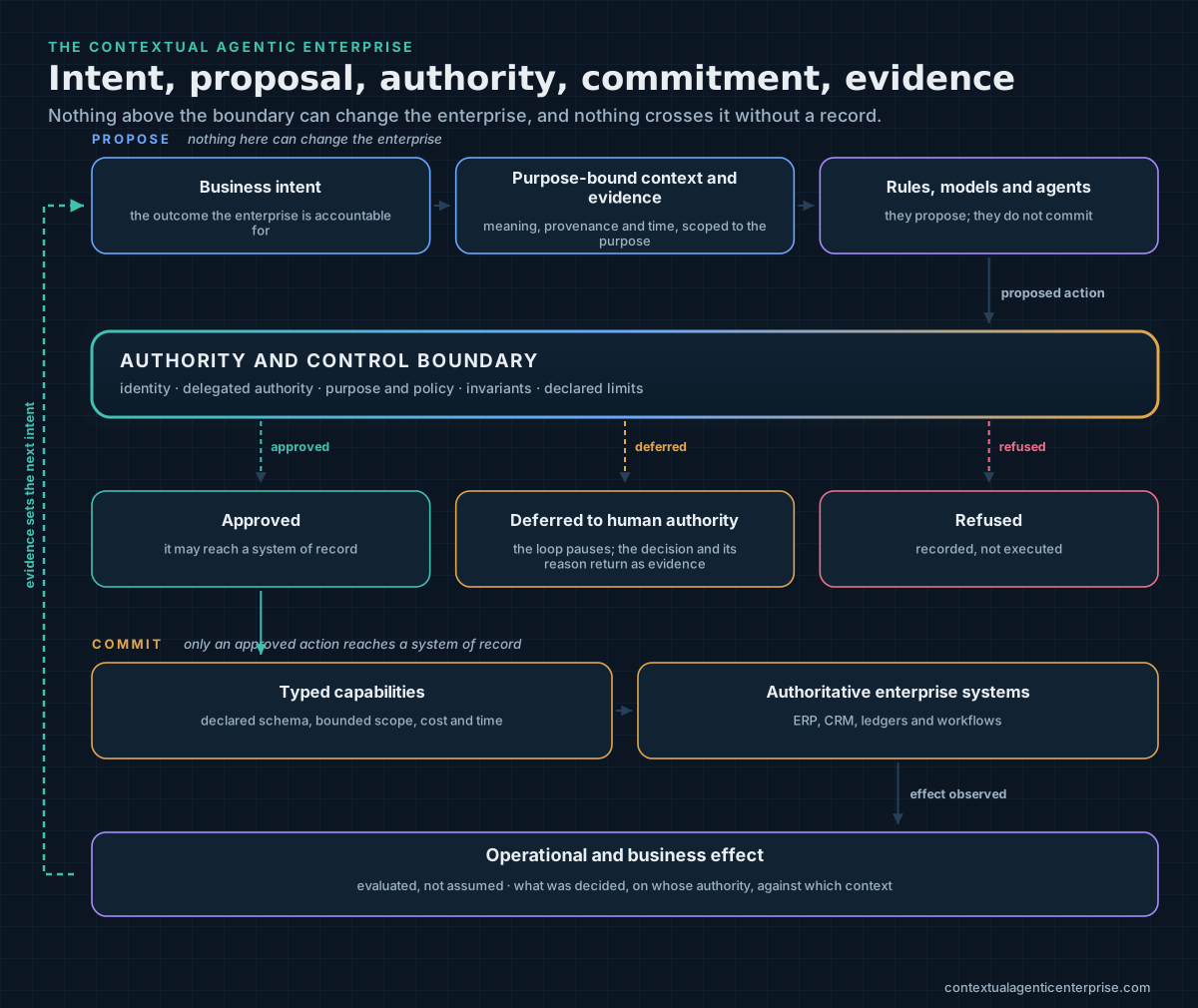
An assistant that drafts a response is primarily an information system. An agent that selects tools, delegates work, invokes services, modifies records or initiates an operational process becomes part of the enterprise control plane.
That transition is profound.
A conventional application follows paths deliberately encoded by developers. A machine-learning model produces outputs within an inference contract. An agent, however, may interpret an objective, construct a plan, select capabilities, obtain additional context, interact with other agents and alter its behaviour according to intermediate results. The execution path may not be known completely in advance.
The enterprise is therefore no longer governing only software components and human users. It must also govern contextual decisions made through probabilistic reasoning and dynamic execution.
What is inside
26 chapters in 9 parts, with appendices. The full contents are on the book page.
- Part I — Historical and conceptual foundations
- Part II — Knowledge, context and semantic foundations
- Part III — Agentic architecture and interoperability
- Part IV — Trust, security, governance and accountability
- Part V — Engineering, integration and operations
- Part VI — Economics, operating model and transformation
- Part VII — End-to-end implementation
- Part VIII — Research frontiers and the next enterprise
- Appendices
Buy the book
Published by Polymath Signal Press. Each link opens the Amazon listing for that format; the price shown there depends on your store.
-
Paperback, black and white
Black-ink interior, 7 × 10 in. Diagrams print in black and white.
ISBN 978-1-7649957-0-2 -
Paperback, premium colour
Premium-colour interior, 7 × 10 in. Diagrams keep their colour.
ISBN 978-1-7649957-1-9 -
Ebook
Reflowable ebook for Kindle.
ISBN 978-1-7649957-2-6
This page counts, without cookies or any identifier, that it was opened and which of its sample and Amazon links were clicked. The counts are clicks, not people, and never include an email address. See the privacy notice. For everything else about the book, see the book page.