Outcome: committed
A £40,000 credit adjustment
The proposal is inside policy and inside the approver's limit. The control layer commits it and writes the evidence record.
Independent research · Enterprise architecture · Practical guidance
Research, architecture and practical guidance for teams building agentic systems. Connect business purpose, shared context and explicit authority with the evidence, operating discipline and cost awareness needed for consequential work.
An independent research and services initiative. Explore the published material today; request the scope and availability of advisory work.
The Contextual Agentic Enterprise
A conceptual model, not a claim of an operating platform.
Explore the architecture →Research, practice and enterprise support
Contextual Agentic explores how people, models, agents and systems can work together around enterprise context, explicit authority and measurable outcomes.
Explore proposed patterns for context, agent authority, governance and evidence. Distinguish the architectural idea from what has been evaluated.
Use articles, labs and resources to examine design choices and failure modes with your team.
Start with the introductory enterprise wizard, then request an agreed review or workshop scope. Availability, deliverables and pricing need confirmation.
A way of thinking
Explore how situation, memory, authority and feedback connect human cognition with the design of agentic systems.
Read Beyond the Prompt Window →Frame the use case, business owner, current process and accepted outcome before choosing an agent architecture.
Review context, delegated authority, human oversight and the boundary where a proposal becomes an external effect.
Examine evaluations, recovery, evidence and whole-operation costs, including the people needed to run the system.
Request access, pricing or a reviewContact Contextual Agentic
Requests open an email enquiry. They do not activate a subscription or create an engagement. No customer outcomes, staffing capacity or accreditation are asserted.
Connected initiative
Explore AI security, digital trust and quantum resilience, or work through the separate Security Check. Enterprise architecture and security assessments share an email-verification process, with distinct questions and reports.
Enterprises possess enormous amounts of data, knowledge, process history and technical capability, yet struggle to assemble the right context, evidence and authority at the moment a consequential decision must be made.
Moving from a model that answers to an agent that acts changes what has to be true around the model.
An assistant produces information that a person then acts on. An agent acts. Consequence, not output, is the whole change, and it moves the risk from the answer to the action.
A working model was never the hard part. The questions that follow are not model questions: which version of the policy applied, whether another customer's data was reachable, who authorised the tool call, how a decision is reproduced three months later.
Deterministic checks run in microseconds to milliseconds on ordinary CPU; a model call is a far larger cost. In the book's worked example the control layer is about one 358,000th of the model call's cost, though only about 1 : 2,657 in time. See the derivation and its assumptions.
Probabilistic reasoning sits inside deterministic control, governance and an evidence loop, and authority lives only outside the model.
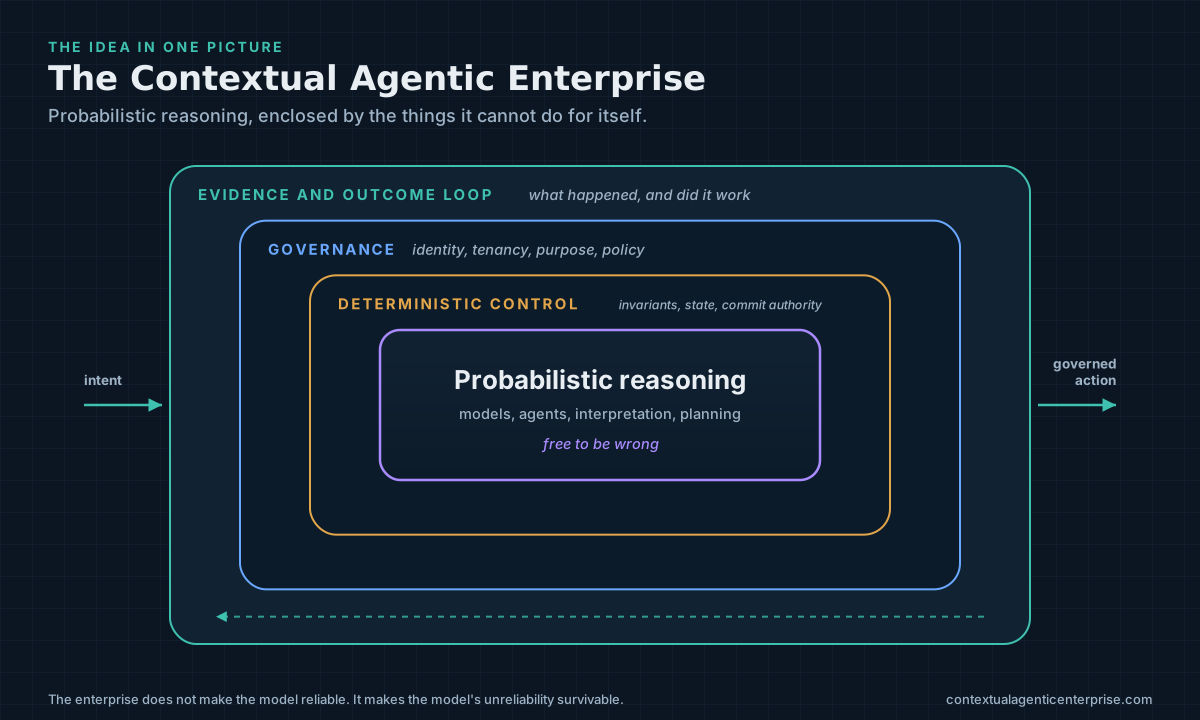
Reasoning that is free to be wrong. It proposes; it does not commit.
Holds invariants, state and commit authority outside the model.
Identity, tenancy, purpose and policy: who may ask for what, and why.
Records what happened and whether it worked, so a decision can be reproduced.
Three proposals cross the same authority and control boundary. The boundary decides, not the model.
Outcome: committed
The proposal is inside policy and inside the approver's limit. The control layer commits it and writes the evidence record.
Outcome: deferred to a named person
No rule covers the clause, so nothing is committed. The proposal goes to a named human who decides.
Outcome: refused
The request breaks a tenancy invariant. It is refused, not escalated for approval, because that invariant is never negotiable.
Illustrative scenarios with invented figures, not real cases.
You have to decide what the agent is allowed to touch, and defend that decision to people who will not accept "the model is usually right" as a control.
You own what runs in production. The interesting failures are not hallucinations; they are actions taken with authority nobody meant to grant.
You have to review a system whose behaviour varies by design. That is possible, but only if the evidence was designed in rather than reconstructed afterwards.
Books and publications
The book has its own reading, sample and purchase pages. It is a publication, separate from assessment access and advisory services.
Available nowPaperback and kindle
From systems of record to governed AI agents and enterprise outcomes
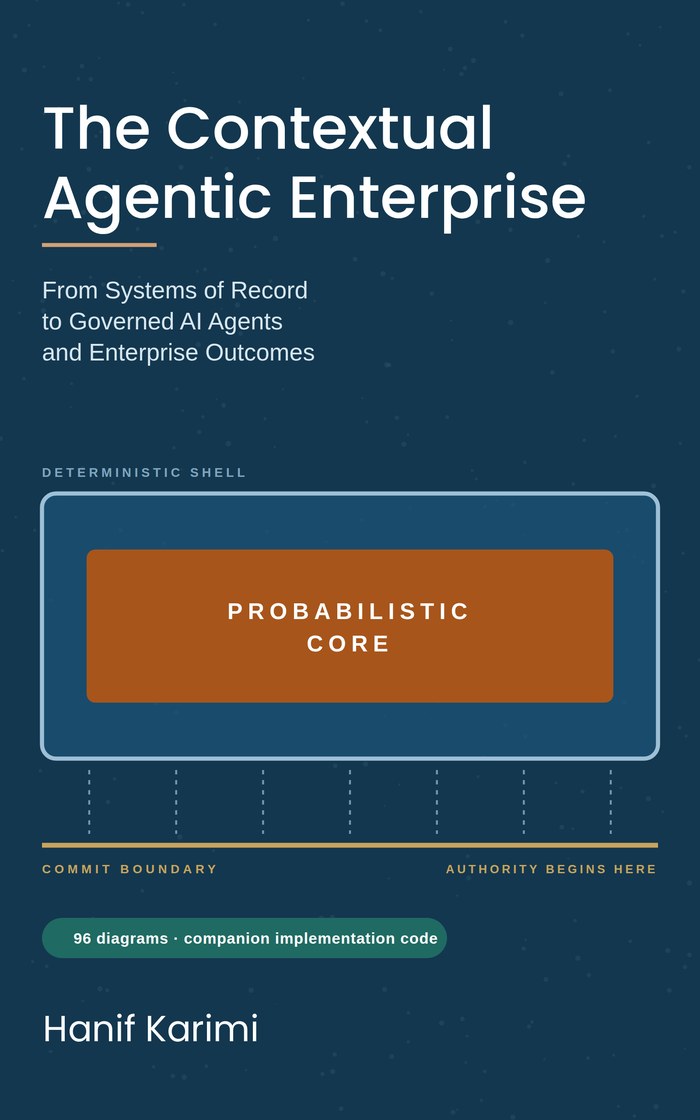
Most enterprise AI stalls after the demonstration. This book is about what comes next: designing the context, authority, controls and evidence that let an agent take part in real work.
Watch — ninety seconds
The Next Enterprise Era. Why a working model was never the hard part, the four rings that contain an unreliable one, and what the controls cost.
There is no speech in the film, so there is nothing to caption. Everything it says is written on screen, and this is that text.
Your model works. That was never the hard part. Then the real questions arrive: which version of the policy did it use; could it reach another customer's data; who authorised that tool call; what happens after a timeout; can a document tell the model to ignore its controls; how do we reproduce a decision made three months ago. Not one of them is a model question.
An assistant produces information that a person then acts on. An agent acts. Consequence, not output — that is the whole change.
So the enterprise encloses it. Probabilistic reasoning sits at the centre, free to be wrong. Around it, deterministic control holds invariants, state and commit authority. Around that, governance holds identity, tenancy, purpose and policy. Outermost, an evidence and outcome loop records what happened and whether it worked. Four rings, each answering a question the model cannot.
The enterprise does not make the model reliable. It makes the model's unreliability survivable.
Three proposals cross one authority and control boundary. A £40,000 credit adjustment is committed, inside policy and limit, with evidence written. A contract variation with an unseen clause is deferred, because no rule covers it and a named human decides. An export including another tenant is refused, because it breaks a tenancy invariant, which is never negotiable. Same model, three outcomes: the boundary decided, not the model.
And the control layer costs about one 358,000th of a single forward pass. Control is not the expensive part. Not having it is.
A connected reading path from enterprise architecture to everyday business practice. Start with the architecture, explore security and software delivery, or choose the beginner-friendly small-business companion for practical, almost no-code workflows.
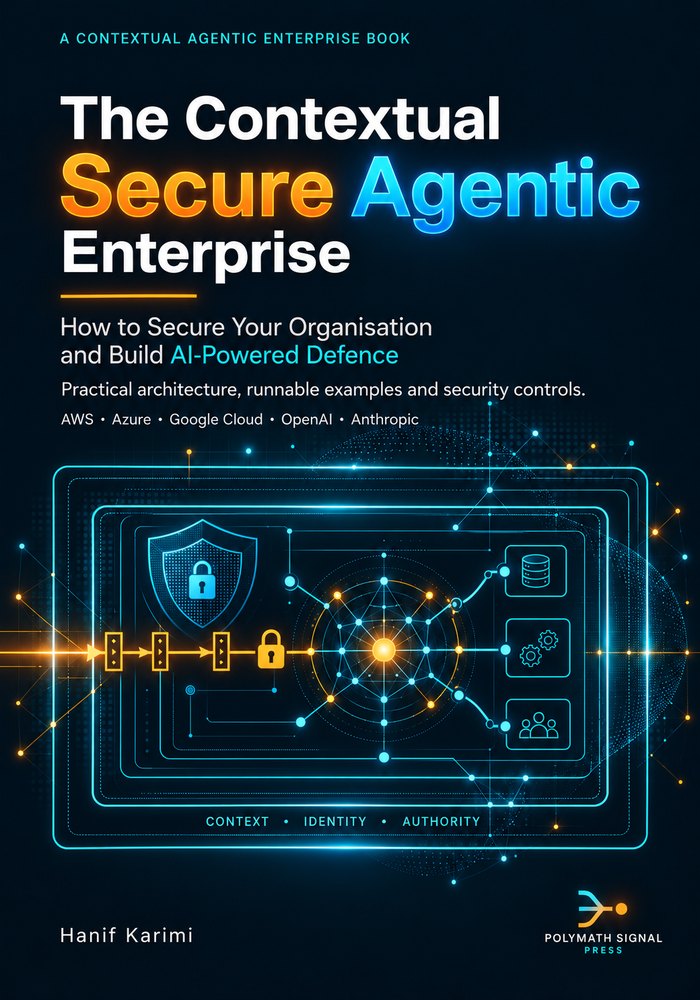
Book 2 of 4
The security
To be released
Planned for the end of October 2026. Dates can move.
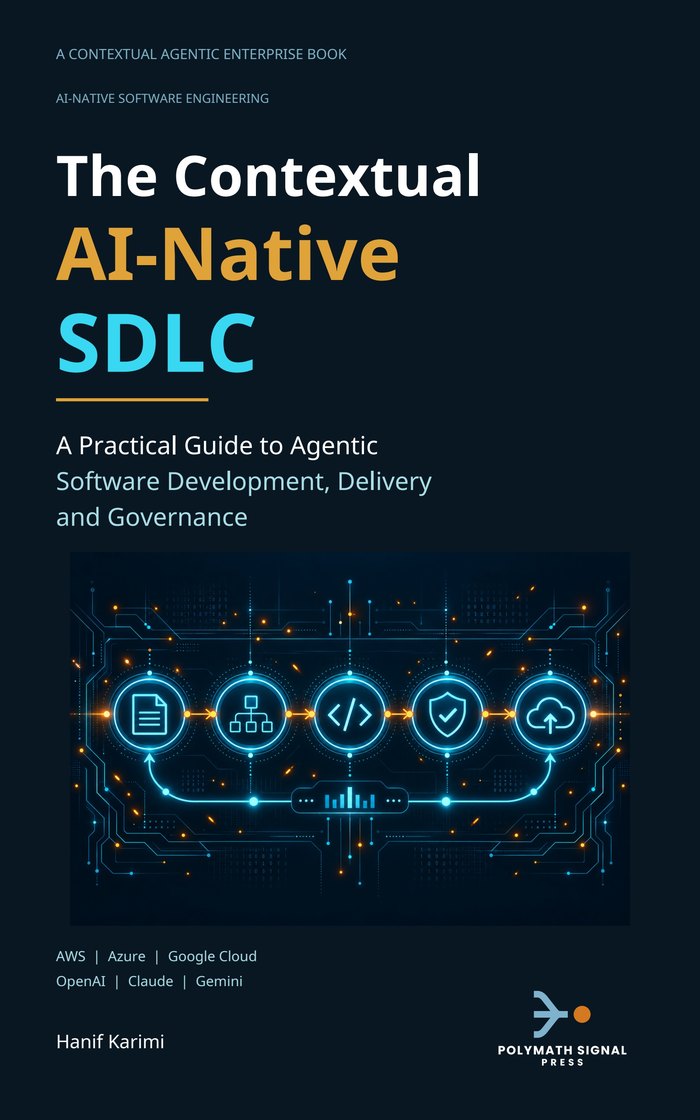
Book 3 of 4
The delivery
To be released
Planned for the end of October 2026. Dates can move.
Book 4 of 4
The small-business companion
To be released
In development; release date to be announced. Dates can move.
When AI agents join real workflows, accountability does not move to the model. Who owns the outcome, the limits, the system checks and the recovery, with one worked example and a 30-day start.
AI is making bespoke enterprise software cheaper to build. Building is only the first bill: integrating, securing, governing and operating it are where the work moves, and where CA proposes to help.
A dual-lens architecture: contextual reasoning proposes, deterministic systems of record decide and commit, and evidence links the two. Includes a fictional procurement walkthrough, a policy gate tested in OPA, and a truthful treatment of evidence and transparency logs.
An independent research and services initiative focused on enterprise agentic systems.
Our published work explores context, authority, governance, engineering and business outcomes. The Contextual Agentic Enterprise is a proposed framework and architectural synthesis, not an industry standard or a claim of an operating enterprise platform.
Application requires organisation-specific architecture, security, privacy, legal, regulatory, operational, safety, accessibility, commercial and governance review, together with appropriate approvals.
A short note when the book is available, when companion material is released, and when a course opens. Nothing else.
The email list is not open yet, and rather than take an address we cannot yet store, here is what works today: the article feed carries every piece as it is published, collects nothing and asks for nothing. You can also follow the Contextual Agentic Page on LinkedIn (opens in a new tab). Or write to contact@contextualagentic.com and we will add you by hand when the list opens.
No tracking, no address stored, no account.