Beyond the Prompt Window: Contextual Thinking in Human Cognition and Autonomous AI Systems
Contextual thinking connects evidence, memory, constraints and feedback. A research essay on human cognition, agent architecture and the limits of autonomous action.
Written as at 1 November 2026.
contextual-thinkingagentic-aiai-securityquantum-resilience
Linear reasoning assumes a closed world; operations never are
Linear reasoning is a claim about the world before it is a method. It assumes that a problem can be isolated, that its inputs are complete, and that the transformation from A to B holds wherever it is applied. That claim is true in a compiler, a proof or a well-instrumented factory cell. It is false in an organisation, and it is false in most places where autonomous software is now asked to act.
Contextual thinking rejects the assumption. It treats an input as meaningful only relative to its situation: what happened before it, who is affected by it, what the environment permits, and what acting will cost. The same alert, customer complaint or failing test has a different correct response depending on those four things. The unit of analysis is therefore not the input but an open graph, in which the input is one node tied to history, stakeholders, constraints and feedback.
The idea has two independent lineages. In cognitive science, situated cognition holds that knowing cannot be separated from the setting in which it is used. Lucy Suchman’s study of people operating photocopiers (Plans and Situated Actions, 1987) argued that plans are resources for action, not programs that determine it. Brown, Collins and Duguid (1989) argued that knowledge is partly a product of the activity and culture in which it develops. Robert Sternberg’s triarchic theory states the practical consequence: its contextual component defines intelligence as the ability to adapt to an environment, to shape it, or to select a different one. The measure is fit to circumstances, not performance on isolated problems.
In systems theory, Ludwig von Bertalanffy’s general system theory (1968) described organisations and organisms as open systems that exchange matter, energy and information with their environment, so their behaviour cannot be derived from their components alone. Cybernetics added the control mechanism. Wiener’s feedback (1948) and Ashby’s law of requisite variety (1956) together say that a controller can regulate a system only if it can represent at least as much variety as the disturbances it faces. A controller whose model contains only A and B cannot regulate a world that contains C through Z. That is the formal case against context-free logic.
The Cynefin framework (Snowden and Boone, 2007) shows where the boundary lies. In the clear and complicated domains cause and effect are knowable, so rules or expert analysis work. In the complex domain cause and effect are coherent only in retrospect, and in the chaotic domain there is no stable relation to exploit. Enterprise cloud operations sit on the complicated-to-complex boundary. Each component is, to a first approximation, deterministic, yet the composed system’s behaviour under a release, a traffic surge and a dependency failure arriving together cannot be read off any component’s specification. A rule engine fails there not because its rules are wrong but because their preconditions are unstated. Every rule carries an implicit “all else being equal”, and in a complex domain all else is never equal.
The AI lineage: situated action, cognitive architectures, language-model agents
The claim that machine intelligence must be situated is older than language models, and the lineage shows which parts of today’s agent design are rediscovery. It runs through three research traditions.
Situated action and agency. Rodney Brooks’s “Intelligence without representation” (1991) attacked detached, centralised symbolic models. His argument was that the world is its own best model and that intelligent behaviour emerges from tight coupling with it. Suchman’s study of plans as resources for action (1987) made the same point about people. Wooldridge and Jennings (1995) then set out the properties that define an agent: autonomy, reactivity, pro-activeness and social ability. Deliberative designs of the belief-desire-intention kind keep long-term goals while re-evaluating the situation before each commitment.
Cognitive architectures. Soar (Laird, Newell and Rosenbloom) and ACT-R (Anderson and colleagues) were built to model unified cognition, and both treat context as structured working memory reconciled with long-term stores, not as a flat sequence. In ACT-R, declarative chunks compete for retrieval on their activation:
A_i = B_i + \sum_j W_j S_{ji} + \epsilon
Here B_i is base-level activation (recency and frequency of use), W_j is the attentional weight of context element j, S_ji is the associative strength between cue j and chunk i, and ε is noise. Chunks that fall below a retrieval threshold are not retrieved at all. In an illustrative case, a goal of “emergency” plus a percept of smoke raises the activation of fire-suppression knowledge and leaves unrelated knowledge below threshold. Soar represents context as a graph of relational assertions. When its preferences cannot select a single operator, because of a tie, a conflict or no proposal, it declares an impasse and creates a substate whose goal is to resolve it. Chunking then compiles the resolution into a new rule.
Language-model agents. Park et al. (Generative Agents, UIST 2023) showed that long-horizon coherence needs architecture beyond the raw window: a memory stream, retrieval that weighs recency, importance and relevance, and reflection that distils experience. Yao et al. (ReAct, ICLR 2023) interleaved reasoning traces with actions and observations, so that each step is corrected by what the environment returned. Dissanayake and Nanayakkara (2025, an arXiv preprint) study context-aware interventions that avoid breaking a user’s reasoning flow.
| ACT-R | Soar | Language-model agent | |
|---|---|---|---|
| Context representation | Specialised buffers plus declarative chunks | Graph of relational working-memory elements | Token sequence in a window, plus external memory |
| Selection | Spreading activation against a threshold | Rule matching and operator preferences | Attention inside the window; retrieval scoring outside it |
| Mismatch signal | Retrieval failure below threshold | Impasse and substate | None built in; the harness must supply it |
| Learning from experience | Base-level strengthening with use | Chunking | Reflection and memory write-back |
Three lessons carry into this essay. First, ACT-R’s separation of goal, perceptual and retrieval buffers is the move made later in memory design, with working context kept apart from session state and episodic memory. Its activation rule is also the analogue of the inclusion test in the formalism below: both score an item by how strongly the current situation cues it and drop what falls under a threshold. The value-of-information form adds the price of the tokens. Second, Soar’s impasse is the analogue of escalation. Unexpected context becomes an explicit, traceable subgoal and not a retry loop. Third, chunking is the cautious analogue of promoting an episode into a rule, which a governed system should do only after verification. These comparisons are this essay’s architectural analogies; the essay does not claim direct historical influence.
What the older architectures lacked is the problem that now dominates. They assumed a benign environment and trusted their own memory. A language-model agent reads text written by others and acts with real credentials, so the missing piece is enforcement, which the later sections add.
Context has four planes, and each fails differently
“Context” is too coarse a word to engineer with. It names at least four planes, each with its own data, its own rate of change and its own characteristic failure when ignored.
The temporal plane holds state history, trajectories, latency decay and predictive horizons. An error rate of four percent means nothing alone. Whether it rose from a tenth of a percent over six minutes or has sat flat since the last deploy decides everything. Evidence also decays: a reading taken ninety seconds ago during a cascading failure is closer to folklore than to measurement, so staleness should be a property of each signal, not a global timeout. The predictive horizon is how far an action’s consequences reach. A rollback now interacts with a batch job scheduled twenty minutes ahead, and a system that reasons only about the present state will miss it.
The relational and social plane holds stakeholder incentives, organisational topology and coordination among actors. Conway’s Law (1968) observes that organisations design systems that mirror their communication structures, which means a service graph is also an ownership graph. The team paged for a payments outage and the team measured on checkout conversion rank mitigations differently, and both rankings are legitimate. For multi-agent systems this plane is the coordination layer: who owns a resource, who may override whom, and whose approval an action needs. Without it, two competent agents can issue contradictory changes to one service.
The environmental and structural plane holds bounded contexts, infrastructure topology, regulatory regimes and physical limits. Eric Evans’s bounded context (Domain-Driven Design, 2003) makes the semantic point: a term such as “order” or “customer” means different things inside billing and inside fulfilment, and moving it across the boundary without translation is a category error. Topology adds blast radius, meaning which dependencies a change can reach. Regulation adds data-residency rules and change freezes. Physics adds inter-region latency and hardware capacity. This plane changes slowly, so it is the one most worth encoding explicitly.
The operational plane holds resource ceilings, cost and compute trade-offs and failure tolerances. Error budgets, rate limits, on-call capacity and the agent’s own token and latency budget all live here. Actions are not free, and neither is deliberation: an optimal decision delivered after the incident window closes is a failed decision. Failure tolerance defines what counts as acceptable degradation, and it is what turns “fix it” into “fix it enough, safely, now”.
The planes are coupled, and the coupling carries most of the value. Business hours (temporal) change who is reachable (relational). A residency rule (structural) removes a mitigation that cost analysis (operational) would otherwise rank first. A context store that keeps four separate lists loses these interactions. The useful representation is one graph with typed edges, in which every fact carries a timestamp, a source and a confidence.
A context window is a capacity; contextual thinking is a policy
A context window is the bounded token buffer a model can attend to in one pass. Contextual thinking is the system’s decision about what enters that buffer, how it is interpreted and what action it licenses. Larger windows ease the first problem but do not by themselves solve the second. Filling a million-token window with undifferentiated logs raises token entropy: the share of tokens that bear on the decision falls, attention is diluted, and models are known to use information in the middle of long inputs less reliably than information at the edges (Liu et al., “Lost in the Middle”, Transactions of the Association for Computational Linguistics, 2024; the findings concern the models and tasks that study evaluated).
| Context window | Contextual thinking | |
|---|---|---|
| Nature | A capacity: a bounded token buffer | A mechanism: selection, grounding, interpretation |
| Question it answers | How much can the model see? | What matters now, and what does it permit? |
| Typical failure | Overflow, dilution, lost-in-the-middle | Mis-framing: the right data read in the wrong situation |
| Where it lives | The model architecture | The system architecture around the model |
For an autonomous agent the term resolves into four concrete mechanisms.
Contextual state machines. The agent’s progress is an explicit state (triaging, investigating, mitigating, verifying, escalated), and transitions are guarded by context predicates, not by events alone. The same alert triggers different handlers in different states. The machine also gives the model a shape for its work and prevents it from re-litigating decisions already settled.
Semantic routing for retrieval. One vector search over everything is context-blind. A router chooses the source by question type: runbooks for procedure, the change log for temporal causation, the topology graph for dependencies, past incidents for precedent. It then filters by recency, ownership and authority, so a superseded runbook version never reaches the model. Retrieval becomes a decision conditioned on the situation instead of a nearest-neighbour lookup.
Dynamically bounded tool use. The tools exposed at each step are a function of state and authority. While investigating, the agent holds read-only tools. Mutating tools appear only after a mitigation plan clears a gate, and they disappear again once the action completes. This is least privilege made dynamic, with the boundary widening and narrowing as risk changes.
Interpretation of environmental feedback. An action’s result is evidence, not truth. Latency fell after a rollback: was it the rollback, or did the traffic burst simply end? A contextual agent compares the outcome with a baseline and treats success signals as hypotheses. A 200 response from a control API means the request was accepted, not that the system recovered.
In a multi-agent system these mechanisms move into a control plane. Triage, change-analysis, impact and remediation agents do not pass free text to one another. They exchange structured intents carrying a goal, constraints, an authority level and an expiry, so negotiation happens over explicit fields. The plane keeps a versioned shared ledger of facts, with one writer per fact class (a design rule this essay proposes, not a universal requirement). Each agent’s read is stamped with a version, and an action based on a stale version is rejected, which is optimistic concurrency applied to reasoning. When two agents’ assessments diverge beyond a set threshold, the plane does not average them. It treats the divergence as a signal of missing context and routes to further evidence gathering or to a human.
Case study: one alert, handled two ways
The scenario is illustrative, not a real incident. A retailer runs a checkout service across three cloud regions. At 14:05 on a weekday the error rate crosses its alert threshold and p99 latency doubles. Eleven minutes earlier a release shipped that included a security patch. A marketing campaign is driving traffic to roughly two and a half times baseline, and the downstream payment provider is returning intermittent timeouts.
Naive execution is linear rule-matching: alert triggered, deploy within the last 30 minutes, roll back. The rule is reasonable and the outcome is poor. The errors are concentrated on calls to the payment provider, not on the code paths the release changed, so the rollback does not remove the cause. It does cold-start caches at peak revenue, and it silently reverts a security patch. Nothing in the rule asked about any of this, because the rule’s preconditions were never written down.
| Naive rule-matching | Contextual execution | |
|---|---|---|
| Trigger | Alert threshold crossed | Alert, then the situation is assembled |
| Evidence consulted | The alert and the deploy log | Traffic, release contents, dependency health, error distribution, business calendar, change-freeze and on-call state |
| Candidate actions | One, fixed by the rule | Rollback, scale out, degrade gracefully, fail over the provider, page a human |
| Action chosen | Roll back the last release | Scale out one region and enable degraded checkout, then re-measure |
| Side effects considered | None | Cold caches at peak revenue, re-exposed vulnerability, blast radius, reversibility |
| If the action fails | Repeat or stop | Compare with baseline, then widen or escalate with the evidence attached |
Contextual execution runs a loop, not a rule. It gathers the surrounding state, filters it to what bears on the decision, weighs candidate mitigations against risk and cost, acts inside enforced limits, and reads the result before acting again. The diagram shows the loop and the planes that feed it.
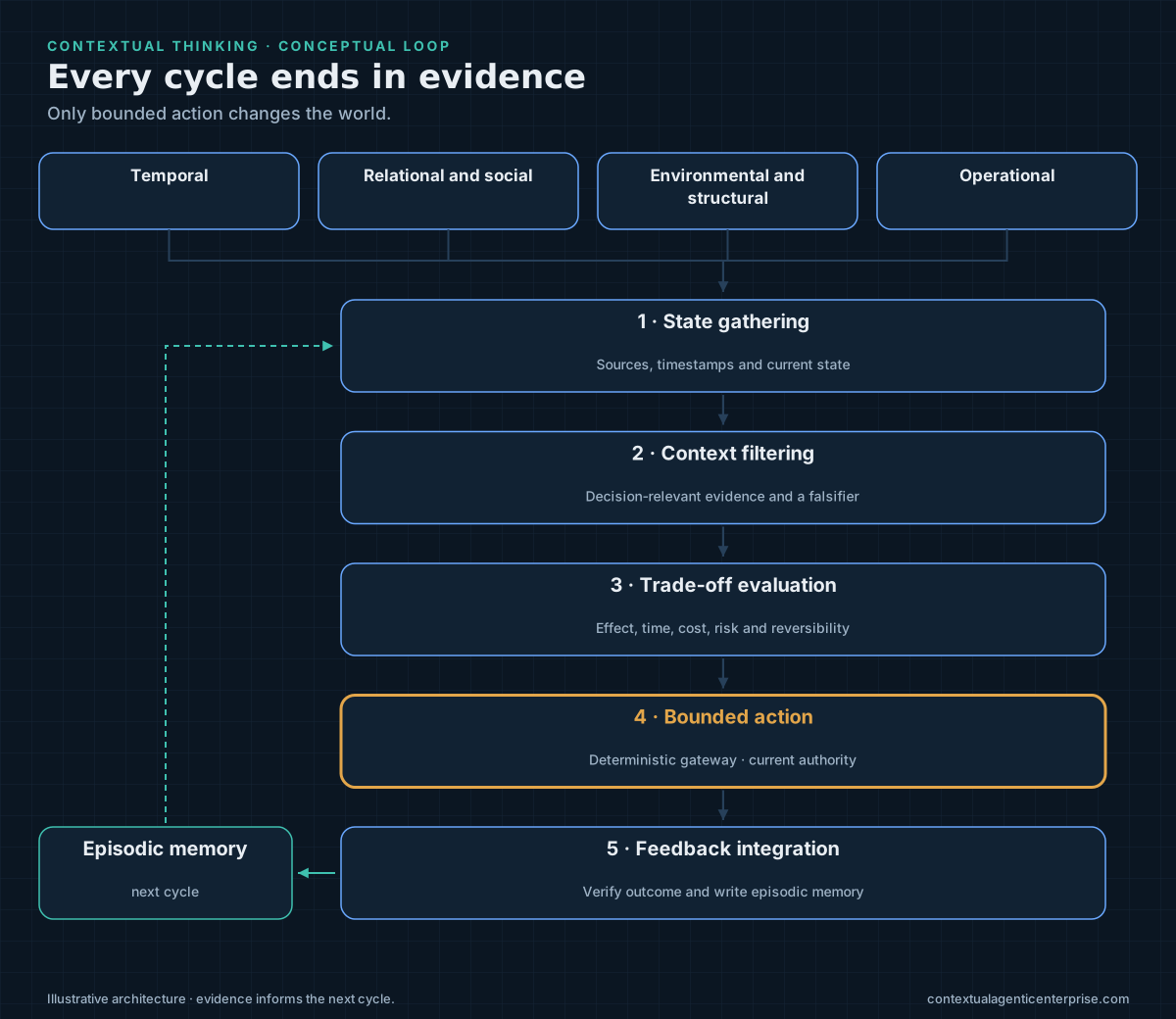
The four planes feed stage 1. Only stage 4 changes the world. Stage 5 writes its outcome to episodic memory, which stage 1 reads on the next cycle.
Applied to the case, the five stages work as follows.
- State gathering. The agents pull the alert, the release manifest and diff summary, traffic against baseline, dependency health, the business calendar, change-freeze status and the on-call roster. Each fact is stamped with its age.
- Dynamic context filtering. Alerts from unrelated services and last quarter’s unrelated incidents are ambient noise. The release timing, the traffic multiple, the provider’s error rate and the per-dependency error split are decision-critical and are kept. Hundreds of signals shrink to the handful the model can reason over.
- Trade-off evaluation. Each candidate is scored on expected effect, time to effect, reversibility, cost and the authority it requires. Rollback scores poorly on effect, since the evidence points away from the new code, and carries a security cost. Scaling out with degraded checkout, which queues payment confirmations, scores best.
- Bounded action execution. The plan passes through a deterministic gateway (next section): the action is on the allow list, confined to one region, reversible and within the agent’s authority. It runs in that one region first.
- Feedback integration. After a settling window the system compares the error rate with both the baseline and the prediction it made. If the prediction held, it proceeds to the remaining regions. If not, it widens the hypothesis or escalates with the evidence attached. The episode is written to memory with its outcome.
Three patterns make the loop dependable
Memory and state: separate what is current from what is remembered
A single growing transcript is the weakest possible memory. A hierarchy works better. The working context is a small, bounded scratchpad rewritten on every cycle. Beneath it sits session state: a versioned ledger of facts for the current incident, each with a timestamp, source and confidence. Episodic memory holds past incidents as structured records of situation, actions taken and verified outcome. Semantic and structural memory holds the topology graph, ownership data and runbooks, which change slowly.
Retrieval from episodic memory should key on a situation signature, not on text similarity alone. Embedding the alert text retrieves every latency incident the company has ever had. Matching first on structured features (service, failing dependency, time since last release, traffic ratio) and using the embedding only to rank the survivors returns precedents that actually resemble the case. Retrieved episodes enter the context labelled as precedent, never as instruction. Write-back is restricted to outcomes the feedback stage verified, together with the evidence used, so the agent cannot teach itself its own mistakes.
Dynamic pruning: keep what the decision needs, and a falsifier
Context saturation is a reliability problem, not only a cost problem. When the context holds contradictory or irrelevant material, models tend to blend it into fluent claims that nothing supports. Pruning shrinks that surface. Each candidate item is scored for inclusion by its relevance to the current state and open hypotheses, its freshness, its provenance and its token cost, and each stage runs under a hard token budget. Ambient material is compressed into aggregates, for example “38 unrelated alerts, none on the checkout dependency graph”, and not dropped silently.
Two safeguards keep pruning honest. First, it is reversible: every pruned item leaves an identifier, so the agent can pull detail on demand, and the dropped set is logged for audit. Second, the filter reserves a falsifier slot for the strongest evidence against the leading hypothesis. Without it, pruning amplifies confirmation bias, because the filter discards exactly the signals that would change the agent’s mind.
Deterministic gateways: non-determinism upstream, determinism at the barrier
The model’s reasoning is probabilistic and should be treated that way. Its actions must not be. The model proposes a typed action, and a deterministic gateway decides whether it executes. The gateway, not the model, holds credentials. It validates the schema, checks the tool against an allow list keyed to the current state, verifies that the action was based on the current context version, enforces blast-radius, rate and change-freeze limits, and compares the action’s risk tier with the approver’s authority. It writes an audit record containing a hash of the context snapshot the decision used.
def gate(action, ctx):
    violations = []
    if action.type not in ALLOWED[ctx.state]:        violations.append("tool_not_permitted_in_state")
    if action.based_on_version != ctx.version:       violations.append("stale_context")
    if action.blast_radius > ctx.limit:              violations.append("blast_radius_exceeded")
    if ctx.change_freeze and not action.reversible:  violations.append("irreversible_during_freeze")
    if action.risk_tier > ctx.approver_tier:         violations.append("needs_higher_approval")
    audit.write(action, ctx.snapshot_hash, violations)
    return Decision(allow=not violations, reasons=violations)
The same input always yields the same decision, which is what makes it auditable and testable without a model in the loop. Rejections return machine-readable reasons, and those reasons re-enter the agent’s context. The agent learns where the boundary sits from the boundary itself, and a rejected proposal becomes information instead of an incident.
A small formalism: context as a graph, constraints as a shell
The argument can be stated precisely. The notation below is a modelling aid, not an empirical result, and its value is that each design choice becomes testable.
A linear system computes an action from the input alone. A contextual system computes it from the input and the situation, where the situation is a typed graph of facts together with decay constants and budgets.
a_t = f(x_t) \qquad \text{versus} \qquad a_t = \pi\left(x_t,\, C_t\right), \quad C_t = \left(G_t,\, \tau,\, B\right)
Here G_t is the graph (services, teams, releases and constraints as nodes; depends-on, owns and constrains as edges), τ holds one decay constant per signal, and B holds the budgets. Evidence loses weight with age at a rate set by its signal type. A deploy marker has a long time constant and a queue depth a short one.
c_i(t) = c_i(t_0)\, e^{-(t - t_0)/\tau_i}
Pruning then becomes a value-of-information test. An item k enters the working context only if the expected improvement in the decision exceeds the price of the tokens it occupies, inside a hard budget.
\mathrm{VOI}(k) = \mathbb{E}\left[U\left(a^{*} \mid K \cup \{k\}\right)\right] - \mathbb{E}\left[U\left(a^{*} \mid K\right)\right] > \lambda \, \mathrm{tok}(k), \qquad \sum_{k \in K} \mathrm{tok}(k) \le B_{\mathrm{ctx}}
In practice VOI is approximated by cheap proxies (relevance to open hypotheses, freshness, provenance), and λ prices latency, cost and dilution together. The falsifier slot sits outside this test: it is reserved, not earned.
The split between model and shell is an optimisation problem with two kinds of term. Preferences are soft and live in the objective. Constraints are hard and define the feasible set.
a^{*} = \arg\max_{a \in \mathcal{A}_{\mathrm{feas}}} \; \mathbb{E}\left[\mathrm{benefit}(a)\right] - \sum_j w_j \, \mathrm{risk}_j(a) - \mathrm{cost}(a), \qquad \mathcal{A}_{\mathrm{feas}} = \left\{ a : g_m(a, C_t) \le 0 \;\; \forall m \right\}
A penalty can be outweighed by a large enough benefit. A constraint cannot. That is why change-freeze windows, blast-radius limits and authority tiers belong in the gateway functions g_m and not in a prompt.
Ashby’s law, used here as an analogy and in a simplified form (Ashby states conditions on how disturbances map to outcomes for a fixed regulator), explains why a context model is needed at all. In entropy terms, the variety left in the outcomes O is bounded below by the variety of the disturbances D less the variety the regulator R can represent.
H(O) \ge H(D) - H(R)
A table of N rules can express at most log2 N bits of response variety, however carefully the rules are written. A situation graph lets the regulator’s variety grow with the situation instead of with the length of the rulebook. This is an illustration, not a proof that graphs outperform rule engines: parameterised rules can generate more outcomes than there are rules.
Finally, autonomy has to be earned numerically. Under independent, representative trials with a stable failure probability, complete observation of outcomes and no observed failures, the rule of three (Hanley and Lippman-Hand, 1983) puts the approximate one-sided 95 percent upper bound on an action type’s failure rate at 3/n after n trials; the exact bound is 1 - 0.05^(1/n), so about 300 clean trials is consistent with a failure rate of one percent. Correlated retries, selectively recorded successes, or a change of model, tool or policy invalidate the count. A bound alone must never widen authority automatically.
p_{\mathrm{fail}} \lesssim \frac{3}{n} \qquad (95\% \text{ confidence, zero observed failures})
Supporting a failure rate below one percent therefore needs roughly 300 clean, comparable executions. “Comparable” does real work here. The bound holds only if past executions resemble the next one, which is why outcomes are stored against a situation signature and not as a bare count.
Contextual thinking is the policy; the framework is where it is enforced
A way of thinking that nothing enforces decays into a prompting style. The loop in this essay therefore separates three jobs. The thinking is probabilistic reasoning over a situation: what is this, what bears on it, what could follow. The policy is the written, versioned statement of what the agent may know and may do. The enforcement is deterministic control outside the model, so that the policy holds when the reasoning is wrong. The Contextual Agentic Enterprise (CAE) framework states the same hierarchy as probabilistic reasoning, deterministic control and governed enterprise action. These are the author’s terms for one way of organising the problem, offered as educational, not as an industry standard. The designs in this essay are architectural positions proposed by the authors, not universal findings, and the code sketch is illustrative policy pseudocode: it omits authentication, tenant isolation, schema validation and an atomic check-and-commit step.
The work is spread across several areas, each carrying one part of that hierarchy.
| Area | What it is | Part it carries |
|---|---|---|
| Contextual Agentic (CA) | An independent research and knowledge initiative | The thinking: the questions of situation, relevance and consequence, published as research, articles and a book series |
| Contextual Agentic Enterprise (CAE) | The framework | The policy: a Context Contract (sources, permissions, freshness, what is withheld), an Agent Execution Envelope (a named, scoped, time-bound, revocable delegation per action type) and an Evidence-First Decision Record |
| CAE Intelligence Fabric | The enabling architecture | The machinery: context assembly, memory, retrieval, a graph of claims and a capability gateway, where the loop’s stages actually run |
| Enterprise Digital Brain | The reference implementation | The demonstration: companion code intended to show the framework end to end; this essay does not assert its current implementation status |
| Contextual Trust | An independent security research and services initiative with its own site | The security pillar of enforcement: agent security, digital trust (PKI, certificates, cryptography) and post-quantum readiness |
The mapping to this essay’s planes is direct. The Context Contract is the written form of the temporal and structural planes: what the agent is allowed to know, and how fresh it must be. The Envelope is the written form of the relational and operational planes: who delegated what, within which limits. The commit boundary, the deterministic validator between proposal and effect, is the gateway of the previous sections, and it evaluates the constraints g_m against the Envelope.
Contextual Trust enters at the point where context stops being merely incomplete and becomes adversarial. Everything in the working context arrived from somewhere. A retrieved document, a ticket comment or a tool result can carry text written to steer the agent. The defence is structural, not a better prompt. Each context item carries provenance and a trust level, and the permission to act is computed from independent policy and current authority. An argument derived from unverified text stays untrusted: it is validated against that policy and cannot change it.
\mathrm{permit}(a) = \bigwedge_{m} \big[\, g_m(a,\, E,\, v) \le 0 \,\big] \qquad \text{with arguments from unverified text in } C_t \text{ validated, never trusted}
Here E is the Envelope, v the context version, and each bracket is a Boolean predicate that holds when the constraint g_m is satisfied. If no action is permitted, the system holds and escalates to a person. The decision is deterministic for a defined input and state snapshot; the externally observed effect is still subject to concurrency, timeouts and partial failure. Text in the window can change what the agent proposes. It can never change what the shell permits. The same pillar covers who is acting and on whose behalf, short-lived delegated credentials whose keys sit with the gateway and never with the model, and signed, tamper-evident decision records. The last of those is where quantum computing arrives.
Quantum changes the trust layer first and the thinking layer later, if at all
Quantum computing touches a contextual agentic system in three ways, and their maturity differs sharply. The effect on security is real and already dated. The effect on analysis is conditional and, for context handling, unproven. The third is a conceptual bridge that needs no quantum hardware.
Trust: a schedule, not a speculation. Shor’s algorithm would break RSA and elliptic-curve public-key cryptography on a large fault-tolerant quantum computer. Craig Gidney’s 2025 estimate puts the factoring of a 2048-bit RSA integer at less than a week on fewer than a million noisy qubits, against an earlier estimate of about 20 million. It is an estimate and not a demonstration, and it says nothing about when such a machine will exist, only that the requirement shrank. Standards bodies have not waited. NIST’s final IR 8547, published on 27 October 2026, lists RSA, ECDSA, EdDSA and finite-field and elliptic-curve Diffie-Hellman as deprecated after 2030 and disallowed after 2035 under NIST standards and guidelines. These are NIST transition dates, not a universal statutory deadline. Its replacements are ML-KEM (FIPS 203) for key establishment and ML-DSA (FIPS 204) and SLH-DSA (FIPS 205) for signatures, with HQC selected for a further key-establishment standard.
Three consequences follow for a governed agentic system. First, decision records are signed and retained, and a signature that becomes forgeable weakens a record that must stand for its whole retention period. Second, traffic carrying retrieved context and model prompts can be recorded now and decrypted later, which matters for anything whose confidentiality outlives the algorithm protecting it. Third, the algorithms in force, key custody and certificate lifetimes become part of the structural plane, so a Context Contract should name them and a gateway should be able to swap them. This is the post-quantum readiness work that Contextual Trust carries.
Analysis: no general speedup for context handling. The popular claim is that quantum hardware will accelerate AI reasoning over large contexts. The evidence does not support that for context assembly or for model inference. A quantum algorithm needs classical data loaded into a quantum state, and the loading cost can erase the advantage, a caveat Scott Aaronson set out in “Read the fine print” (Nature Physics, 2015). For several quantum machine learning algorithms with exponential speedups on low-rank data, classical algorithms with comparable sampling access later matched them up to polynomial factors, a line of work that began with Ewin Tang’s 2018 recommendation-system result and is surveyed in Chia et al.. Grover’s algorithm gives a quadratic speedup for unstructured search, which is real but modest, and error-correction overheads can absorb much of it.
The most plausible leverage is narrower. The trade-off evaluation stage can face large combinatorial candidate sets, such as scheduling, placement or mitigation portfolios, and simulating quantum systems is valuable in chemistry and materials. Whether quantum hardware beats the best classical methods on enterprise optimisation at useful scale is, as at the date of writing, unestablished, and this essay treats it as such. The architectural answer does not depend on how that resolves. A quantum service would sit behind the gateway like any other capability, with a typed contract, a declared side-effect class, a timeout and a budget. Contextual thinking decides whether its cost and latency are justified for the case in hand.
Concept: context is literal in quantum theory. The Kochen-Specker theorem (1967) shows that quantum measurement outcomes cannot all be assigned values independent of which compatible measurements are made alongside them. Quantum cognition, as in Busemeyer and Bruza’s Quantum Models of Cognition and Decision (2012), borrows that mathematics to model human judgement effects such as question-order effects, where an answer depends on what was asked first. It is a modelling language, not a claim that brains compute quantum-mechanically, and it supports this essay’s central point that an input has no meaning apart from its situation.
What it means for Contextual Agentic. Quantum is a forcing function for the trust pillar now, an optional capability later, and a research lens throughout. In CAE terms, the Context Contract and the Evidence-First Decision Record gain cryptographic fields, and evidence retention has to be planned against the migration schedule. The research agenda should watch the compute question, not promise an answer to it.
Governed autonomy is the horizon
Contextual thinking changes what an AI system is accountable for. A reactive assistant answers the question it was asked. A contextual collaborator establishes which situation the question belongs to, decides what evidence bears on it, and chooses an action whose consequences it can bound and verify. The difference is not model size or window length. It is architecture: context planes modelled explicitly, a loop that filters before it reasons, memory separated by lifetime, and a gateway that makes every action deterministic and auditable.
The cognitive science and the engineering point the same way. Sternberg’s contextual intelligence and Ashby’s requisite variety converge on one claim: an effective agent matches the variety of its environment by adapting to it, shaping it or selecting another. An organisation that deploys agents blind to its incentives, topology and constraints has automated the closed-system error, only faster.
The horizon is governed autonomy: neither unlimited autonomy nor permanent supervision, but autonomy whose scope widens as evidence accumulates. A gateway can grant larger blast radii and lower approval tiers to the action types whose verified outcomes, recorded in episodic memory, justify it. Trust becomes an empirical property of a track record, not a configuration setting. The systems that earn it will be the ones whose builders treated context as something to engineer. The rest will remain fast linear reasoners in an open world.
Sources
Opened and checked while drafting:
- Gidney, C. (2025). How to factor 2048 bit RSA integers with less than a million noisy qubits. arXiv:2505.15917.
- NIST (2026). Transition to Post-Quantum Cryptography Standards, NIST IR 8547 (final).
- Chia, N.-H., Gilyen, A., Li, T., Lin, H.-H., Tang, E. and Wang, C. Sampling-based sublinear low-rank matrix arithmetic framework for dequantizing quantum machine learning.
Algorithm and statistics references, with bibliographic details taken from the publishers’ or authors’ records on 1 November 2026:
- Shor, P. W. (1997). Polynomial-time algorithms for prime factorization and discrete logarithms on a quantum computer. SIAM Journal on Computing 26(5), 1484–1509. doi:10.1137/S0097539795293172.
- Grover, L. K. (1996). A fast quantum mechanical algorithm for database search. Proceedings of the 28th Annual ACM Symposium on the Theory of Computing, 212–219.
- Hanley, J. A. and Lippman-Hand, A. (1983). If nothing goes wrong, is everything all right? Interpreting zero numerators. JAMA 249(13), 1743–1745. Only the publisher’s abstract page was opened; the full text was not retrieved.
Citation status. The remaining works are cited by author and year. Their publisher or author-hosted records were opened on 1 November 2026 and support the claims made here, with these limits: the exact passages of Suchman (1987), Bertalanffy (1968) and Wiener (1948) were not pinned; Soar is cited from the project’s official publications index and not from one pinned paper; the Kochen and Specker paper is dated 1967 in some records and 1968 in others, and the original title page was not seen; Snowden and Boone (2007) was read only as far as the publisher’s accessible material. The mathematics and the code sketch are the authors’ illustrations, not results from these sources.
Related
Context Is Not a Prompt: Introducing the Context Contract
Most context failures are not retrieval misses. They are correct material given to the wrong purpose. A Context Contract declares, versions and tests what an agent may know.
Zero Trust for AI Agents: Identity, Authority and Continuous Verification
An agent is neither a user nor a service account. Zero Trust still applies, but it has to verify the agent, the principal and each action, and treat content as influence, never authority.
Contextual Agentic Memory: What an Enterprise Agent Should Remember, Retrieve and Recheck
Agent memory is more than a bigger prompt or a vector store. Keep remembered evidence apart from business state, instructions and permission, control its lifecycle, and recheck before acting.