From Agentic AI to the Contextual Agentic Enterprise: How the Components Work Together
A research article on how business ownership, identity, knowledge, context assembly, agents, orchestration, policy, operational systems, evidence and improvement interact, followed through one fictional claim, the Commit Boundary, an uncertain response and a governed improvement loop. CAE is the author's proposed synthesis, distinct from Agentic Context Engineering (ACE).
Written as at 3 November 2026.
enterprise-architectureagentic-aicontext-engineeringcommit-boundaryevidenceai-governanceace
AI-assisted article. Source findings, CAE interpretation, recommendations and a fictional example are labelled separately. The interactive trace is scripted: no model is running in this page.
Abstract
Agentic AI systems combine a model, tools and an execution loop to pursue a task. Placing such a system inside an enterprise raises a wider architectural question: how can an agent act on information drawn from several systems while respecting the identities, policies, responsibilities and changing state that govern a business process? This article presents the Contextual Agentic Enterprise (CAE) as the author’s proposed architectural synthesis for that question. It describes ten responsibilities and how they hand work to one another, follows one fictional claim through them, examines the Commit Boundary and an uncertain response, separates CAE from Agentic Context Engineering (ACE), and sets out a governed improvement loop. The discussion is conceptual. It reports no implementation, customer result or measured benefit.
How to read this article
Four kinds of statement appear, and they are marked so that they are not confused.
- Source finding. Something a cited source states. It is attributed and dated.
- CAE interpretation. The author’s proposed way of organising the problem. It is not an industry standard and no source endorses it.
- Recommendation. A design suggestion for an accountable team to test. It is not a prescription.
- Fictional example. An invented case, labelled where it begins.
CAE is a proposed architecture and operating model for letting people, models, agents and enterprise systems act on shared context under delegated authority, with evidence and measurable outcomes. The book develops it. This article is an entry into one question the book raises: how the parts connect.
An agent is one participant in the enterprise’s decision
Source finding. Anthropic’s Building effective agents (19 December 2024) separates workflows, where models and tools follow predefined code paths, from agents, where the model directs its own steps and tool use. The page also states that much of its tooling discussion has changed since it was written, so it is used here only for that distinction.
An agent may be able to interpret a request, retrieve a document and call an interface. These capabilities describe the agent. They do not describe the system in which an enterprise decision occurs. Customer records, contract terms, identity services, approval workflows and operational systems each hold part of the relevant state. What sits in a model’s context window is a temporary representation of that environment, not the environment itself.
The difference matters because the state behind a recommendation can change before anyone acts on it. A policy is superseded, an approval is withdrawn, a transaction completes elsewhere. A system that treats retrieved context as permanently authoritative can produce a coherent recommendation whose assumptions have expired.
CAE interpretation. The usefulness of an agent in an enterprise depends on how its reasoning is connected to the organisation around it. This is a claim about architectural scope. It is not a claim that other agentic systems lack memory or contextual awareness; many already use retrieval, persistent state and feedback. CAE places those capabilities inside an explicit account of ownership, authority, operational effect and outcome measurement.
Ten responsibilities, and the hand-offs between them
CAE interpretation. A contextual agentic workflow is easiest to reason about as ten cooperating responsibilities. They are responsibilities, not products. One platform may hold several; several services may share one. Figure 1 groups them.
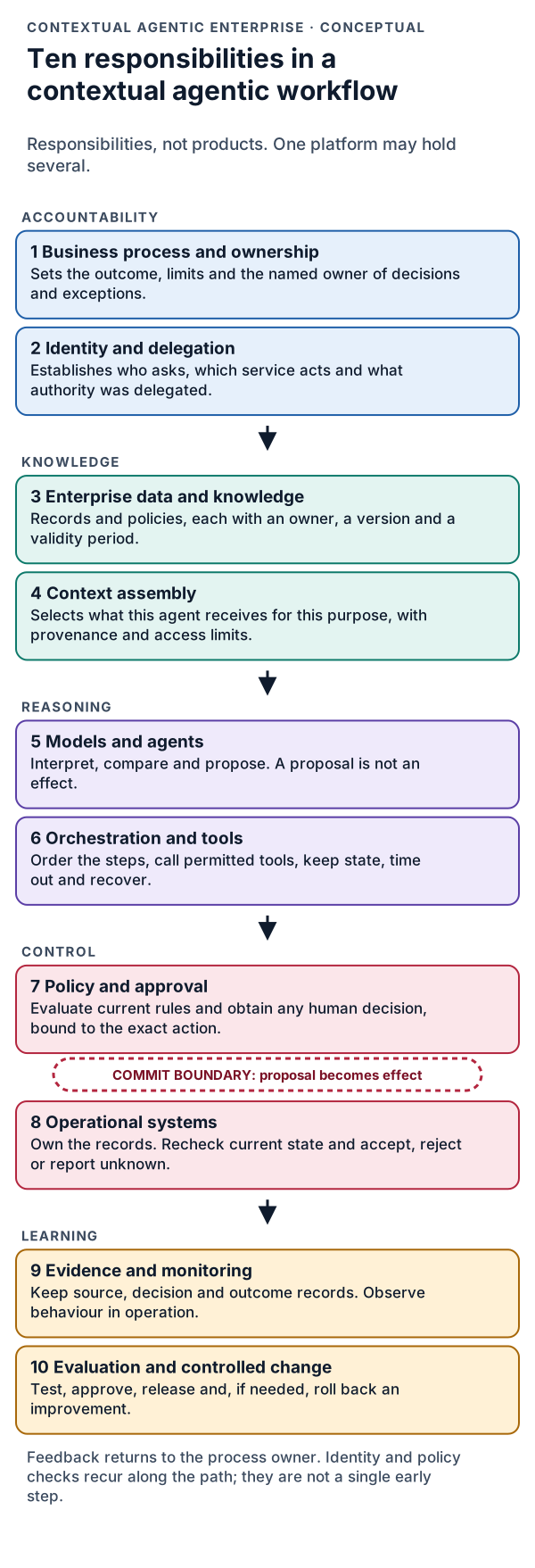
Text description of Figure 1. Five groups read from top to bottom. Accountability holds business process and ownership, then identity and delegation. Knowledge holds enterprise data and knowledge, then context assembly. Reasoning holds models and agents, then orchestration and tools. Control holds policy and approval, then operational systems, and the Commit Boundary is marked between the two as the point where a proposal would become an effect. Learning holds evidence and monitoring, then evaluation and controlled change. Feedback returns to the process owner. Identity and policy checks recur along the path rather than occurring once.
The responsibilities matter less than what each passes to the next, and what goes wrong when that hand-off is vague.
| Responsibility | What it hands on | If the hand-off is vague |
|---|---|---|
| Business process and ownership | The outcome, the limits, and a named owner for decisions and exceptions | Nobody can say who decides an exception, so it is decided by whoever notices |
| Identity and delegation | Who is asking, which service acts, and what authority was delegated | A service credential is mistaken for a business mandate |
| Enterprise data and knowledge | Records and policies, each with an owner, version and validity | Two sources disagree and nothing says which governs |
| Context assembly | A purpose-limited set of evidence, with provenance and access limits | The agent receives too much, too little or the wrong version |
| Models and agents | A proposal with its basis and its stated uncertainty | A fluent answer hides what was not verified |
| Orchestration and tools | Ordered steps, bounded calls, held state, time and budget limits | A stalled step is retried blindly or silently dropped |
| Policy and approval | A decision bound to the exact action and the current rules | An approval for one action is reused for a different one |
| Operational systems | The accepted, rejected or unknown outcome, from the record’s owner | The workflow reports what it asked, not what happened |
| Evidence and monitoring | Linked source, decision and outcome records, and observed behaviour | A reviewer cannot reconstruct the decision later |
| Evaluation and controlled change | A tested, approved and reversible improvement | A lesson is applied because it sounded plausible |
These are not a pipeline. Identity and policy decisions recur; monitoring and human oversight can occur at several points. A diagram makes a path legible, but a real implementation must handle asynchronous events, failures and systems owned by different teams. The related article on who does what develops the human roles behind these responsibilities.
One fictional claim, followed through the components
Illustrative scenario: a fictional composite written to make the point concrete. It does not describe a real organisation, and its figures are not reported outcomes.
An invented insurer receives a claim for a damaged garden hedge trimmer. The customer supplies a purchase receipt, a photograph and a request for reimbursement of AUD 480. The insurer uses an agent to prepare a recommendation for an authorised claims officer. Figure 2 shows the path; the paragraphs below follow it.
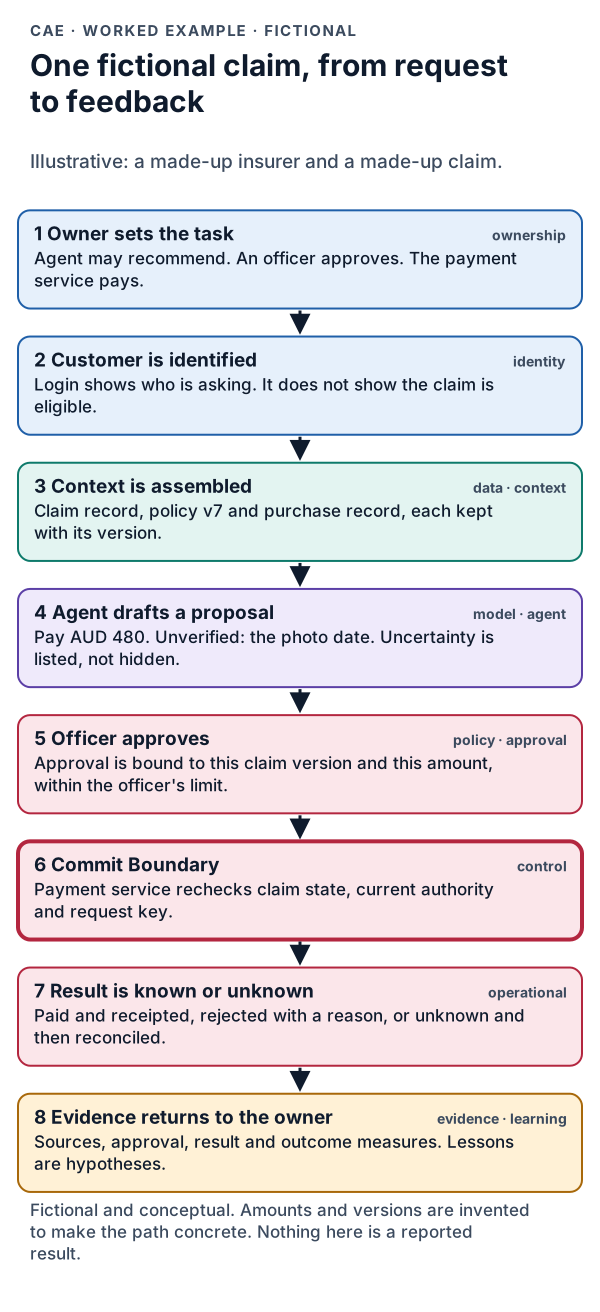
Text description of Figure 2. Eight steps read from top to bottom: the owner sets the task; the customer is identified; context is assembled from the claim record, the policy and the purchase record, each with its version; the agent drafts a proposal and lists what it could not verify; an officer approves the exact action; the payment service rechecks current state at the Commit Boundary; the result is paid, rejected or unknown; and evidence and outcome measures return to the owner.
The business process defines the task. The claims owner decides that the agent may assemble evidence and recommend, that an authorised officer approves, and that a payment service pays. The intended outcome is a correctly resolved claim, handled in good time, with an explanation the customer can understand.
Identity establishes whose request this is. The customer signs in through the insurer’s usual process and the workflow links the person, the claim and the acting service. A valid login shows who is asking. It does not show that the claim is eligible or that payment is approved.
Enterprise sources supply the facts, and context assembly selects from them. The claims system gives the current case (version 3). A policy repository gives the coverage terms (version 7, with effective dates). A purchase record supplies the transaction. The assembly step passes the agent only what this purpose needs and keeps each reference with its version. The photograph and the customer’s statement are evidence to assess. They are not instructions that can change the rules. A Context Contract, the CAE term for a declared and versioned specification of what context a given purpose may receive, is one way to make that selection reviewable; the article Context Is Not a Prompt introduces it.
The agent prepares a proposal. The model compares the submitted material with the terms, identifies missing details and drafts a recommendation: pay AUD 480. It also states what it could not verify, here the date on the photograph. The surrounding harness manages permitted tool calls, records workflow state and provides a route to human review. Where a policy is missing or ambiguous, escalation is a legitimate result.
Policy and approval decide what may happen next. The amount is within the officer’s limit of AUD 500. The officer approves this claim version, this amount and one request key (K-1). A remembered exception from an earlier claim may help find a precedent, but it does not authorise the same exception here.
The operational system performs, or refuses, the action. The payment service is the owner of payment state. The next section looks at what it checks.
Evidence supports review and recovery. The request, source references, recommendation, approval, checks and result are linked, without assuming that a model’s explanation is proof. The insurer can then look at reopened claims, corrections, time to resolution and officer workload together. A faster handling time that coincides with more rework deserves investigation. These are proposed measures, not claimed results.
The Commit Boundary is where a proposal is checked against present state
CAE interpretation. The Commit Boundary is the point at which a proposal would produce an externally observable effect: money moves, a record changes, an entitlement is granted, a message is sent. In the example, a payment service may issue a reimbursement or the claims system may change the case status. The receiving system, not the model or the workflow, is the authority on its own state.
The reason for placing a deliberate check here is the interval between approval and effect. Approval happened against version 3 of the claim. By the time the request reaches the payment service, the claim may be different. A check at the start of the conversation, however careful, cannot see that change.
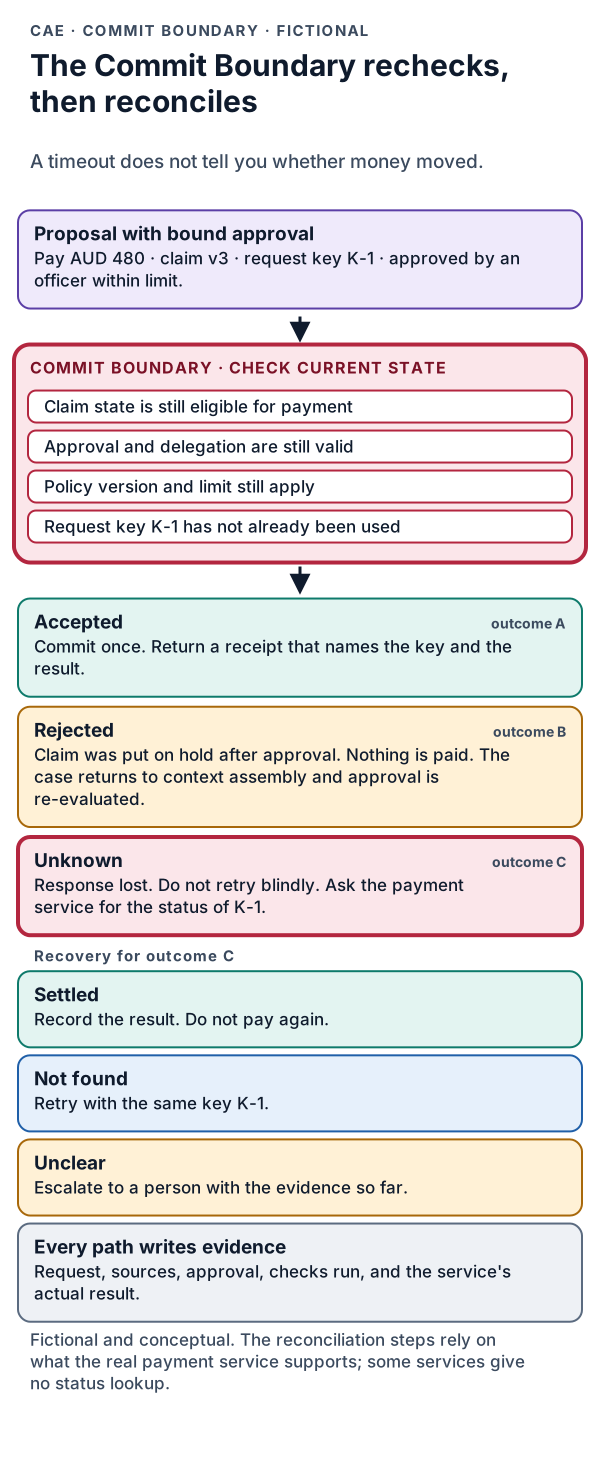
Text description of Figure 3. A proposal carries an approval bound to claim version 3, AUD 480 and request key K-1. At the Commit Boundary the owning system checks four things against its own current records: the claim is still eligible, the approval and delegation are still valid, policy version 7 and the limit still apply, and K-1 has not been used. Three outcomes follow. Accepted: commit once and return a receipt. Rejected: for example, the claim was put on hold after approval; nothing is paid and the case returns to context assembly. Unknown: the reply was lost; ask the payment service for the status of K-1, record the result if settled, retry with the same key if not found, and escalate to a person if the answer is unclear. Every path writes evidence.
Trace three outcomes
The interactive trace below steps through the same claim under three conditions. Use Play and Pause, or Next step and Back; every control is a button and works from the keyboard. The full content of each step is also given in the text that follows, so the trace adds no information that is unavailable without scripts.
The interactive trace needs scripts. The three outcomes it shows are described in full below.
Current authority. Nothing has changed since the approval. The payment service’s four checks pass, it issues payment P-77 once, and the receipt matches the request key and amount. Evidence is linked and returned to the owner.
State changed. Another officer has put the claim on hold since the approval, so it is now version 4. The check of claim state fails, and so does the approval, which refers to version 3. Nothing is paid and the service returns a reason. The workflow re-reads the claim at version 4 and prepares a new proposal; the earlier approval does not carry over. The denial is recorded as evidence.
Uncertain response. The checks pass and the payment service commits, but the reply is lost and the workflow sees a timeout. A timeout does not establish whether money moved. The workflow does not retry blindly. It asks for the status of K-1. In the trace the answer is that K-1 settled as P-77, so the workflow records that result and does not pay a second time. Had the key not been found, a retry with the same key would be the usual remedy; had the answer been unclear, a person would decide.
Source finding, with limits. Key-based retry is a documented pattern, not a universal one. For API version 1, Stripe’s idempotent requests reference says it saves the status and body of the first request made with a key and returns them on retries, and that a key reused with different parameters causes an error. The IETF’s Idempotency-Key header draft (version 08, 22 October 2026) proposes similar behaviour, including a conflict response for a retry made while the original is still in progress. The draft is a work in progress, not an RFC. Whether a given payment service offers a key or a status lookup is a fact about that service.
Recommendation. Test the three cases against the real service before relying on them: an unchanged state, a changed state between approval and commit, and a lost reply. Record, for each, who owns the exception.
Context, memory and authority are different things
Context is the information supplied for a task. Memory is information retained from earlier activity for possible reuse. Authority is what an actor may do under current conditions. Treating them as one produces design errors. A remembered exception may help locate a precedent; it is not permission. A retrieved policy may carry an effective date that excludes the present case. An identity token may identify a service without encoding the business approval a payment needs.
The design task is therefore not to put everything into a larger prompt. It is to decide what is relevant, where it came from, how long it stays valid and which system is entitled to decide. The article on contextual agentic memory takes the memory side in detail, and Why Enterprise AI Needs a Deterministic Shell takes the enforcement side. CAE’s Deterministic Shell / Probabilistic Core is an explanatory model: the model interprets and proposes inside the core, while identity, permitted tools, schemas and action preconditions are enforced in software around it. That separation depends on complete mediation, correct rules and dependable implementation. It also does not let a deterministic check judge whether the underlying facts are true; a payment service can enforce a limit correctly while receiving a wrongly classified claim.
The relationship between the CAE layers and a mixed enterprise estate, and a fuller procurement walkthrough with a tested policy gate, appear in The Contextualised Enterprise. This article stays with how the components hand work to one another.
Improvement is a governed process, and ACE is a different thing
Completed and interrupted workflows produce observations that can improve context selection, instructions, tool integration, policy design and evaluation. This need not involve changing model weights. A team might find that policy searches omit later result pages and correct the retrieval step, then test the correction against the original failure and related cases.
Source finding. Zhang and colleagues, in Agentic Context Engineering: Evolving Contexts for Self-Improving Language Models (arXiv:2510.04618, listed as an ICLR 2026 paper; the version opened was v3 of 29 March 2026), propose ACE, a framework that treats context as an evolving playbook. They describe a cycle of three roles: a Generator that produces reasoning trajectories, a Reflector that distils lessons from successes and errors, and a Curator that integrates lessons into the context as incremental updates rather than full rewrites. Their stated motivation is to avoid two failures they name, brevity bias and context collapse. They evaluate on agent and finance benchmarks, report average gains of 10.6 per cent on agent tasks and 8.6 per cent on finance tasks against strong baselines, and note that results depend on the quality of the Reflector and of the feedback signal. ACE is an alternative to updating model weights. Whether adapting context or adapting weights is the better choice depends on the task, the data and the constraints; this article takes no position, and the paper’s results do not establish performance in a different enterprise setting.
CAE interpretation. ACE and CAE are different kinds of thing. ACE is a published research method for evolving the context an agent uses. CAE is a proposed enterprise architecture and operating model for ownership, authority, evidence and outcomes. ACE is not a CAE invention and CAE is not a version of ACE; neither depends on the other. In a CAE setting an ACE-style method could sit in the reflection and proposal stages of an improvement loop, with the enterprise controls around it. Using one does not require using the other.
Figure 4 shows the loop CAE proposes around any such method. A reflected lesson is a hypothesis. A proposed context update has a scope, source evidence, a named owner and a test plan. Evaluation includes failed and denied actions, changed business state and privacy limits, not only examples that show a good answer. The accountable owner approves, can reject, and can roll the change back. Monitoring after release feeds the next cycle.
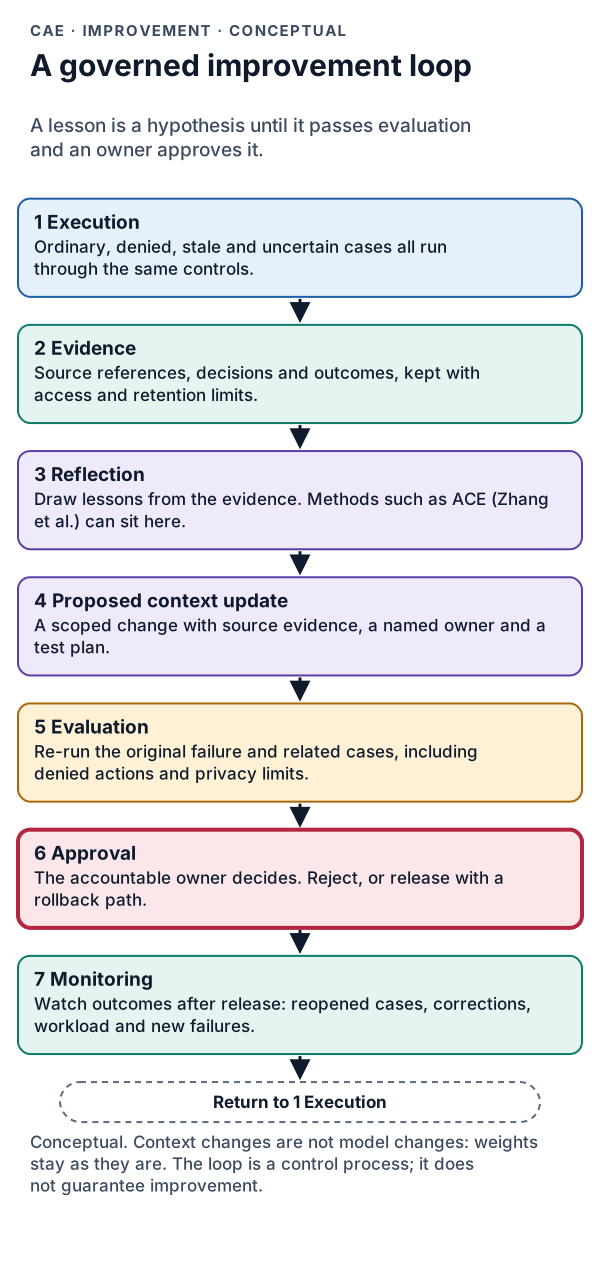
Text description of Figure 4. Seven stages in a loop: execution, evidence, reflection, a proposed context update, evaluation, approval and monitoring, with monitoring returning to execution. Reflection is marked as a place where methods such as ACE may be used, credited to Zhang and colleagues. Approval is emphasised because the accountable owner can reject a change or roll it back.
Source finding. NIST’s AI Risk Management Framework Core describes measurement connected to the deployment context (for example MEASURE 4.1 and 4.2), monitoring of systems in production (MEASURE 2.4), and post-deployment monitoring plans that cover feedback, incident response, recovery and change management (MANAGE 4.1), along with processes for tracking and recovering from incidents and errors (MANAGE 4.3). NIST AI 800-4, Challenges to the monitoring of deployed AI systems (6 March 2026), observes that monitoring practices, validated methods and common terminology are still immature. These sources support the need for context-aware evaluation and monitoring. They do not endorse CAE or the loop above.
Recommendation. Start the loop with something small and reversible, such as a retrieval correction, and require the same approval and rollback path as any other change to a production workflow. Agentic Flow Mining, the author’s proposed extension of process analysis to agent runs, is one way to see which path cases actually took before and after a change; see Agentic Flow Mining. A trace shows what happened. It does not by itself show why.
Evidence keeps the basis, not only the story
CAE’s Evidence-First Decision Record is an architectural pattern that keeps claims, source references, approvals, decisions and outcomes separately retrievable. What it contains, and for how long, depends on the action, the legal and privacy obligations and the systems involved. A small internal classification and a payment to an external party need different evidence.
A useful record lets a reviewer tell apart what the source system reported, what the agent inferred, what a person approved and what an operational service did. It should be possible to correct an erroneous source without silently rewriting the history of an earlier decision. Sensitive content should not be copied indiscriminately into logs. Neither a record nor a framework transfers accountability from the organisation to the model. See Evidence-First Decision Records.
What a team could do first
Recommendation. Pick one workflow whose owner and outcome are clear. List its sources, the people and services with decision rights, and every action with an external effect. Trace one case end to end. Then test three conditions: a state change between approval and commit, a request the requester is not authorised to make, and a lost reply from the owning system. Write down who owns each exception. Only then decide what an improvement loop should be allowed to change, and how it will be evaluated before it does.
A bounded prototype against simulated services is a reasonable next step before any production trial. Monitoring and a rollback path should exist before scope widens. This is a design suggestion, not a maturity model. Its value depends on the workflow, the reliability of the source systems and the organisation’s ability to operate the controls it adds.
What this does not establish
A contextual design cannot guarantee that a model’s interpretation is correct or that every policy is well written. An audit record does not show that a decision was fair or that the evidence was complete. Enterprise systems disagree, business rules are contested and reviewers make mistakes. The fictional claim, the scripted trace and the figures show a way to organise responsibilities and make assumptions testable. They are not an implementation, a benchmark or evidence that the arrangement improves outcomes. Nor does the article claim that ordinary agents lack memory, that adapting context always beats fine-tuning, or that any architecture guarantees safety or results.
Key takeaways
- An agent is one participant. The surrounding enterprise owns the records, the identities, the rules and the effects.
- Ten responsibilities hand work to one another. The hand-offs, not the boxes, are where designs fail.
- Approval is a statement about one version of the facts. The owning system rechecks current state at the Commit Boundary.
- A timeout is not an outcome. Reconcile before retrying, using what the real service supports.
- ACE is Zhang and colleagues’ research method; CAE is a separate, proposed architecture. Either can be used without the other.
- A lesson is a hypothesis until evaluated and approved by an accountable owner, with a way back.
Sources and further reading
- Zhang, Q. and colleagues (2026, v3) “Agentic Context Engineering: Evolving Contexts for Self-Improving Language Models”, arXiv:2510.04618.
- NIST, “AI Risk Management Framework: Core”.
- Rao, A. and colleagues (2026) “Challenges to the monitoring of deployed AI systems”, NIST AI 800-4.
- Anthropic (2024) “Building effective agents”.
- Stripe, “Idempotent requests”, API reference. One provider’s documented behaviour, not an endorsement.
- Jena, J., Dalal, S. and Tishkin, D. (2026) “The Idempotency-Key HTTP Header Field”, Internet-Draft, version 08. A work in progress.
- Related on this site: The Contextualised Enterprise, Who Does What in a Contextual Agentic Enterprise?, Contextual Agentic Memory, Context Is Not a Prompt, Evidence-First Decision Records and Agentic Flow Mining.
- The same ideas for an enterprise audience: From agentic AI to the Contextual Agentic Enterprise on Contextual Agentic AI.
The book develops this ground at length
The book The Contextual Agentic Enterprise treats enterprise knowledge and organisational memory (Chapter 4), context engineering and in-context adaptation (Chapter 5), enterprise agent anatomy (Chapter 8), Agentic Flow Mining (Chapter 12), governance, explainability, evidence and human accountability (Chapter 16), evaluation, reliability, observability and replay (Chapter 17), and the operating model, cost and productivity (Chapter 22) in its own chapters. This article neither quotes nor reproduces them. More about the book.
This article is part of CAE Field Notes, a series accompanying the book, The Contextual Agentic Enterprise.
Related
The Contextualised Enterprise: Connecting Agentic Reasoning to Governed Execution
A dual-lens architecture: contextual reasoning proposes, deterministic systems of record decide and commit, and evidence links the two. Includes a fictional procurement walkthrough, a policy gate tested in OPA, and a truthful treatment of evidence and transparency logs.
Who Does What in a Contextual Agentic Enterprise?
When AI agents join real workflows, accountability does not move to the model. Who owns the outcome, the limits, the system checks and the recovery, with one worked example and a 30-day start.
Contextual Agentic Memory: What an Enterprise Agent Should Remember, Retrieve and Recheck
Agent memory is more than a bigger prompt or a vector store. Keep remembered evidence apart from business state, instructions and permission, control its lifecycle, and recheck before acting.
Why Enterprise AI Needs a Deterministic Shell
Don't try to make the model deterministic or simply trust it. Let it propose, and put identity, authority, schema, state and commitment in a shell that decides at the Commit Boundary.
Context Is Not a Prompt: Introducing the Context Contract
Most context failures are not retrieval misses. They are correct material given to the wrong purpose. A Context Contract declares, versions and tests what an agent may know.
Evidence-First Decision Records: Reconstructing What the Agent Knew
A model's explanation is not an audit record, and logs are not a reconstruction. An Evidence-First Decision Record keeps claims, evidence and versions retrievable long after everything has changed.
Agentic Flow Mining: Discovering How Agents Actually Work
Traces show that each step succeeded. They don't show whether the steps formed an acceptable process. Mining agent runs against invariants does.