The Minimum Action-Evidence Bundle: What Must Accompany a Consequential Action
Evidence for an agent's action is neither a log of everything nor a fixed form. It is the smallest verifiable set that lets a control decide, and approval must bind to it.
Written as at 8 August 2026.
ai-governanceevidenceagentic-aiarchitecture
For: enterprise architects and the engineers who build agent control paths. The decision: what information a consequential action must carry before anything is allowed to decide on it.
A quick orientation for readers new to the series. The Deterministic Shell is the deterministic software that surrounds a model and decides whether its proposals may become real. The Commit Boundary is where that decision happens. Last week’s Field Note put an action gateway on that boundary. This one asks what the gateway needs to see.
An approval that cannot say what it approved
Illustrative scenario: a fictional composite written to make the point concrete. It does not describe a real organisation, and its figures are not reported outcomes.
Imagine a mid-sized building-materials wholesaler that banks with a regional bank. Its daily outbound transfer limit is $50,000. The finance director asks for an increase because a new supplier contract involves weekly payments of about $180,000.
A business-banking agent reviews the request. It reads the contract, checks twelve months of transfers (the busiest day was $46,200), confirms the customer’s identity was re-verified by a call-back to the registered number, and recommends a 90-day increase to $250,000 on the operating account ending 0638. The relationship manager reviews the case and clicks approve.
The case record now holds limit_increase_approved = true. Two days later, a follow-up email asks for the increase to be made permanent and applied to a second account as well. The agent finds the approved flag and applies $250,000, permanently, to both accounts. Nobody approved that. The flag simply could not tell the difference.
Logging everything answers the wrong question
The usual responses to “what evidence should an agent action carry?” fall into two camps. The first is to log everything: every prompt, retrieved document and tool call. That produces volume, not sufficiency. A reviewer six months later has thousands of lines and still can’t tell which contract version the manager saw. It also copies customer data into places it was never meant to go.
The second is a fixed form: one evidence template for every action. It is too heavy for a balance lookup and too light for a fivefold limit increase, so teams quietly fill it with defaults.
Neither answers the question a control actually faces at the moment of commitment: is there enough verifiable information, right now, to decide whether this specific action may proceed?
Why now? Agents are moving from recommending changes like this to executing them, and most organisations answer the risk with a human approval step. Australia’s Guidance for AI Adoption asks organisations to “maintain human control”, and approval is where that control usually lives. It is only as meaningful as the information it is bound to.
The bundle is the minimum basis for one decision
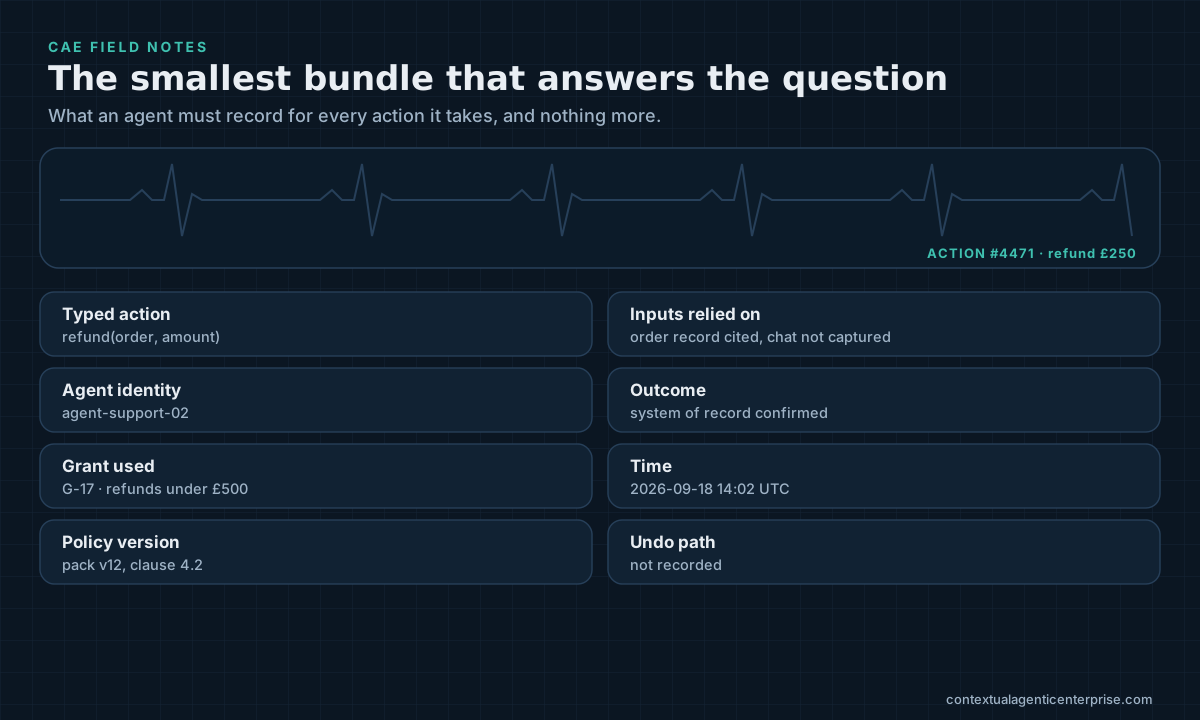
The Minimum Action-Evidence Bundle (MAEB) is the smallest verifiable set of information needed to evaluate one consequential action at the Commit Boundary. It is a CAE design construct, set out in the book. No agent framework supplies it for you.
The book specifies its elements in detail. Here they are in five groups, each answering one question:
- Who, and on whose authority. The customer and the bank staff the agent acts for, the agent and its version, how authority reached it, and the Authority Envelope: the explicit bounds on its tools, resources, actions, values, duration and kinds of side effect.
- What, exactly. A canonical statement of the operation, target, parameters and expected effect, precise enough for software to compare: raise the daily limit on account 0638 from $50,000 to $250,000, expiring in 90 days.
- Why it is justified. The policy decision with its version, and references to the evidence: the contract, the transfer history and the call-back record, each with its source and retrieval time.
- How it executes safely. Any human approval the risk requires, scoped to what was reviewed, plus the controls that stop a duplicate or late execution and say how the change would be reversed.
- How it can be traced and trusted. Identifiers that connect the proposal to its workflow and decision record, and integrity protection that shows whether anything was altered.
Two properties matter as much as the contents. First, the bundle holds references and digests, not copies; the contract stays in the document store, and the bundle proves which version was relied on. Second, it scales with risk. A balance enquiry needs very little. A permanent fivefold limit increase needs strong identity, fresh evidence and bound approval.
The action gateway checks the bundle and returns one of four outcomes. It permits the action when everything required is present and current. It denies it when a rule forbids it. It escalates when the rules call for human judgement, and it sends the action back for re-evaluation when something material is stale or inconsistent.
Approval binds to a payload, not to a case
The key idea is simple to state. An approval is a statement about a specific payload and the specific evidence the reviewer saw. It is not a property of the case, and it cannot be reused like a Boolean.
A practical procedure follows from that.
- Classify the action. A read-only lookup, a small reversible change and a large or hard-to-reverse change each get a different tier.
- State the intent canonically. Account, operation, old and new values, expiry. If two requests can’t be compared field by field, they can’t be governed.
- Reference the evidence. Record source, version, retrieval time and a digest for each item. Let the shell resolve them, rather than trusting the agent’s claim that it “verified” something.
- Bind approval to a digest. The manager’s approval covers the hash of the intent plus the evidence references presented on screen.
- Recompute at execution. If the payload about to execute doesn’t match the approved digest, the approval does not apply. Changing the expiry, the value or the account starts a new evaluation.
- Fail closed. A missing element for the tier returns re-evaluate or deny, never permit.
Applied to the wholesaler, the follow-up request produces a different intent (permanent, two accounts), so its digest doesn’t match. The gateway escalates it to the relationship manager as a new decision, with the original approval shown as context rather than as authority.
Where bundles go wrong
Self-attested evidence. The agent writes “identity verified” into the bundle. Unless that statement points to a call-back record the shell can resolve, it is a claim, not evidence.
Check, then change. The gateway validates the bundle and the adapter then executes slightly different parameters. The executed payload must be the checked payload.
Stale but present. The transfer history was retrieved three weeks ago, before a run of unusual payments. Freshness belongs in the tier rules.
The request is not examined. Raising a transfer limit is an attractive first step for anyone who has compromised a customer’s mailbox. How the request arrived is part of the evidence.
The bundle mistaken for the record. The bundle is what a control needs to decide. The Evidence-First Decision Record keeps what was decided and why, for later scrutiny. They connect; they aren’t the same thing.
The bundle also has limits. It can’t make evidence true: a well-referenced forged contract is still forged. It doesn’t choose the tiers or write the policy. Those remain decisions for the people who own the risk.
Who does what
Executives decide the risk tiers for agent actions and who owns them, and make clear that an approval covers what the approver saw, nothing more.
Architects design a canonical action schema for each consequential operation, the evidence each tier requires, and approval records bound to payload digests.
Engineers implement and test the mismatch cases: changed value, changed account, changed expiry, expired evidence and a replayed approval. Each must fail to reach the limits system.
How the bundle scales in the banking example
| Action | Tier | What the bundle must add | Approval |
|---|---|---|---|
| Show the customer’s current daily limit | Read-only | Principal, agent identity, data-handling check | None |
| Temporary increase to $75,000 for 24 hours | Reversible, moderate | Canonical intent, recent transfer history, policy decision | Pre-authorised by policy within the envelope |
| 90-day increase to $250,000 | Consequential | Contract and call-back references with digests, fraud-screen result, expiry and duplicate controls | Relationship manager, bound to digest |
| Permanent increase on two accounts | Consequential, harder to reverse | Everything above for each account, plus fresh identity verification | New approval; the earlier one is context only |
Key takeaways
- The Minimum Action-Evidence Bundle is a CAE design construct: the smallest verifiable basis for deciding one consequential action.
- Evidence means sufficiency for a decision, not a log of everything and not one fixed form.
- The bundle carries references and digests, so sensitive material stays where it is governed.
- Its required contents scale with the action’s risk tier.
- Approval binds to the exact payload and evidence reviewed; any material change requires a new evaluation.
Sources and further reading
- The Contextual Agentic Enterprise, Chapter 3 (§3.6.3–3.6.4).
- National AI Centre (2025) Guidance for AI Adoption.
What the book adds
Chapter 3 gives the bundle’s complete element list, what each element must contain, and how the four gateway outcomes and permit binding work with it. Next week’s Field Note looks at what happens when a workflow is replayed with an old bundle: Checkpointing Is Not Rollback.
This article is part of CAE Field Notes, a series accompanying the book, The Contextual Agentic Enterprise.
Related
Closing the Governance-to-Action Gap with Runtime Mediation
Policies, approval screens and audit logs describe governance. Only a control on the execution path enforces it, and every consequential action must pass through one.
The Commit Boundary: Where AI Recommendations Become Enterprise Consequences
Controls placed at the start of an agent conversation check the wrong thing. The decisive check evaluates the exact action about to become real, at the moment it becomes real.
Evidence-First Decision Records: Reconstructing What the Agent Knew
A model's explanation is not an audit record, and logs are not a reconstruction. An Evidence-First Decision Record keeps claims, evidence and versions retrievable long after everything has changed.
Checkpointing Is Not Rollback: The Dangerous Myth of Agent Time Travel
Restoring an agent's workflow state does not restore the world. Safe recovery needs an effect journal, idempotency keys and compensation governed as a new action.