Productivity Is Not Headcount Reduction: Designing the Human-Agent Enterprise
Minutes saved on a task are not roles removed from an organisation. Measure outcomes with quality, then redesign human work around authority, exceptions and evaluation.
Written as at 12 August 2026.
productivityoperating-modelfuture-of-workagentic-ai
For: transformation executives, CFOs and HR leaders. The decision: what to count as productivity before a workforce number goes into a budget.
A handle-time saving has become a headcount target
Illustrative scenario: a fictional composite written to make the point concrete. It does not describe a real organisation, and its figures are not reported outcomes.
Consider a state government contact centre that handles vehicle registration, infringement fines and concession enquiries. It has 400 full-time equivalent staff. A three-month pilot of an AI agent that drafts answers, summarises calls and completes routine transactions shows agent-assisted calls running markedly shorter. The business case converts the saved minutes into staff and books a 30 per cent reduction, from 400 to 280, into next year’s budget.
Every number in that chain may be accurate. The chain itself is the problem. It assumes that minutes saved on the pilot’s calls are minutes saved across the centre’s whole workload, that the calls left over will look like the calls that were automated, and that nothing new needs doing once the agent is live. None of those assumptions has been tested.
The evidence is real, uneven and easy to overstate
Start with the good news, because it is substantial. Brynjolfsson, Li and Raymond (2025) studied 5,179 customer support agents and found 14 per cent more issues resolved per hour overall, and 34 per cent more among novices. Cui and colleagues (2025) ran three field experiments at Microsoft, Accenture and a Fortune 100 company covering 4,867 developers and found about 26 per cent more completed tasks, with larger gains for less experienced developers. These are serious studies, and the first one measured a contact-centre-like workload directly.
The counter-evidence is just as serious. In METR’s randomised study (Becker et al., 2025), 16 experienced open-source developers working on 246 issues were 19 per cent slower when AI tools were allowed. They had forecast they would be 24 per cent faster, and afterwards they felt 20 per cent faster. Dell’Acqua and colleagues (2023) describe a “jagged frontier”: among 758 BCG consultants, quality rose on tasks inside the model’s capability, but on a task outside it they were 19 percentage points less likely to reach a correct answer.
At organisational scale, DORA (2024) linked every 25 per cent rise in AI adoption with 1.5 per cent lower delivery throughput and 7.2 per cent lower stability. Its 2025 report found adoption associated with higher throughput but still with instability, and describes AI as an “amplifier” of an organisation’s existing strengths and weaknesses.
Read together, the studies support three conclusions. The gains are real but vary widely by task and by person. Individual gains don’t turn into system gains by themselves, a point made for software teams in When Code Becomes Cheap. And people’s own sense of how much faster they are is not a reliable measure.
Productivity belongs to outcomes, and human work moves to authority, exceptions and evaluation
The position of the Contextual Agentic Enterprise (CAE), which is the book’s proposal rather than settled doctrine, has two parts.
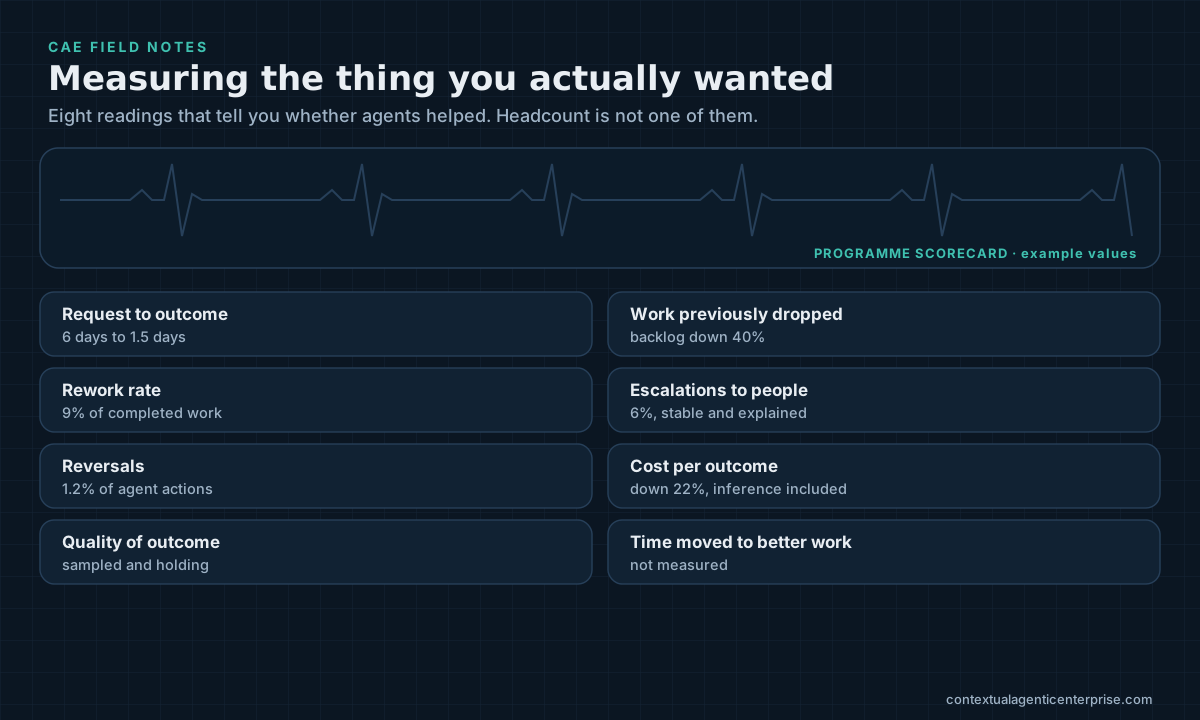
First, measure productivity at the level of the outcome, with quality built in. Trace the value chain: a new capability changes how a task is done, which improves a process, which improves a result someone cares about. Time saved on a call sits at the first link. A citizen’s problem resolved correctly on first contact sits at the last. Only the last link justifies the investment.
Second, expect human roles to change before headcount does. In a Deterministic Shell design, the agent proposes and the shell decides what it may commit. Someone still holds the authority to approve a fine payment plan or a hardship concession, as argued in A Model Can Recommend an Action. Someone handles the cases that fall outside the jagged frontier. And someone evaluates the agent: sampling its work, correcting the knowledge it relies on and deciding when it may do more. Australia’s Guidance for AI Adoption (National AI Centre, 2025) asks organisations to decide who is accountable and to maintain human control. In a contact centre, those are jobs with names.
Six checks before a workforce number goes in the budget
- Baseline the outcomes now. Before the rollout, measure first-contact resolution, repeat contacts, time to a decision and complaint rates. Without a baseline, any later saving is a claim.
- Split the demand. Classify contacts into routine, complex and exception work. The agent is likely to absorb the routine share first, so the remaining calls will tend to be harder and longer.
- Measure quality-adjusted throughput. Count cases resolved correctly the first time per staff hour, not calls closed. A faster wrong answer generates a repeat contact.
- Compare, don’t survey. Use a phased rollout or matched teams, and record other changes (a simpler form, a policy change) that would otherwise be credited to the agent.
- Design the new work. Staff the authority, exception and evaluation roles explicitly, including knowledge stewardship, and plan the skill transitions.
- Then decide what to do with measured capacity. Absorb backlog, improve service levels, or reduce roles through a planned transition. Each is a legitimate choice once the capacity has been measured rather than assumed.
In the contact centre, the checks change the conversation. Suppose the phased rollout shows routine registration enquiries largely handled by the agent, but average handling time for the remaining calls rising, and repeat contacts on concession cases climbing until the knowledge base is corrected. The capacity gain turns out to be real and smaller than planned, and part of it is needed to staff concession approvals and weekly quality review. The centre can still reduce headcount if that is its choice, but the figure is now derived from evidence and quality is protected.
The failure modes are mostly measurement failures
- Booking the saving before it exists. Once the reduction is in the budget, every later measurement is under pressure to confirm it.
- Counting activity. Calls closed, messages drafted and tasks completed rise easily. Correctly resolved cases may not.
- Ignoring failure demand. Wrong or incomplete answers come back as repeat contacts, complaints and reviews, often in another team’s queue.
- Losing the novices’ path to expertise. The largest measured gains are for less experienced staff. Cutting the junior roles removes the people the tools help most, and the route by which experts are formed.
- Humans as a blanket safety net. Asking staff to check every low-risk action wastes the capacity gained and dulls review where it matters.
- Trusting self-report. The METR gap between felt and measured speed is a warning about surveys of hours saved.
This framing doesn’t tell an organisation how large its workforce should be. It only makes sure the answer comes from measured outcomes.
Each role owns part of the measurement
Executives decide that workforce targets follow measured outcomes rather than lead them, and which outcome measures the programme will be judged on.
Architects design the telemetry that ties agent activity to case outcomes, the authority boundaries that keep approvals with named people, and the escalation routes for exception work. Mined flows from Agentic Flow Mining show where humans wait for agents and agents wait for humans.
Engineers implement and test the outcome measures in the pipeline, the controlled comparisons, and quality checks that catch repeat contacts and reversals, not just completions.
What the business case claims, and what to measure instead
| Business-case claim | Why it is weak on its own | What to measure instead |
|---|---|---|
| Agent-assisted calls are much shorter | Pilot calls may have been easier than the full mix | Handling time for the remaining calls after rollout |
| Staff report saving time every week | Self-report runs ahead of measurement | Cases resolved correctly first time per staff hour |
| 120 roles can go | Assumes no new work appears | Hours spent on approvals, exceptions and evaluation |
| Agent resolves most enquiries | Resolution may not stick | Repeat contacts and complaints within 30 days |
| Service is unchanged | Averages hide the hard cases | Time to decision for complex and concession cases |
Key takeaways: measure the outcome, then design the work
- Time saved on a task is the first link in a value chain, and only the last link, a better outcome, justifies a workforce decision.
- The published evidence shows real gains that vary widely, with larger benefits for less experienced workers and clear losses outside the model’s capability.
- Self-reported productivity runs ahead of measured productivity, so surveys of hours saved can’t carry a headcount target.
- Human work in an agent-enabled organisation shifts towards authority, exception handling and evaluation, and those roles need to be staffed deliberately.
- Headcount changes can be a legitimate result of measured capacity, but they make a poor starting assumption.
Sources and further reading
- The Contextual Agentic Enterprise, Chapters 22 and 23.
- Brynjolfsson, E., Li, D. and Raymond, L. (2025) “Generative AI at Work”, Quarterly Journal of Economics 140(2).
- Cui, Z., Demirer, M., Jaffe, S., Musolff, L., Peng, S. and Salz, T. (2025) “The Effects of Generative AI on High-Skilled Work”, Management Science.
- Becker, J., Rush, N., Barnes, E. and Rein, D. (METR, 2025) “Measuring the Impact of Early-2025 AI on Experienced Open-Source Developer Productivity”, arXiv:2507.09089.
- Dell’Acqua, F. et al. (2023) “Navigating the Jagged Technological Frontier”, HBS Working Paper 24-013.
- DORA (2024) Accelerate State of DevOps Report; DORA (2025) State of AI-assisted Software Development.
- National AI Centre (2025) Guidance for AI Adoption.
Where the series goes from here
The book sets out the outcome measures in full, how to run a credible productivity experiment, and what human oversight costs and returns. More about the book.
This is the last of sixteen pieces. Several threads it touched deserve their own treatment, including agent identity, human approval and selective escalation, and why developer surveys can’t measure AI productivity, and they are on the list for what comes next.
This article is part of CAE Field Notes, a series accompanying the book, The Contextual Agentic Enterprise.
Related
A Model Can Recommend an Action. It Does Not Acquire Authority to Perform It
Directors ask whether their AI is safe. The better question is on whose authority it acts, because accuracy, confidence and technical access are not a delegation.
Why Enterprise AI Needs a Deterministic Shell
Don't try to make the model deterministic or simply trust it. Let it propose, and put identity, authority, schema, state and commitment in a shell that decides at the Commit Boundary.
Agentic Flow Mining: Discovering How Agents Actually Work
Traces show that each step succeeded. They don't show whether the steps formed an acceptable process. Mining agent runs against invariants does.