Trust Is Not a Permission Dialog: Earning Agent Autonomy One Step at a Time
Faced with an agent asking to read, send and pay, most managers click deny, and the agent stalls. The fix is not more trust. It's autonomy granted by the step, per action, on evidence.
Written as at 15 August 2026.
agentic-aitrustai-adoptionai-governanceplaybook
A recent Harvard Business Review article by Thomas McKinlay, Stefano Puntoni and Serkan Saka opens with a scene most of us have lived through. A manager sets up a new AI agent for the team. It asks for permission to access, create and delete files; to read and send email; to view and make payments. Each request feels a step too far, so the manager denies them. Then the agent keeps getting stuck, the manager concludes agents aren’t ready, and the pilot quietly dies.
The authors’ diagnosis is that trust, more than technology, is the obstacle. They cite a ServiceNow index in which 59% of enterprises say they use agentic AI but only 9% have turned that into autonomous workflows, and they draw five practices from the research: be upfront about the agent’s limitations, make it come across as competent rather than chummy, show it understands people’s longer-term goals, frame it as a helper, and keep people in control when it matters.
I agree with all five. I want to add the architectural half of the argument, because the permission dialog in that opening scene is itself part of the problem.
The dialog asks the wrong question
“Read and send emails: allow or deny?” asks a manager to make one decision about thousands of future actions they can’t see. Sending a meeting summary to your own team and sending a price to a client are both “send email”. Paying a known supplier £40 for stationery and paying a new bank account £40,000 are both “make payments”. A sensible person would say yes to the first of each pair and no to the second. The dialog lets them say only yes to both or no to both.
So people do the rational thing and say no. The agent is left able to do almost nothing, which confirms the suspicion that it can’t do anything useful. Low trust produces low permissions, which produce low value, which justify the low trust.
One line from the article gets to the heart of it. Adam Seligman, Workato’s CTO, told the authors that companies need to be able to say “you can draft this email, but you can’t send it”. That sentence describes a boundary, not a feeling. Trust becomes manageable when you can grant it at that level of precision.
The autonomy staircase
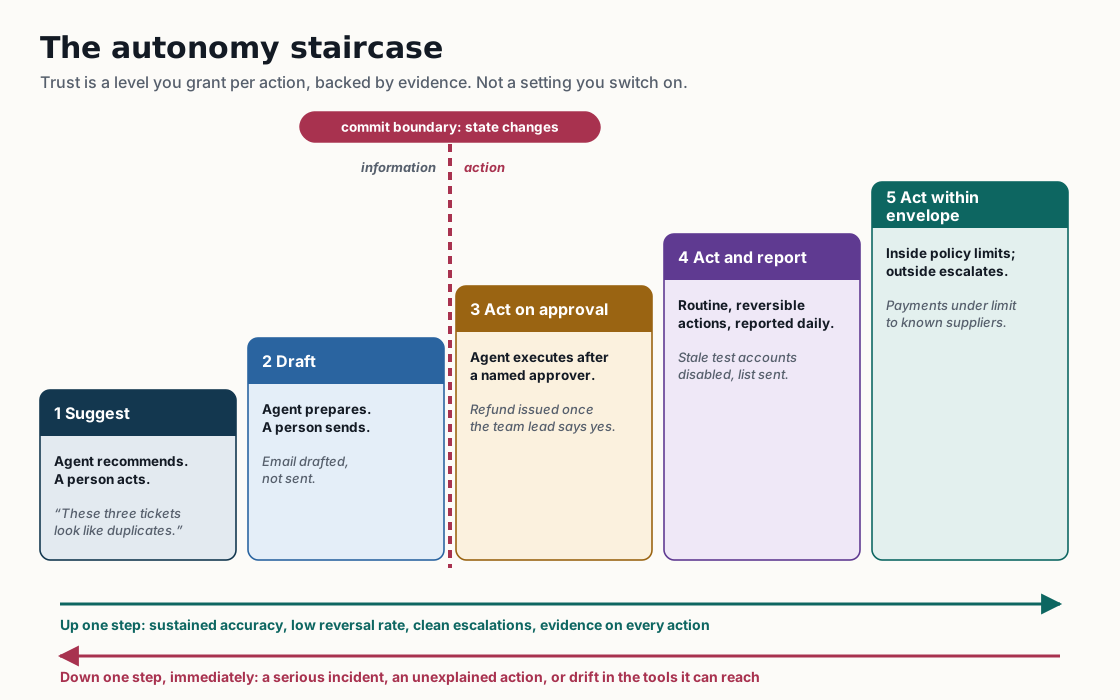
Automation researchers have described levels of automation for decades; Parasuraman, Sheridan and Wickens’s model from 2000 is the classic reference. The staircase applies the same idea to agents in five steps.
- Suggest. The agent recommends and a person acts. “These three tickets look like duplicates.”
- Draft. The agent prepares the change in full, and a person sends or applies it. The email is written; the button is yours.
- Act on approval. The agent executes, but only after a named approver says yes to this specific action.
- Act and report. For routine, reversible actions, the agent executes and reports what it did, daily or per batch.
- Act within an envelope. The agent executes anything inside limits set in policy (amount, counterparty, time, data class), and anything outside them escalates.
Two things make the staircase more than a maturity model.
The step belongs to the action, not the agent. The same finance agent can sit on step 5 for paying known suppliers under a limit, step 3 for a new supplier, and step 1 for anything involving a change of bank details. The question stops being “do we trust this agent?”, which nobody can answer, and becomes “for this kind of action, at this value, what step have we earned?”, which you can.
There’s a hard line between steps 2 and 3. Steps 1 and 2 produce information; a person still makes the change. From step 3 on, the agent changes state. That line is the commit boundary, and it has to be enforced in code outside the agent: a proposal of type “send external email” from an agent whose grant covers only “draft email” is refused by the boundary, whatever the agent was told or talked into.
Earning the next step
Trust between colleagues is built on a track record, and the staircase makes the track record explicit. Move an action type up one step when you have evidence, not enthusiasm:
- Sustained accuracy on that action type: its proposals are accepted unchanged at a high rate, over enough volume to mean something.
- A low reversal rate: few of its completed actions are later undone or corrected.
- Clean escalations: when it hits its limits it stops and asks, rather than finding a creative way round.
- Complete evidence for every action, so you can check all of the above.
Move it down a step immediately after a serious incident, an action nobody can explain, or a change in the tools it can reach. Trust is lost faster than it’s earned, and the staircase should be too.
This answers one of the HBR article’s findings rather neatly. The authors report research showing people perceive less privacy risk from an agent than from a person, until they are reminded that the agent has real power over decisions. At that point their concern rises. The staircase doesn’t hide the agent’s power; it makes it legible. People can see exactly what the agent may do on its own, what needs their yes, and what it will never do.
The five practices, re-read as design
The article’s five practices work better when they are built into the system rather than left to messaging.
Be upfront about limitations. Publish, for each action type, the step it sits on and why. “This agent can draft client emails but not send them, because its accuracy on pricing questions isn’t yet good enough” is a limitation statement people can use.
Competent, not chummy. The most competent thing an agent can say is what it checked. Have every proposal carry its reasons and its evidence, such as the three criteria it used, which is exactly what the commit boundary needs anyway.
Show it understands the goal. Tie proposals to the objective they serve, and record that link. A decision record that says “reconciled against the headcount plan” is useful to the manager today and to the auditor next year.
A helper, not a powerful entity. The staircase is how you make that framing true rather than just saying it. Below step 3, the agent really is a helper.
People in control when it matters. Step 3 and the escalation path of step 5 are where control lives. Design them so the approver sees the proposal, the evidence and the policy in one place and can decide in seconds; otherwise approval becomes a rubber stamp.
What to do this quarter
Executives: ask for your top agent use cases broken down by action type, with the step each action sits on today. If the answer is a single allow/deny per agent, you are in the permission-dialog trap.
Architects: make the step an attribute of the grant, enforced at the commit boundary. The agent proposes; the boundary looks up the step for this action type and value, and permits, routes for approval, or refuses.
Team leads: pick one agent and one action type that is stuck on “deny”. Put it on step 2 for a month and measure how often its drafts go out unchanged. That number is your case for step 3.
Trust in an agent shouldn’t be an act of faith. It should be a level, granted per action, with evidence to support it and a way back down.
References
- The Contextual Agentic Enterprise, Chapters 3, 13 and 14.
- McKinlay, T., Puntoni, S. and Saka, S. (2026) 'To Adopt AI at Scale, Employees Need to Trust Agents', Harvard Business Review, 9 September. https://hbr.org/2026/09/to-adopt-ai-at-scale-employees-need-to-trust-agents
- McKinlay, T. et al. (2026) Wharton Blueprint for AI Agent Adoption. Knowledge at Wharton special report. https://knowledge.wharton.upenn.edu/special-report/wharton-blueprint-ai-agent-adoption/
- Parasuraman, R., Sheridan, T. B. and Wickens, C. D. (2000) 'A model for types and levels of human interaction with automation', IEEE Transactions on Systems, Man, and Cybernetics, 30(3), pp. 286-297. https://doi.org/10.1109/3468.844354
Related
The Commit Boundary: Where AI Recommendations Become Enterprise Consequences
Controls placed at the start of an agent conversation check the wrong thing. The decisive check evaluates the exact action about to become real, at the moment it becomes real.
Delegation Is Not Authority: Governing Multi-Agent Handoffs
When one agent hands work to another, authority should narrow, never widen. A delegated task must carry its origin and its limits, or it becomes a way to launder a prohibition.
The Agentic AI Playbook: Five Rungs from Model to Governed Enterprise
LLM, RAG, agent, agentic system: every popular diagram stops at four rungs. The enterprise needs a fifth, where authority is checked before anything changes.