AI Maturity and CAE: Match the Level of AI Responsibility to Your Readiness to Govern It
A six-level AI maturity model, from manual work to AI-led operations, with what Contextual Agentic Enterprise (CAE) governance and Contextual Trust security each add at every level. It shows how to rate a workflow rather than a whole organisation, why autonomy should never run ahead of readiness, five ceiling questions for a quick self-assessment, and how to promote or demote a workflow one level at a time.
Written as at 24 September 2026.
ai-maturityai-maturity-modelagentic-aiai-governancecaecae-opsdelegated-authorityai-readinessagent-security
About this article. The Contextual Agentic Enterprise (CAE) is a vendor- and platform-agnostic architecture framework from Contextual Agentic, and Contextual Trust is its security pillar. The maturity model below is an editorial model written for this series. It is not a standard, a certification or a benchmark, and the example workflows and the insurer in Part 8 are fictional. Any adoption of CAE should be undertaken in consultation with Contextual Agentic or an authorised advisory partner, who will tailor the gates to the organisation.
Short answer
AI maturity is the wrong thing to measure for a whole organisation. Measure it for each workflow, and match the level of responsibility you give AI to how ready that workflow is to be governed. Readiness has three parts: the quality of the context the AI acts on, the clarity of the limits on what it may commit, and the evidence you keep. CAE supplies the gates between levels, and Contextual Trust supplies the security controls that must be in place from the first level up.
Summary for busy readers
- Six levels. Level 0 is manual work. Levels 1 and 2 are individuals and then teams using AI as an assistant. Level 3 connects tasks across teams with people approving every key output. Level 4 lets agents commit routine actions inside delegated limits. Level 5 lets agents coordinate whole workflows while people manage outcomes, policy and audit.
- Per workflow, not per company. A firm can run meeting summaries at Level 2 and access reviews at Level 3 on the same day, and should.
- Autonomy must not outrun readiness. The danger zone is a capable agent on stale context, with vague limits and no replayable record.
- CAE adds the gates. From Level 3 every output carries a Context Contract and an Evidence Bundle and every write passes the deterministic shell. Level 4 needs the Context Stability Index at or above the threshold and tested limits. Level 5 needs CAE Ops running, independent audit and a tested stop.
- Security starts at Level 1. Managed identity and data rules come before any agent exists.
- Move one level at a time, and step back by rule. Promotion is a signed decision. Demotion is automatic when context drifts, evidence has a gap, a rule is broken or something changes.
Part 1: Why the question should be asked per workflow
“Which level is our organisation at?” invites a flattering average. One team has automated a reporting task end to end, another has banned the tools, and a third is pasting customer data into a free chatbot. The average says “Level 2” and hides all three facts.
A workflow is the better unit because the things that decide whether AI should be trusted are properties of the workflow. How wrong can a mistake be? Is the context it relies on current and complete? Who is accountable? Can the decision be reconstructed later? Drafting an internal summary and approving a customer refund differ on every one of those questions, even inside the same team and with the same model.
So the rest of this article rates workflows. An organisation’s profile is then simply the list of its workflows and their levels, which is also the list an executive, auditor or regulator is likely to ask for.
Part 2: The six levels
Many organisations describe AI adoption as a ladder, from no use to AI-led operations. This article uses a six-level version and adds, at each rung, the governance gate CAE requires and the security control Contextual Trust requires.
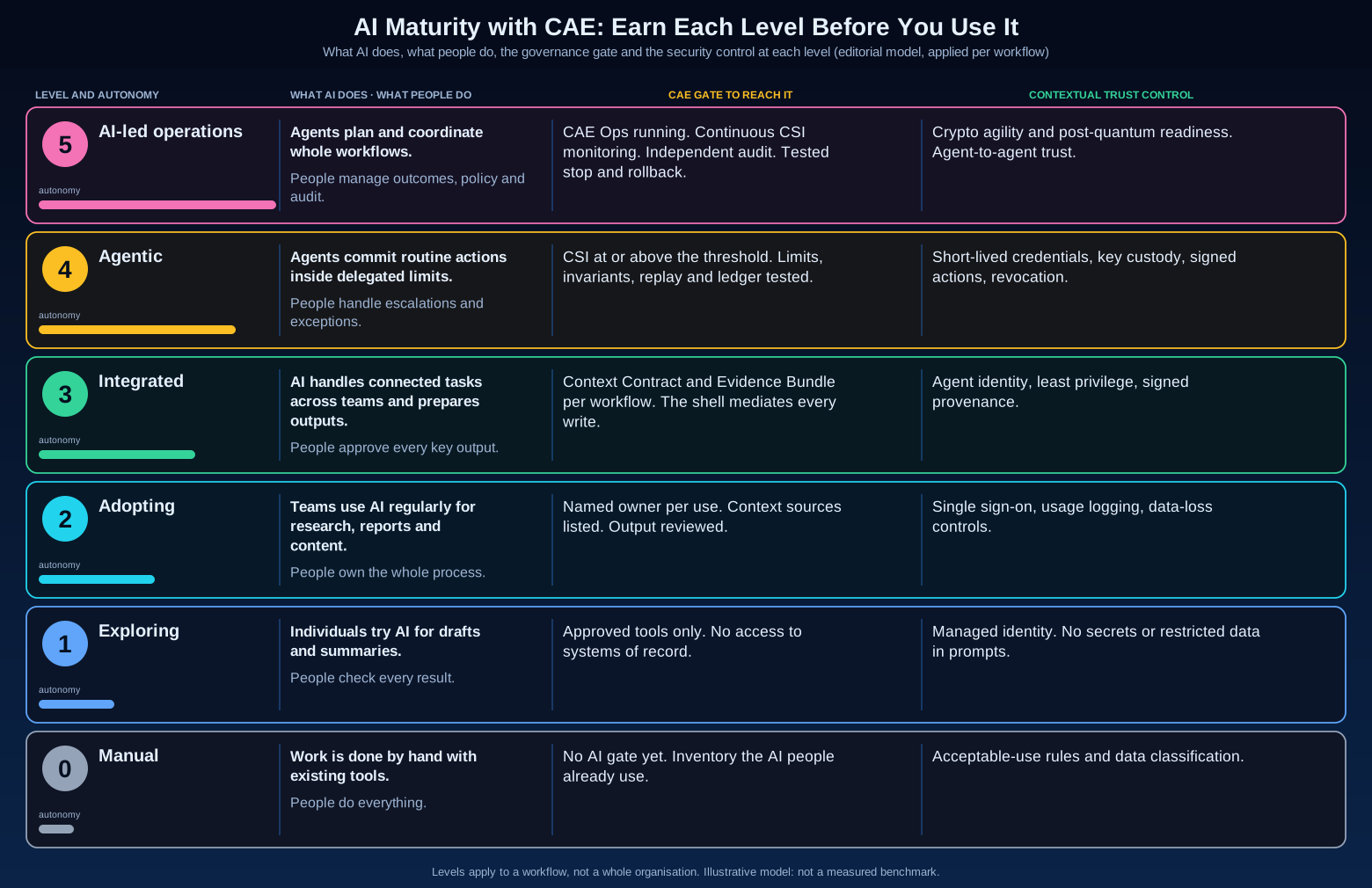
Level 0, Manual. People do the work with existing tools. There is nothing to govern yet, but there is something to discover: people may already be using AI tools that no one has approved. The first job is an honest inventory.
Level 1, Exploring. Individuals try AI for drafts, summaries and questions, and check every result themselves. The gate is simple: approved tools only, and no connection to systems of record. The security control is just as basic and just as often skipped: managed identity, data classification, and a rule that secrets and restricted data do not go into prompts.
Level 2, Adopting. Teams use AI regularly for research, reports and content, and people still own the whole process. The gate is a named owner for each use, a list of the context sources the AI draws on, and a person reviewing the output. Single sign-on, usage logging and data-loss controls give the security side something to see.
Level 3, Integrated. AI handles connected tasks across teams and prepares outputs, and people review and approve every key one. This is where CAE starts to matter in earnest. Each workflow gets a Context Contract, the signed, time-bound snapshot of the facts the AI works from. Each proposal travels as an Evidence Bundle. Every write passes through the deterministic shell, which alone holds write credentials. Contextual Trust adds agent identity, least privilege and signed provenance, so you can say which agent produced what, on whose authority.
Level 4, Agentic. Agents commit routine actions inside delegated limits, and people handle escalations and exceptions. The gate is demanding on purpose. The workflow’s Context Stability Index must be at or above the admission threshold (0.85 in the reference model), the delegated limits and invariants must be written and tested, and decisions must be replayable from the ledger. Credentials are short-lived, keys are held outside the agent, actions are signed, and any agent’s access can be revoked at once.
Level 5, AI-led operations. Agents plan and coordinate whole workflows, and people manage outcomes, policy and audit. CAE Ops must be running: contract operations, policy operations, escalation, evaluation and evidence operations as routine disciplines, with continuous monitoring of context stability, independent audit, and a stop and rollback that have actually been tested. Contextual Trust’s concern widens to cryptographic agility, including post-quantum readiness, and to trust between agents.
Level 5 is not the goal for every workflow. For many, especially those with high consequences or heavy regulation, Level 3 or 4 with well-designed escalation is the right place to stop.
Part 3: Match autonomy to readiness
Plot a workflow by the autonomy it has been given against its readiness, and three regions appear.
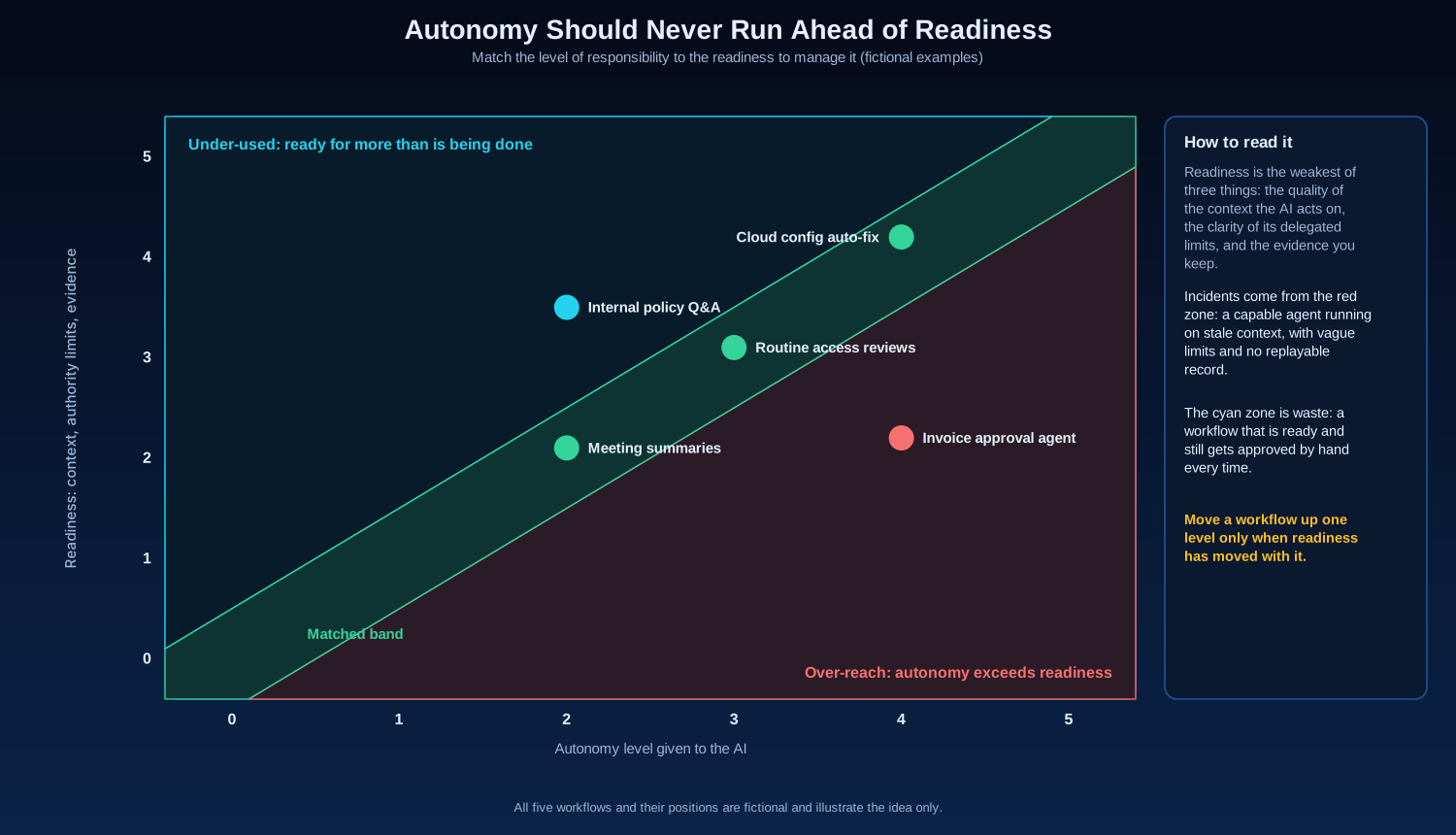
The green band is where autonomy and readiness match. Below it is over-reach, where autonomy exceeds readiness. Above it is waste, where a workflow is ready for more than it is allowed to do.
Readiness is the weakest of three things.
- Context quality. Is the information the AI acts on current, complete, owned and signed? A contract that expires in fifteen minutes is a different thing from a spreadsheet someone emailed last month. In CAE this is what the Context Contract and the Context Stability Index measure.
- Authority limits. Is it written down what the agent may commit alone, what it must escalate, and which rules no level of authority may break? Vague limits are the commonest reason a promising agent is pulled back.
- Evidence. Can you show afterwards what was proposed, what was checked, who approved and why, and can you replay it? Without that, a good outcome is luck and a bad one is a dispute.
The weakest of the three sets the ceiling. A workflow with excellent context and no evidence is not Level 4 ready. This is why the incidents that make headlines tend to come from the over-reach zone: capable agents, run on stale or unowned context, with no limit and no record.
The waste zone matters too. A ready workflow that is still approved by hand every time is a cost, and it trains reviewers to click through without reading, which is its own risk.
Part 4: What CAE adds at each step up
The jump from Level 2 to Level 3 is the first one where AI output leaves the person who asked for it and enters a connected process. That is why CAE’s concepts begin there.
| Concept | First required at | What it does at that level |
|---|---|---|
| Context Contract | Level 3 | Fixes the facts a decision depends on, signed and time-bound |
| Evidence Bundle (MAEB) | Level 3 | Carries a proposal with the evidence that supports it |
| Deterministic shell | Level 3 | Alone holds write credentials; returns Commit or Escalate |
| Delegated authority and invariants | Level 4 | Defines what an agent may commit alone and what no one may break |
| Context Stability Index admission | Level 4 | Decides whether the workflow’s context is good enough for autonomy |
| Hash-chained, anchored ledger and replay | Level 4 | Makes each decision reviewable and checkable later |
| CAE Ops | Level 5 | Runs the contracts, policies, agents, escalations and evidence as a discipline |
Notice what does not change. The agent’s reasoning may be as capable at Level 3 as at Level 5. What changes is how much it is allowed to commit without a person, and how much proof the surrounding system can produce. Maturity, in this model, is governance maturity, not model capability.
Part 5: Security from the first level
It is tempting to treat security as a late-stage control, added when agents begin to act. The model puts it in the first column instead, because the failures that cost most at Level 1 and 2 are data failures, not agent failures: restricted data pasted into an unapproved tool, credentials shared in prompts, outputs trusted without a check.
Contextual Trust is the security pillar of CAE, and its controls scale with the levels.
- Levels 0 to 2: acceptable-use rules, data classification, managed identity, single sign-on, usage logging and data-loss controls.
- Level 3: a distinct identity for each agent, least privilege, and signed provenance on what agents produce.
- Level 4: short-lived credentials, key custody outside the agent, signed actions and immediate revocation.
- Level 5: cryptographic agility, including readiness for post-quantum migration, and a basis for trust between agents.
Frontier-model vulnerability discovery, covered in a companion article, is a good example of a workflow that needs the Level 4 controls before it should be allowed near anything valuable.
Part 6: Five ceiling questions
You can place a workflow quickly by asking five questions in order. A “no” sets a ceiling on the level the workflow can claim, and its level is the lowest ceiling it hits.
| Question | If the answer is no, the highest level the workflow can claim is |
|---|---|
| Can we list every AI tool and data source this workflow uses? | Level 1 |
| Does each use have a named owner and a reviewed output? | Level 2 |
| Does the workflow have a Context Contract, and does every output carry evidence? | Level 2 |
| Are limits, invariants, escalation and replay written, tested, and is context stability at or above the threshold? | Level 3 |
| Is CAE Ops running, with independent audit and a tested stop and rollback? | Level 4 |
Two things make this useful. It is quick enough to run across a whole portfolio of workflows in a day. And it turns an argument about ambition into a list of missing evidence, which is easier to act on.
Part 7: Moving up and down
Promotion should be a decision, not a drift. The loop is short.
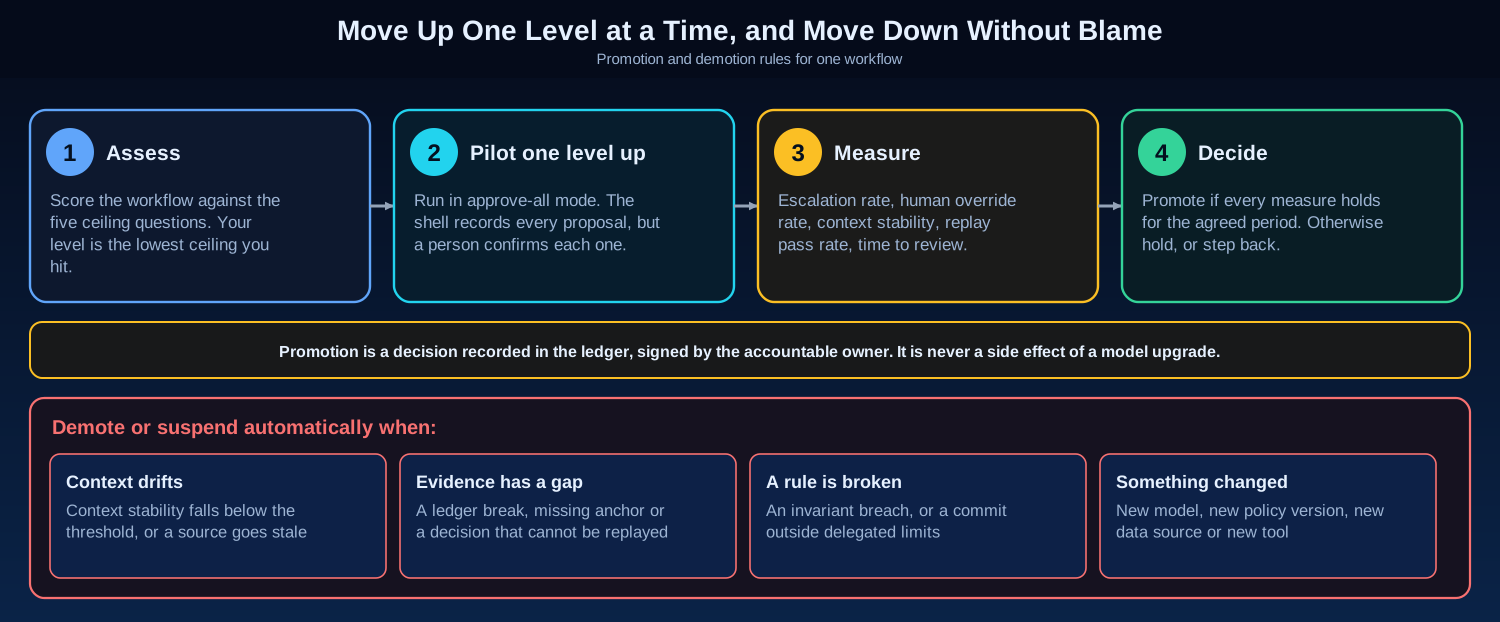
Assess the workflow with the five questions. Pilot it one level up in approve-all mode: the shell records every proposal, but a person confirms each one. Measure the escalation rate, the human override rate, context stability, the replay pass rate and the time reviewers spend. Then decide: promote if every measure holds for the agreed period, otherwise hold or step back.
Promotion is recorded in the ledger and signed by the accountable owner. It is never a side effect of a model upgrade or a vendor announcement.
Demotion deserves equal care, and it should be automatic. If context stability falls below the threshold, if the ledger has a gap, if an invariant is breached or a commit exceeds its limit, or if the model, policy version, data source or tool has changed, the workflow drops a level or is suspended until it is re-assessed. Make this rule-based and blameless. A system that steps back by rule is a system people will let run at higher levels.
Part 8: A worked example (fictional)
A fictional regional insurer runs one claims workflow at three points in time.
At Level 2, claims staff use AI to summarise long files and draft letters. A named team lead owns the use, the sources are the claim file and the policy wording, and every letter is read before it goes out. Risk is low and so is the saving.
At Level 3, the AI prepares a recommended decision for routine windscreen claims and sends it as an Evidence Bundle. The Context Contract fixes the policy version, the cover limits and the claim facts, with a short expiry. The shell checks the bundle against the contract and the rules, and a person approves every recommendation. Handling time drops, and every decision now has evidence attached.
At Level 4, after a pilot in approve-all mode, the insurer delegates payment of straightforward windscreen claims below a set value. Anything above the limit, with a fraud flag, or with stale policy data is escalated to a named person with the evidence. The Context Stability Index for this workflow clears the threshold, and the ledger allows any decision to be replayed. Complex injury claims stay at Level 2 because their context is too varied and their limits are too hard to write down.
The insurer is now at three levels at once, on purpose. All figures and details here are constructed for illustration.
Part 9: Common mistakes
Rating the organisation instead of the workflow. It produces an average that helps no one decide anything.
Buying a level. Tools do not confer maturity. A Level 4 product used inside a Level 2 governance setup is a Level 2 workflow with a risk attached.
Skipping a level. Jumping from assistant use to autonomous action skips the approve-all stage where you learn what the agent gets wrong.
Treating security as a later phase. Identity, data rules and logging are the cheapest controls and the ones whose absence is hardest to repair after an incident.
Never demoting. A workflow that can only go up will eventually run above its readiness.
Part 10: Using this ladder with the Executive Maturity Model
The series already has a companion resource, the Executive Maturity Model, and the two answer different questions. This ladder asks how much responsibility AI has been given in a workflow. The Executive Maturity Model asks how well governed an agent is, across six dimensions including context, authority and enforcement, on five levels from Demonstrated to Routine.
Used together, they check each other. The ladder says where AI is acting. The Executive Maturity Model says whether the governance behind it is strong enough. Our suggestion, which is editorial, is that a workflow should not sit at Level 4 on this ladder unless it can show at least the Governed level (3) on the Executive Maturity Model for the dimensions that apply to it. If the two disagree, trust the lower one.
Part 11: Limits
This is an editorial model. The levels are a simplification, the gates are what we recommend rather than what any standard requires, and the Context Stability Index threshold of 0.85 is a reference value from the formal paper, to be tuned for each organisation. No benchmark exists in this article, and no organisation’s position on the ladder is described. Some regulated settings will require a human in the loop at any level, whatever the readiness. The levels also say nothing about whether AI should be used for a given purpose at all, which is a question of ethics, law and consent, not of maturity.
Frequently asked questions
What are the levels of AI maturity?
This article uses six: 0 manual work, 1 exploring, 2 adopting, 3 integrated, 4 agentic and 5 AI-led operations. Each level hands AI more responsibility and asks more of the governance around it.
How do I know which level my organisation is at?
Do not rate the organisation. Rate each workflow with the five ceiling questions in Part 6. The result is a list of workflows and levels, which is more useful than a single number.
Should every workflow reach Level 5?
No. Level 5 suits workflows where context is stable, limits are writable and mistakes are recoverable. Many high-consequence or heavily regulated workflows are better at Level 3 or 4 with clear escalation.
What does CAE add to an AI maturity model?
The gates. CAE says what must exist before AI is given more responsibility: a Context Contract and Evidence Bundle from Level 3, delegated limits, a Context Stability Index at or above the threshold and a replayable ledger from Level 4, and CAE Ops with independent audit at Level 5.
Why is security in the first level?
Because the first failures are data failures. Managed identity, data classification and no secrets in prompts are cheap controls that prevent the most common early mistakes, and they are the foundation for the agent identity and key controls later.
Is this maturity model a standard?
No. It is an editorial model from Contextual Agentic. The NIST AI Risk Management Framework and ISO/IEC 42001 are useful general context, but this model is not derived from either and does not claim conformance with them.
Sources
The numbered references in the front matter are the sources for this article. The six levels, the gates, the ceiling questions, the workflow examples and the insurer in Part 8 are editorial or constructed for illustration.
Disclosure: The Contextual Agentic Enterprise is a vendor- and platform-agnostic architecture framework from Contextual Agentic, and CAE Ops is the operating model that runs it. Contextual Trust is its security pillar. Any adoption or use in a production setting should be undertaken in consultation with Contextual Agentic or an authorised advisory partner, who will tailor the gates, limits and thresholds to the organisation. This article is general information, not legal, compliance or financial advice. The companion book, The Contextual Agentic Enterprise (Polymath Signal Press, 2026), develops the architecture further.
Related
How CAE Governance Works: Seven Concepts, One Control Loop
A visual, in-depth guide to how Contextual Agentic Enterprise governance works. Seven concepts (Context Contract, Evidence Bundle, Deterministic Shell, Policy and Invariants, Delegated Authority and Escalation, Evidence Ledger, CAE Ops), what each one is for, who owns it, what it prevents, and how they combine into a single control loop around every agent decision.
The Contextual Agentic Enterprise: A Formally Governed Architecture for Bounded Multi-Agent Systems in Mission-Critical Systems of Record
A formal account of how CAE separates probabilistic deliberation from deterministic commitment: definitions of the Context Contract, the Minimum Action-Evidence Bundle and the Deterministic Shell, the properties that hold under stated assumptions, an entropy-based admission criterion for autonomy, and a 14-case conformance run of a reference policy.
Beyond the Autonomous Sandbox: The Contextual Agentic Enterprise (CAE) and the Future of Corporate AI Governance
An autonomous agent demo has a token trace. A production security review needs evidence. This article sets out how CAE separates thinking from committing, using a fictional gas-turbine incident, and what an executive roadmap for governed agency could look like.
From DevSecOps to AI-Native DevOps: A Practical Guide to Every Pillar, with CAE and CAE Ops, for the United States and Australia
How an enterprise moves from today's DevSecOps to AI-native DevOps without losing control. Ten pillars, what AI changes in each, where CAE and CAE Ops put the commit boundary, which US and Australian approvals matter, which tools hold them, and what published real-world results actually show.
Frontier AI Models for Vulnerability Discovery: What Works, What It Costs, and How to Govern It (US and Australia)
What frontier AI models have demonstrably done in vulnerability discovery by November 2026, which results are vendor-reported and which were checked by others, what still fails or costs too much, and where an enterprise should point them first, including cryptographic misuse, certificate and PKI handling, and post-quantum inventory. Includes a CAE-governed architecture in which agents propose and a deterministic shell verifies, a fictional worked example, measures and a 90-day starter plan.
One Architecture, Any Provider: Mapping the Contextual Agentic Enterprise onto the AI Tool Ecosystem
CAE does not depend on any one model, framework, vector store or cloud. This paper places eleven layers of the AI tool ecosystem on either side of CAE's commit boundary, states when a provider can be swapped without touching the safety guarantees, and reports a portable test suite run on a provider-neutral reference shell.