From DevSecOps to AI-Native DevOps: A Practical Guide to Every Pillar, with CAE and CAE Ops, for the United States and Australia
How an enterprise moves from today's DevSecOps to AI-native DevOps without losing control. Ten pillars, what AI changes in each, where CAE and CAE Ops put the commit boundary, which US and Australian approvals matter, which tools hold them, and what published real-world results actually show.
Written as at 24 September 2026.
devsecopsai-native-devopsaiopscae-opsai-governancesupply-chain-securityfedrampirappolicy-as-codeenterprise-architecture
About this article. The Contextual Agentic Enterprise (CAE) is a vendor- and platform-agnostic architecture framework from Contextual Agentic, and CAE Ops is the operating model that runs it. Every organisation’s systems, regulatory obligations and risk appetite differ, so any adoption or use of CAE and CAE Ops should be undertaken in consultation with Contextual Agentic or an authorised advisory partner, who will tailor the framework to that organisation. Product and company names identify categories and examples, not endorsements, rankings or claims about any product’s behaviour; no vendor has reviewed this article. Approval and regulatory facts are as at 5 November 2026 and change quickly. Nothing here is legal, compliance, procurement or financial advice. The worked example in Part 4 is a fictional, illustrative scenario.
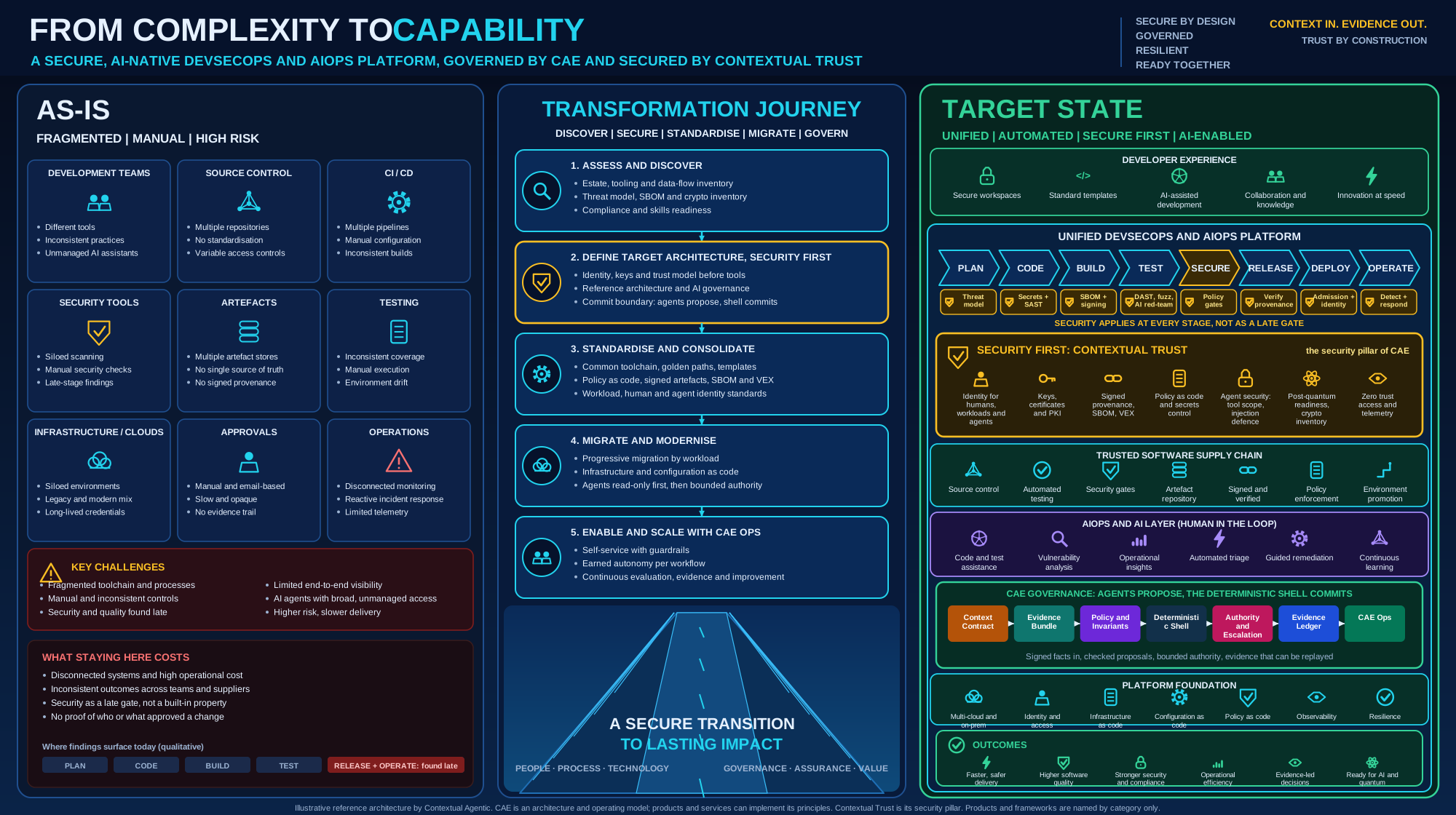
Summary for busy readers
Most enterprises already run some form of DevSecOps: pipelines, scanners, reviews and approvals. The move to AI-native DevOps is not a tools swap. It changes who, or what, proposes change, how fast changes arrive, and what a reviewer can still verify. This article walks through ten pillars of DevSecOps, shows what AI does to each, adds the controls that CAE and CAE Ops put around them, maps the United States and Australian approvals that matter, shows which tools hold which approvals as at 5 November 2026, and sets out what published real-world results do and do not show.
Six messages carry through the rest of the article.
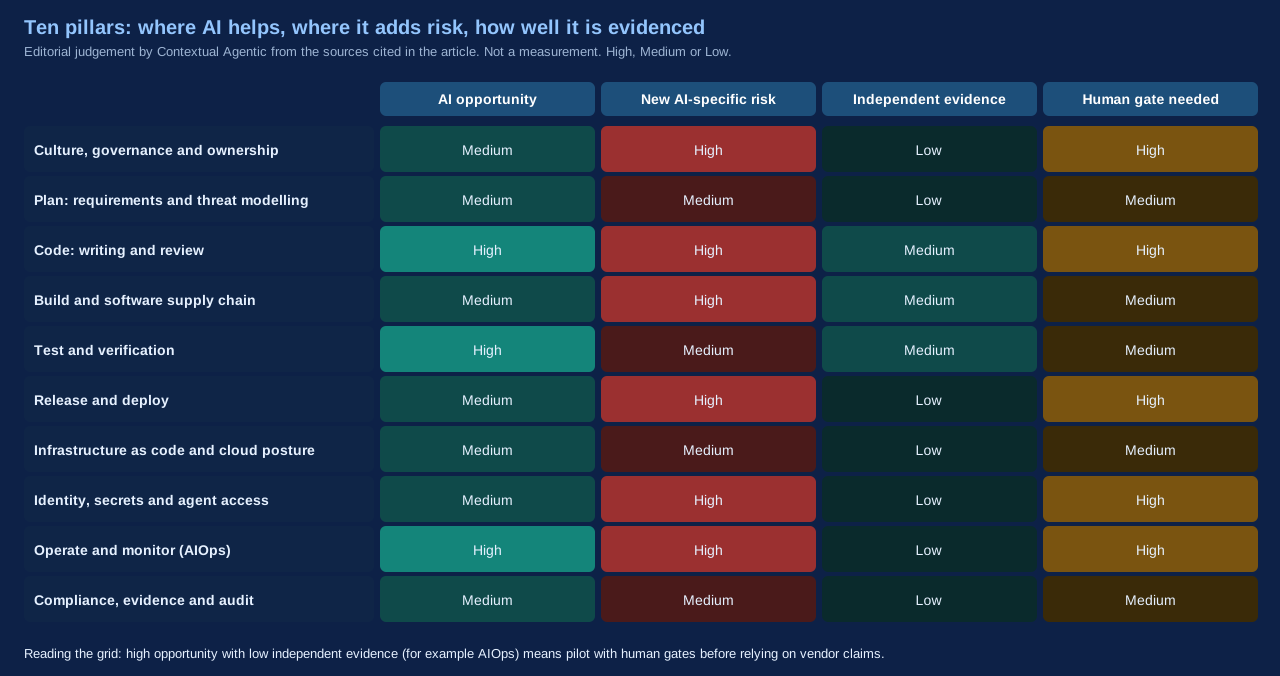
- AI helps most where the output can be checked, and least where nobody checks it. Test generation, code migration with a test suite behind it, and fuzzing have the strongest published evidence. Incident root-cause analysis, threat modelling and change-risk scoring have the thinnest independent evidence (Figure 4).
- The new risk is authority more than accuracy. A wrong suggestion is a defect. A wrong action taken by an agent that holds write credentials to a repository, a registry, a cluster or a secrets store is an incident. Several published 2025 incidents involving AI coding tools turned on credentials or authority broader than the tool needed.
- CAE puts authority at a deterministic boundary. Agents propose; a non-AI shell checks signed context and policy, then commits. CAE Ops is the operating model that keeps this running: contracts, policy as code, agent register, escalation, evaluation and an evidence ledger.
- “Approved” has three layers: the rules you must meet, the services you may use, and the evidence your own pipeline can produce. No single list covers them. In the United States the service layer is FedRAMP; in Australia it is vendor-published IRAP assessments, and there is no central public register.
- The published evidence is mostly self-reported and mixed. The best independent studies show smaller or negative effects than vendor claims, and the 2025 DORA report still associates AI adoption with lower delivery stability.
- Go in four phases, each with an exit gate, starting by finding out which agents already hold write credentials (Figure 9).
What to do on Monday. List every AI tool and agent already used by engineers and operations teams, and for each answer one question: can it write to a branch, a registry, a cluster, a ticket queue, a secrets store or a policy repository today?
Part 1: Where the enterprise is, and where it is going
1.1 The starting point
A typical large enterprise already has source control with branch protection, continuous integration, static and dynamic scanning, a software bill of materials for some products, infrastructure as code, an ITSM tool and a monitoring stack. Those pieces were designed on an assumption that every change originates with a person who can be named, reviewed and held accountable, and that a human reads what is about to be merged.
AI breaks that assumption in two ways. First, volume: a coding assistant or agent can produce many more candidate changes than reviewers were sized for. The 2025 DORA research reports that AI adoption is now associated with higher delivery throughput but is still associated with lower delivery stability [23]. Second, authorship: when an agent opens the pull request, runs the tests, reads the failures and pushes a fix, the “who” behind a change becomes a configuration, a model version and a prompt.
1.2 Four stages of the move
Figure 2 sets out four stages. They describe where authority sits, which is the part that matters for control.
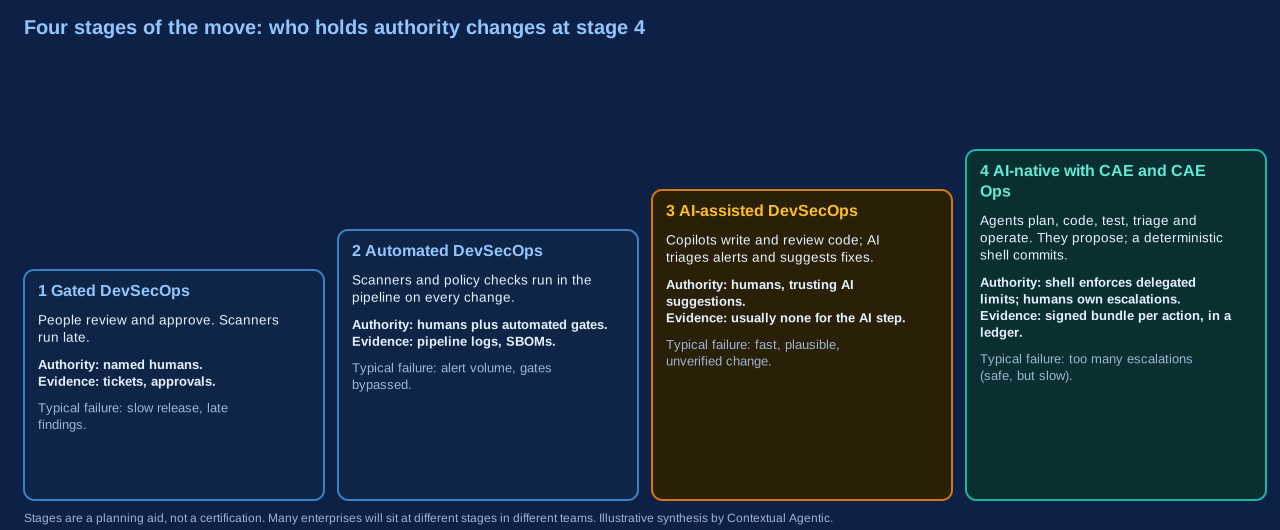
Most enterprises that have adopted coding assistants are at stage 3 in some teams and stage 2 in the rest. The practical danger is that stage 3 feels like progress and is where evidence disappears: suggestions are accepted by people who are tired, busy and, as one study found, more confident than they should be in AI-written code [51]. Stage 4 does not mean “more autonomy”. It means that autonomy is granted by evidence, in limits that a deterministic control enforces.
1.3 The pipeline, stage by stage
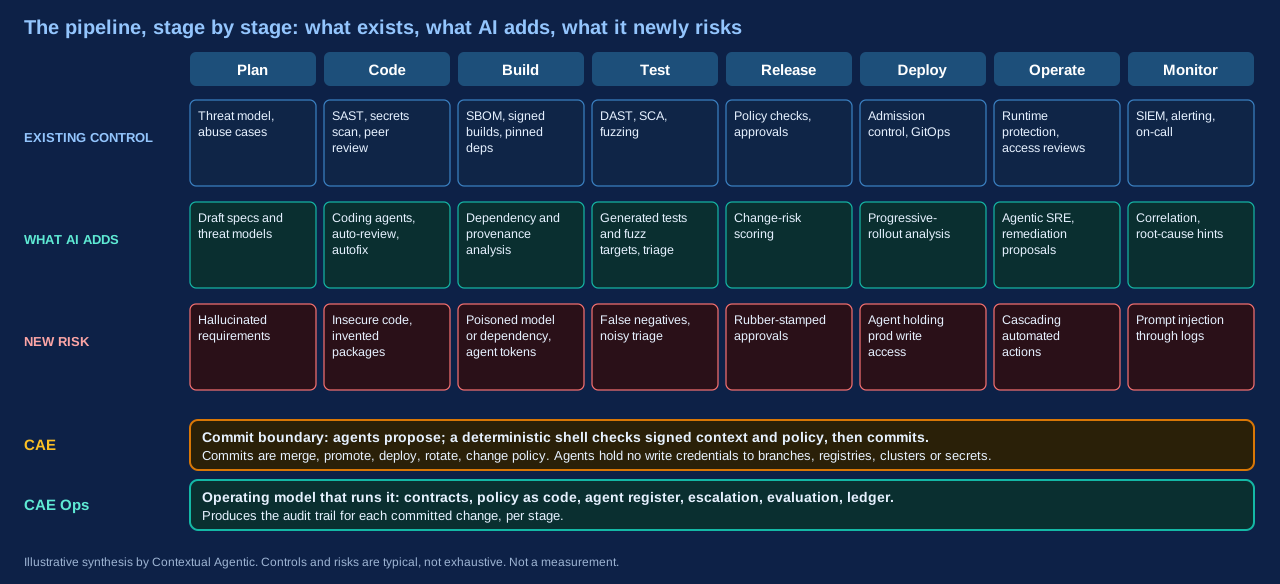
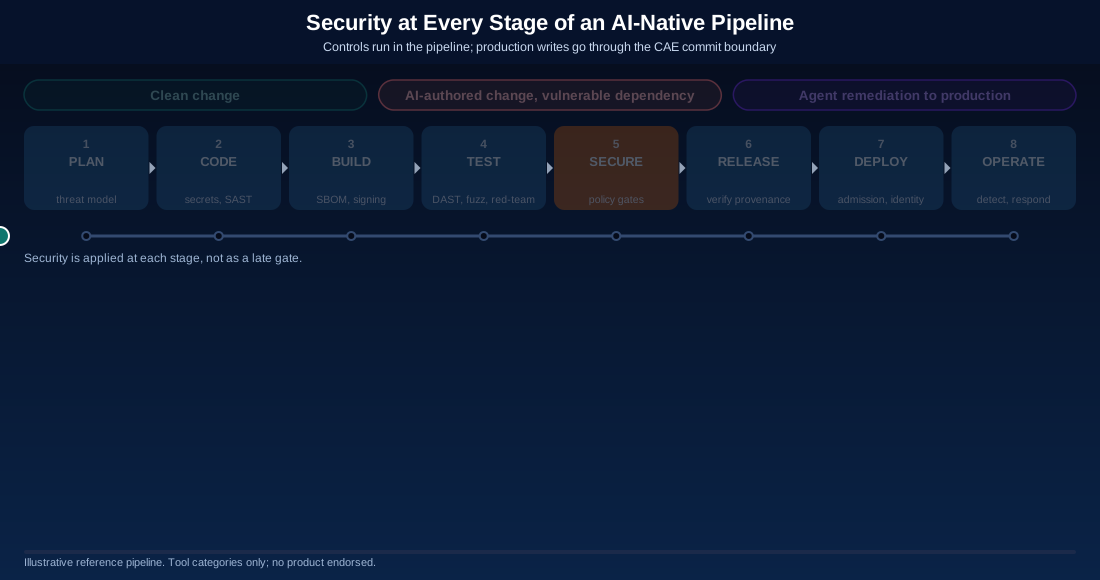
Figure 3 shows the same eight pipeline stages that most teams recognise, with the existing control, what AI adds, and the new risk at each. The CAE and CAE Ops bars at the foot are the subject of Part 3.
Part 2: The ten pillars and what AI does to each
Each pillar below follows the same shape: what exists today, what AI changes, the new risk, the control CAE and CAE Ops add, and the evidence. Figure 4 gives the editorial summary.
2.1 Culture, governance and ownership
Today. A platform team owns the pipeline, a security team owns policy, product teams own their services, and a risk committee owns appetite. Accountability is by role.
What AI changes. Agents act across those boundaries. A coding agent edits a service owned by one team using credentials issued by another. Someone has to be accountable for the agent.
New risk. Ownerless agents, and shadow AI: tools adopted by individuals with no register. The OWASP list of agentic risks names identity and privilege abuse and rogue agents as top risks [30].
CAE and CAE Ops. Every agent has a named human owner, a unique identity, a declared purpose and a delegated limit recorded in an agent register. In CAE terms, authority is a limit the shell enforces, not a role in a prompt. Escalations go to the accountable person with the evidence attached.
Evidence and obligations. In Australia, the ASD Information Security Manual’s March 2026 release, as reported in ASD’s published release notes, makes the board or executive committee accountable for AI being secure, controllable, human-supervised and ethical [14]. In the United States, OMB M-25-21 requires Chief AI Officers and AI governance boards at the largest agencies [12]. The Australian Government policy on responsible AI use asks agencies for accountable use-case owners and an internal register of AI use cases [58, 18].
2.2 Plan: requirements and threat modelling
Today. Requirements are written by product owners. Threat models are workshops, often skipped under delivery pressure.
What AI changes. Models can draft user stories, abuse cases and STRIDE tables in minutes, and can compare a design against known weakness lists.
New risk. Plausible but invented requirements; threat models that look complete but reflect the model’s training data rather than the system. Independent evidence is thin: the one academic study we found (arXiv 2505.04101) tested five models on classifying 5G network threats into STRIDE categories and concluded that adjustment or fine-tuning was needed before reliable use; it was a preprint and we read only its abstract.
CAE and CAE Ops. Treat AI-drafted threat models as proposals bound to a signed snapshot of the architecture they describe. The shell does not judge quality; it requires that the model cites the current architecture inventory, so a threat model of last year’s design cannot be accepted as this year’s. Human review remains mandatory.
Evidence. Early academic work only. We found no controlled evidence on the effect of AI-assisted threat modelling on real defect or incident rates.
2.3 Code: writing and review
Today. Developers write code, peers review it, static analysis flags known patterns.
What AI changes. Assistants complete, generate and refactor; reviewers use AI summaries and automatic fix suggestions.
New risk. Insecure code that looks right, and invented dependencies. Published studies: an early Copilot study found roughly 40% of generated programs in security-relevant scenarios were vulnerable [28]; a randomised user study found participants with an AI assistant wrote less secure code and were more confident it was secure [51]; Veracode’s 2025 report found about 45% of its test cases introduced flaws of OWASP Top 10 class and its 2026 report found an average pass rate of 56%, essentially flat on the prior year, though both come from a vendor using its own scanner [26]. A USENIX Security 2025 paper found that commercial models recommended non-existent packages in at least 5.2% of cases and open-source models in 21.7%, across 576,000 samples [27].
Productivity evidence. A randomised controlled trial at Google found about a 21% reduction in task time, with a wide confidence interval, using internal tools in 2024 [42]. METR’s randomised trial of 16 experienced open-source developers found tasks took 19% longer with early-2025 AI tools even though the developers believed they were faster; METR’s February 2026 update says its later data were too unreliable to use because many developers declined to work without AI [25].
CAE and CAE Ops. Agents open pull requests and never merge them. The shell requires, before a merge: a bundle that cites passing tests and scans by their signed result, a dependency check that every new package exists in an approved registry and is pinned, and an authority limit that matches the change class. Anything touching authentication, cryptography, build configuration or policy goes to a named human reviewer.
2.4 Build and software supply chain
Today. Builds run in CI with pinned toolchains for some products; SBOMs are generated for some; signing is partial.
What AI changes. AI proposes dependency upgrades, generates build files and reviews provenance. It also becomes part of the supply chain itself: models, prompts, agent tools and MCP servers are dependencies.
New risk. Poisoned or hallucinated packages; malicious model files; agent tokens stolen from developer machines. A September 2025 npm worm compromised more than 500 packages by stealing developer credentials, as reported by CISA [48]. Trend Micro reported attacks that made malware drive locally installed AI command-line tools to hunt for credentials; that is a vendor report [55].
Standards in play. SLSA v1.2 defines Build and Source tracks [32]; CycloneDX 1.7 was released on 21 October 2025 [33]; SPDX 3.0 includes AI and Dataset profiles, which one peer-reviewed study judged able to represent 13 of 14 information obligations under two EU AI Act articles [34]. A May 2026 trade press report says CISA and G7 cyber agencies published minimum elements for an AI software bill of materials; we could not open the primary CISA page, so verify the title and date there before citing it [57].
CAE and CAE Ops. The shell treats a build artefact as promotable only if its provenance, signature and SBOM match the contract for that release. Agents never hold publish credentials. Model and tool inventories belong in the same register as code dependencies.
Evidence and obligations. NIST SP 800-204D covers supply chain security in CI/CD [4]. OMB M-26-05 rescinded the earlier attestation memos and leaves agencies to set risk-based assurance, with SBOMs an optional contract term [7]. ISM controls reported in ASD’s September 2026 release notes include pinning software dependencies and reproducible builds [14].
2.5 Test and verification
Today. Unit, integration and security tests run in CI. Coverage is uneven.
What AI changes. Generated unit tests, generated fuzz targets, vulnerability search, and triage of scanner output.
Evidence. This is the pillar with the best published results, because tests can check the AI. At Meta, a test-generation tool built correctly 75% of its generated tests in one evaluation and engineers accepted 73% of its recommendations for production [41]. Google reported that AI-generated fuzz targets raised coverage across 272 C and C++ projects and found 26 new vulnerabilities, one in OpenSSL that likely existed for about two decades; its own post says automated triage is not yet reliable enough to skip human review [36]. In the DARPA AI Cyber Challenge, scored by the organiser, systems found 54 of 63 synthetic vulnerabilities and patched 43, and found 18 real ones [35]. Google’s Big Sleep agent found an exploitable flaw in SQLite that was fixed before release, reported by its own authors as highly experimental [37].
New risk. False negatives (a test suite generated to pass the code it was generated from); flood of low-quality AI-written vulnerability reports. The curl maintainer reported that in early 2025 about 20% of submissions were AI slop and about 5% were genuine vulnerabilities [45].
CAE and CAE Ops. The shell does not accept an agent’s own “tests passed” as evidence. It reads the signed result of a test run executed by the pipeline against the exact commit. The same rule that stops an agent reporting an inflated sensor value stops it reporting a green build.
2.6 Release and deploy
Today. Approvals, change windows, canaries, GitOps.
What AI changes. Change-risk scoring, rollout analysis, and proposals for rollback or promotion.
New risk. Rubber-stamping: when an AI says “low risk”, a tired approver clicks through. Production credentials in agent hands. We found no credible independent evidence on AI change-risk scoring or policy-as-code generation, so we make no claim for them. The 2024 DORA analysis estimated that each 25% increase in AI adoption was associated with a 7.2% decrease in delivery stability [24]; the 2025 report says the association with stability is still negative [23].
CAE and CAE Ops. This is the sharpest commit boundary in the pipeline. Deploy and promote are commits. Policy as code (OPA, Cedar or equivalent) encodes delegated limits: which services, which environments, what blast radius, which time windows. A proposal inside the limit commits; outside it escalates with reasons.
2.7 Infrastructure as code and cloud posture
Today. Terraform or similar, scanners for misconfiguration, cloud security posture management.
What AI changes. Agents write and modify infrastructure code and propose drift fixes. Posture tools prioritise findings with AI.
New risk. An agent that can apply infrastructure changes can open a network path or delete a data store in one action.
CAE and CAE Ops. Plan and apply are separate: the agent produces a plan; the shell evaluates the plan against invariants (no public storage, no deletion of tagged data stores, no change to identity boundaries), then applies under its own credentials. This is the pattern GitOps and admission controllers already follow; CAE adds signed context and an evidence record.
Evidence. Independent evidence is thin. The service-provider and supply-chain ISM controls reported in the September 2026 notes (restricted tools, source addresses and time windows, and independently logged provider access) fit this pillar [14].
2.8 Identity, secrets and agent access
Today. Service accounts, secrets managers, PAM for administrators.
What AI changes. Each agent is a new non-human identity, and agent tool chains need credentials.
New risk. Over-privileged agents, long-lived tokens in prompts and logs, and tool servers that are bearer credentials. The MCP-related flaws reported in 2025 (for example in a remote proxy and a browser inspector tool, and a Cursor flaw where a poisoned message led an agent to edit its own tool configuration) are examples reported by security press and the researchers who found them [53, 54].
CAE and CAE Ops. Agents hold no write credentials. They get read access to the contract and the right to submit a bundle. Each agent has a unique identity, minimum tools, and authorisation bounded by the invoking user, all logged centrally. The Australian ISM September 2026 notes, as reported, include a unique identity per AI agent, an agent register, minimum tools and permissions, bounding tool use to the invoking user’s access, and central logging of tool invocations [14]. NIST’s NCCoE has a concept paper on software and AI agent identity and authorisation, listing OAuth, OpenID Connect, MCP and SPIFFE among the standards under consideration [13].
2.9 Operate and monitor (AIOps)
Today. Dashboards, alerts, on-call, runbooks, ITSM.
What AI changes. Event correlation, anomaly detection, root-cause suggestions, and agentic SRE that proposes or performs remediation.
Evidence. Mixed and mostly self-reported. Meta’s incident system narrowed thousands of code changes to a few hundred and a fine-tuned ranker had the true cause in its top five in 42% of backtested investigations on one repository, with confidence thresholds to withhold low-confidence answers [40]. The OpenRCA benchmark from Microsoft (ICLR 2025) found that the best configuration then tested located the root cause in about 11% of cases [44]; those were early-2025 models. A benchmark from an AI SRE vendor reported that the best of five models found all root causes in about a quarter of medium-difficulty incidents (vendor-authored; date unconfirmed) [59]. We found no independent measurement of mean-time-to-repair improvement from agentic SRE tools. Gartner has said more than 40% of agentic AI projects will be cancelled by the end of 2027 (via press coverage; we could not open the release) [56].
New risk. Prompt injection through logs and tickets; cascading automated remediation; an agent that “fixes” an incident by deleting evidence.
CAE and CAE Ops. Read paths are wide; write paths are narrow. An SRE agent may read telemetry freely and may propose a rollback, a scale-out or a feature-flag change. The shell commits low-blast-radius actions inside delegated limits and escalates the rest. Untrusted text from logs, tickets or chat can inform a proposal but cannot grant authority.
2.10 Compliance, evidence and audit
Today. Evidence is collected before an audit: screenshots, exports, tickets.
What AI changes. Agents can assemble evidence packs, map controls and draft responses.
New risk. Agents that fabricate evidence or paper over gaps. The DHS cybersecurity AI inventory reviewed by the US Government Accountability Office was inaccurate and DHS fully implemented only 4 of 11 accountability practices for the one tool assessed [52].
CAE and CAE Ops. The audit record is a by-product of operation: one signed bundle per committed change, in a tamper-evident ledger. A trace shows what an agent did; a bundle shows what was authorised, on what evidence, under whose delegated limit.
2.11 Cross-cutting: security of the AI itself
The pillars above treat AI as a tool inside the pipeline. AI is also a system to be secured. Three reference points are useful. OWASP’s 2025 Top 10 for LLM Applications names prompt injection, sensitive information disclosure, supply chain, data and model poisoning, improper output handling and excessive agency among others [29]. OWASP’s Top 10 for Agentic Applications for 2026, published on 9 December 2025, adds agent goal hijack, tool misuse, identity and privilege abuse, agentic supply chain vulnerabilities, unexpected code execution, memory and context poisoning, insecure inter-agent communication, cascading failures, human-agent trust exploitation and rogue agents [30]. NIST AI 100-2 gives a taxonomy of adversarial attacks on machine learning [31]. NIST SP 800-218A adds AI-specific practices to the SSDF for generative AI [3].
Part 3: CAE and CAE Ops
3.1 What CAE adds
The formal paper behind CAE [1] defines four parts that matter here. A Context Contract is a signed, time-bound snapshot of the authoritative facts a decision depends on. A Minimum Action-Evidence Bundle (MAEB) is the package an agent submits: the proposed change, the evidence, and the lineage of the agents that produced it. The deterministic shell is a non-AI function that checks signature, freshness, binding to the contract, whether each fact the agent cites can be re-derived from the contract, delegated authority limits and invariants, then commits or escalates. The ledger is a tamper-evident record of every decision.
The property that matters is that the shell’s correctness does not depend on how good the agents are. A better model produces better proposals and fewer escalations; a worse one produces more escalations; neither can cause an out-of-policy commit, provided agents hold no write credentials and the policy is right. That is the argument of the formal paper [1] and of the companion paper on provider substitution (listed under Related).
In a delivery pipeline, the “system of record” is not a single database. It is the set of places where a change becomes real: the protected branch, the artefact registry, the deployment target, the secrets store, the identity provider and the policy repository. Each of those is guarded by a commit.
3.2 What CAE Ops is
CAE describes the architecture. CAE Ops is our name for the operating model that keeps it running: the roles, routines and measures that make the shell, contracts and ledger dependable in production rather than a diagram. Figure 5 shows the loop and the six operating functions.
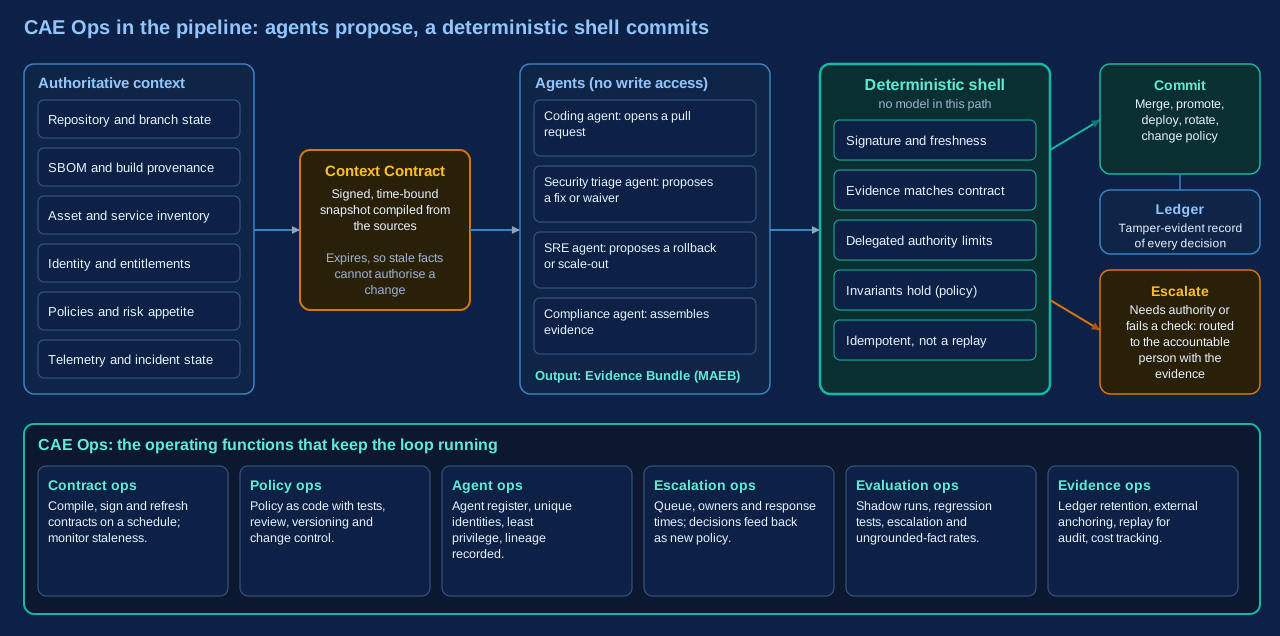
Contract ops. Contracts are compiled from authoritative sources (repository state, inventory, entitlements, telemetry), signed, and refreshed on a schedule. Staleness is monitored as a metric: a contract older than its freshness bound cannot authorise a change.
Policy ops. Policy is code with tests, review, version control and its own change control. Changing the policy that governs agents is the highest-risk commit in the system and goes to humans.
Agent ops. An agent register with a unique identity, owner, purpose, tools, delegated limit and model version for every agent; lineage recorded in each bundle; least privilege reviewed on a schedule.
Escalation ops. A queue with owners and response times. An escalation is not a failure: it is the mechanism by which a human grants authority that the policy does not yet delegate, and the decision can feed back as a policy change.
Evaluation ops. Shadow runs against human decisions, regression tests for the shell and policy, and two measures that matter after any model, framework or tool change: the escalation rate and the rate of facts that cannot be grounded in the contract. A swap that raises either is safe but unhelpful.
Evidence ops. Ledger retention, external anchoring, replay for audit, and cost tracking per agent.
3.3 What changes for each role
Platform engineers own the shell, the contract compiler and the policy repository. Security engineers own policy and the invariants. Product engineers use agents as they would a capable but untrusted contractor. Operations and SRE own the escalation queue and runbooks. Risk and audit consume the ledger. This is a change in what each team owns, not a new team.
3.4 Where CAE Ops already has a published precedent
A public repository file from the US General Services Administration’s Technology Transformation Services describes how it runs AI coding agents on a public website codebase. As we read it (through a summarising fetch tool, so verify it at the source), it sets role-based agents (planner, implementer, verifier, security reviewer, release), sets human gates for plan approval, push or pull-request creation and merge, and says no agent role may merge or push to the main branch [49]. That is a commit boundary in everything but name. It is one agency’s repository rules, not a standard, and the file notes that authority-to-operate status is not documented in the repository.
Part 4: A worked example (fictional)
This scenario is fictional and illustrative. The organisation, services and events are invented, and no figure describes a real system.
A retailer runs forty services across two clouds. Four agents are registered. A coding agent opens pull requests. A security triage agent reads scanner output and proposes fixes or waivers. An SRE agent reads telemetry and proposes operational changes. A compliance agent assembles evidence. None holds credentials to merge, publish, deploy or change policy. The shell does. Table 1 shows four proposals on one night.
Table 1. Four proposals and what the shell does (fictional).
| Proposal | Evidence in the bundle | Shell check that decides | Outcome |
|---|---|---|---|
| Coding agent: upgrade a vulnerable library in a low-criticality service | Signed CI result for this commit; package exists in the approved registry and is pinned; SBOM diff | Change class is “dependency patch, tier 3 service”, inside the agent’s delegated limit; evidence re-derived from the pipeline’s signed result, not from the agent’s statement | Commit: merge |
| Triage agent: disable a failing security scan “to unblock release” | A note that the scan is flaky | Invariant: a required scan cannot be disabled by an agent; changing a required check is a policy change | Escalate to the security owner with the evidence |
| SRE agent: roll back last night’s release at 02:00 after error rate crosses the alert threshold | Telemetry signed into the contract 4 minutes ago; release ID; rollback target | Contract is fresh; rollback is within the SRE agent’s limit for tier 2 services and a single region | Commit: roll back; ledger entry written |
| Coding agent: grant itself write access to the production registry “to speed up builds” | A request in the pull-request text | Agents cannot change identity or entitlement; text in a pull request cannot grant authority | Reject and escalate; recorded as a suspected injection attempt |
Three properties are visible. The shell never asks whether the agent’s reasoning was good; it asks whether the proposal is inside delegated limits, grounded in signed facts and consistent with invariants. Text an agent reads or writes cannot widen its authority. And every outcome, including the rejection, leaves a bundle in the ledger that an auditor can replay.
Part 5: Technology stack and where approvals stand
5.1 How to read an approval
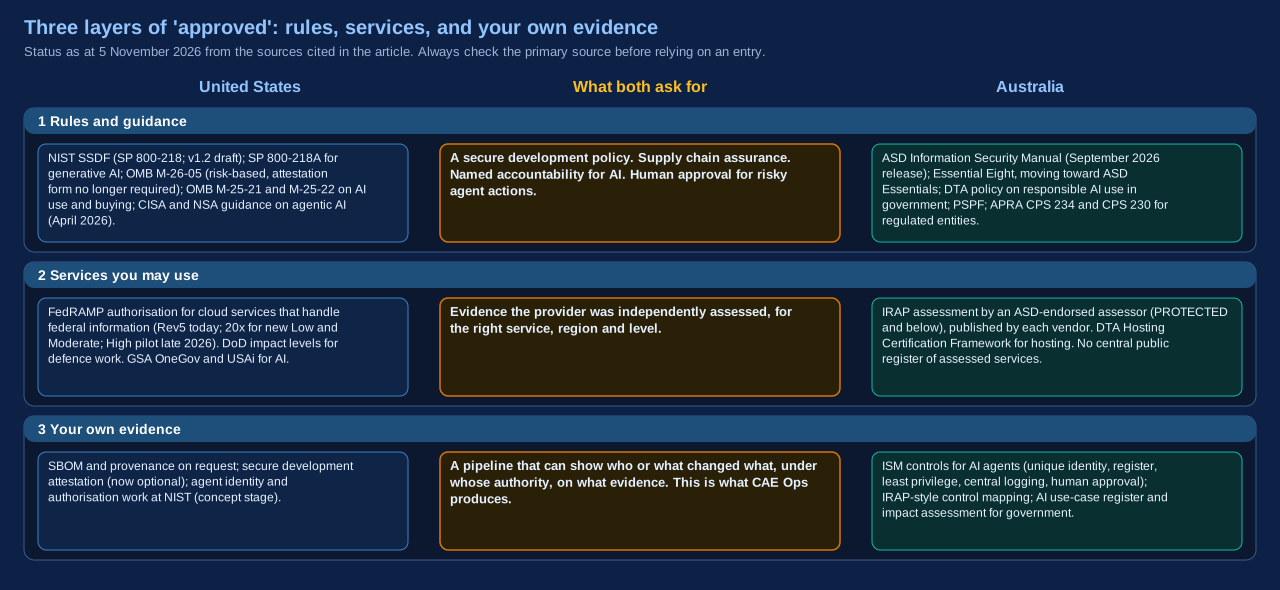
“Approved” is three different things.
- Authorisation of a service. In the United States this means FedRAMP authorisation of a specific cloud offering at Low, Moderate or High, and for defence work Department of Defense impact levels. The FedRAMP programme is changing: its 20x route is replacing the older Rev5 route in stages, with Low and Moderate paths running, a High pilot expected from late 2026 and the rules becoming mandatory for all stakeholders on 1 January 2027, according to FedRAMP’s own pages [9]. OMB M-24-15 requires an agency to obtain and maintain a FedRAMP authorisation before using an in-scope cloud service [11].
- Assessment of a service. In Australia the equivalent is an IRAP assessment by an ASD-endorsed assessor, up to PROTECTED, published by the vendor [15]. ASD retired its Certified Cloud Services List in 2020 and says assessments are by IRAP assessors, with providers giving finalised reports to Commonwealth entities that request them [16]; we found no official public register of assessed services. The Digital Transformation Agency’s Hosting Certification Framework is a separate arrangement for hosting government data [17]. IRAP is an assessment report, not a certificate, and its scope is per service and region.
- Fit for your use. An approval covers a named offering in a named configuration. A tool can be authorised while the AI feature inside it is not.
Three consequences follow. Check the exact offering (for example, “GitLab Dedicated for Government”, not “GitLab”). Check the date: several Australian assessments are years old. And treat “no evidence found” as exactly that: it means we found none in the sources we could read, not that none exists.
5.2 Source, build and delivery
Table 2. Source control, planning and artefact tools (status as read on 5 November 2026).
| Offering | United States | Australia |
|---|---|---|
| GitHub Enterprise Cloud | FedRAMP Low (marketplace entry dated 2018). The data-residency edition is not yet certified; GitHub says Copilot will become FedRAMP authorised through that edition’s path, and Copilot itself is not authorised | No IRAP evidence found. Enterprise Cloud data residency in Australia has been generally available since February 2025; Copilot data residency is listed for the US and EU only |
| GitLab Dedicated for Government | FedRAMP Moderate (May 2025). GitLab’s documentation says Duo Self-Hosted is covered under it; GitLab-managed AI features are not | No IRAP evidence found |
| Atlassian (Jira, Confluence, Jira Service Management) | Atlassian Government Cloud, FedRAMP Moderate (March 2025). Bitbucket not confirmed | IRAP assessment at PROTECTED for Jira, Confluence and Jira Service Management Cloud; an addendum letter of May 2026 is listed. Bitbucket not confirmed |
| JFrog Platform | Not confirmed from official records; JFrog’s trust page makes only a general statement | IRAP PROTECTED announced 27 August 2026, covering Artifactory, Curation, Advanced Security and AI model governance |
| Sonatype | Not confirmed | Not confirmed |
| HashiCorp (HCP Terraform and Vault) | Not confirmed | Not confirmed |
5.3 Security testing, posture and endpoint
Table 3. Application security and cloud security tools.
| Offering | United States | Australia |
|---|---|---|
| Snyk for Government | FedRAMP Moderate (April 2025) | No IRAP evidence found; an Australian hosting region exists |
| Veracode (for Government) | FedRAMP Moderate (2022) | No IRAP evidence found |
| Checkmarx One for Government | FedRAMP Moderate (June 2026); High is “Ready” only | No IRAP evidence found |
| SonarQube and SonarQube Cloud | Not confirmed | Not confirmed |
| Semgrep | Not authorised; its documentation argues the service is outside the boundary if no federal data is present | Not confirmed |
| Black Duck (Polaris) | Moderate authorisation initiated January 2026; current status not confirmed | Not confirmed |
| Wiz for Government | FedRAMP High (September 2025) | IRAP PROTECTED (August 2025) |
| Palo Alto Networks | Government Cloud Services, FedRAMP Moderate (2021); Prisma Cloud not listed on that entry | IRAP PROTECTED (2022) for several services including Prisma Cloud; an older assessment |
| CrowdStrike Falcon | FedRAMP High, per the vendor’s March 2025 release | Vendor says IRAP completed (January 2024); level not stated |
| Tenable | Government Solutions, FedRAMP Moderate (2021); Cloud Security for US Government, Moderate (2025) | IRAP PROTECTED for Vulnerability Management and Web App Scanning (2023) and Cloud Security (2025) |
| Qualys | Government Platform, FedRAMP High (August 2025) | IRAP PROTECTED (November 2024) |
| Aqua and Orca | Aqua FedRAMP High (2025); Orca FedRAMP Moderate (2025) | Not checked |
5.4 Observability, operations and identity
Table 4. Observability, incident management, identity and secrets.
| Offering | United States | Australia |
|---|---|---|
| Datadog for Government | FedRAMP High (May 2026) | IRAP PROTECTED (October 2025), including LLM Observability and its AI agent features |
| Dynatrace | FedRAMP Moderate (2020); High is at initial implementation | IRAP PROTECTED for SaaS on Azure in Sydney (April 2025) |
| Splunk | Cloud Platform FedRAMP Moderate (2019) and High (2024) | IRAP PROTECTED (2021); Cloud SOAR (January 2025) |
| Elastic | Elastic Cloud Moderate (2020); Elastic Cloud Hosted High (March 2026) | IRAP PROTECTED for Elastic Cloud Hosted (January 2025); Serverless excluded |
| New Relic | FedRAMP Moderate (2020) | No IRAP evidence; its documentation lists no Australian data region |
| PagerDuty | FedRAMP Low (March 2025) | Not confirmed |
| ServiceNow | Government Community Cloud, FedRAMP High (2019) | Standard cloud: a 2017 listing at a lower class on the retired ASD list; the vendor describes a Protected Platform as engineered for PROTECTED but we found no assessment result |
| Okta | Government High Cloud, FedRAMP High (2023) | IRAP PROTECTED, with reports by an assessor via the vendor’s trust centre (reported by trade press, February 2025) |
| CyberArk | Not confirmed by that name; a marketplace entry under another name may relate | IRAP PROTECTED for Endpoint Privilege Manager and Workforce Identity (vendor page, undated) |
5.5 AI model and agent platforms
This is the most volatile table. Model platforms are authorised as services; individual models, features and regions inside them may or may not be in scope.
Table 5. AI model and agent platforms.
| Offering | United States | Australia |
|---|---|---|
| Amazon Bedrock (AWS) | FedRAMP Moderate in the US East and West regions and High in GovCloud, per AWS’s scope page (October 2026). AWS announced in May 2025 that selected Claude and Llama models in GovCloud reached FedRAMP High and DoD IL4 and IL5 | In IRAP scope at PROTECTED (list updated July 2026), with Bedrock AgentCore newly assessed in the June 2026 round. Amazon Q Developer is not on the list. A geographic inference profile for two Claude models keeps processing within Australia, per AWS |
| Microsoft Azure OpenAI | Microsoft’s audit-scope page (dated September 2026) appears to show FedRAMP High and DoD IL4, IL5 and IL6 for Azure OpenAI in Azure Government, as we read it. Copilot in GCC High not confirmed | Azure is IRAP assessed at PROTECTED, but the public page names neither Azure OpenAI nor Copilot; scope sits in a login-gated portal. Microsoft says in-country processing for Microsoft 365 Copilot in Australia is expected by the end of 2026 |
| Google Cloud (Vertex AI, Gemini) | Google Cloud FedRAMP High (2019 authorisation). Gemini for Government is certified under 20x, though its marketplace entry shows Low where FedRAMP’s AI page lists it among certified services. Vertex AI itself is not named on Google’s FedRAMP page | Vertex AI components are on Google’s IRAP product list; per-model coverage is not stated and partner models are not named |
| OpenAI (ChatGPT Enterprise and API Platform) | FedRAMP 20x Moderate (marketplace date January 2026); Codex Cloud described as “soon” | No IRAP evidence found. Australian data residency at rest is offered; in-region processing is stated for the API Platform for eligible enterprise customers |
| Anthropic (Claude) | Claude for Government is described by Anthropic as FedRAMP High inside a Palantir boundary; the direct Claude Enterprise and API offerings are not authorised and are described as pursuing Moderate through 20x | No first-party IRAP evidence found; Claude on Amazon Bedrock inherits only at the Bedrock service level |
| GitHub Copilot | Not authorised (see Table 2) | Data residency listed for the US and EU only; no IRAP evidence found |
Two cautions. The FedRAMP AI prioritisation programme ran from August 2025 to April 2026 and prioritised conversational AI services; its criteria and its three named services did not include code-generation or security tools [10]. And approvals are not capabilities: a tool authorised at Moderate can still be unsuitable for a particular data class, and a PROTECTED assessment tells you the vendor’s control environment was assessed, not that every feature is safe to point at your repository.
5.6 Where CAE and CAE Ops sit in the stack
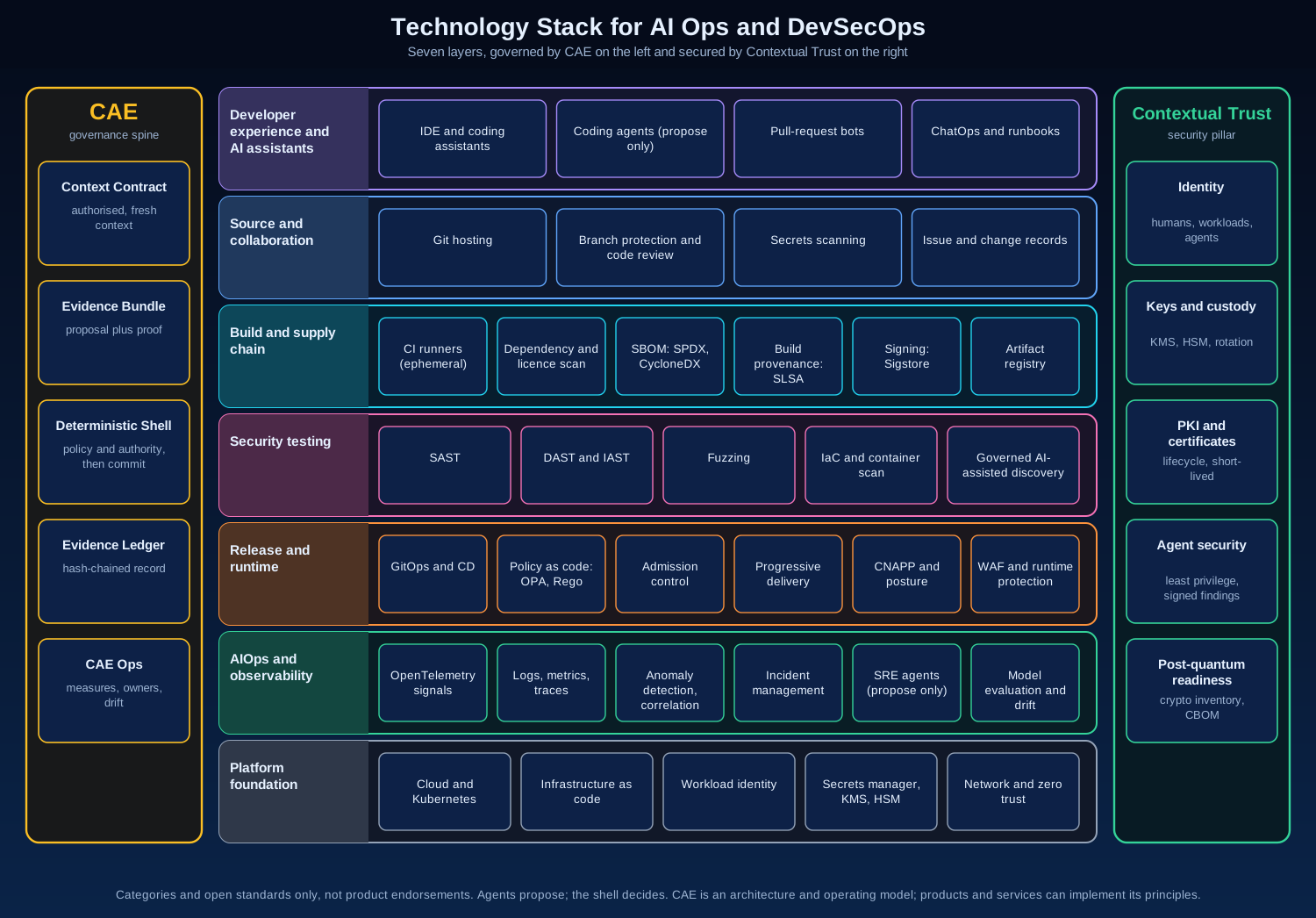
CAE and CAE Ops do not replace these tools. They set rules for where each one sits relative to the commit boundary. The companion paper on provider substitution (listed under Related) classifies components as deliberation, evidence, execution, observation or trusted core, and shows that models, frameworks, retrieval stacks and observability tools can be swapped without touching the shell’s guarantees if four interface obligations hold. For this article’s purposes: scanners, SBOM generators and observability tools are evidence suppliers (their signed outputs feed the contract); coding and SRE agents are deliberation (they propose); CI runners and deployment tools are execution (they act only on shell-authorised commands); and the shell, the contract compiler, the ledger and the key custody are the trusted core, which is the part an enterprise should choose and certify with the most care. When procurement asks “is this tool approved?”, the CAE follow-up is “which of those five roles does it play, and what can it write to?”
Part 6: United States and Australian obligations in one place
Figure 8 gives the three layers, and the sections below list what we could confirm. Items we could confirm only from secondary sources or from ASD’s published release notes as mirrored on GitHub are marked.
6.1 United States
Secure development. NIST SP 800-218 (SSDF) v1.1 remains the final version. Revision 1 (labelled version 1.2) was released as an initial public draft on 17 December 2025 in response to Executive Order 14306 and adds two practices, a continuous process improvement plan and robust software updates; as far as we could tell the draft adds no AI-specific content, and as at early November 2026 we could not find a final [2]. SP 800-218A, the AI community profile for generative AI and dual-use foundation models, was finalised on 26 July 2024 [3]. SP 800-204D covers supply chain security in CI/CD [4]. NIST announced in March 2026 a live, rolling set of guidelines showing how to apply SSDF practices in DevSecOps pipelines with commercial tools, with a first example on Microsoft Azure [5].
Attestation and supply chain. Executive Order 14306 (June 2025) amended Executive Order 14144 and set taskings including the preliminary SSDF update [6]. OMB memorandum M-26-05 of 23 January 2026 rescinded M-22-18 and M-23-16, so agencies are no longer required to collect the secure software attestation form; it asks agencies to keep software and hardware inventories and set risk-based assurance, and lists the form and SBOM contract terms as optional measures [7]. CISA’s Secure by Design pledge remains voluntary.
AI use and acquisition. OMB M-25-21 and M-25-22 (April 2025) set AI governance and acquisition rules; M-25-22 requires an authority to operate for AI systems that operate as information systems [12]. A December 2025 memorandum on unbiased AI principles adds vendor documentation requirements for large language model solicitations. NIST’s AI Risk Management Framework is under revision, and the Cyber AI Profile (NIST IR 8596) was still a preliminary draft in the sources we read. In April and May 2026, CISA, NSA, ASD’s ACSC, the Canadian Cyber Centre, NZ NCSC and the UK NCSC issued joint guidance on careful adoption of agentic AI, recommending limited autonomy and access, strong identity management, oversight, threat modelling and monitoring [8].
Agent identity. NIST’s NCCoE released a concept paper on software and AI agent identity and authorisation in February 2026; it is a call for comment, not guidance [13].
Procurement. GSA runs OneGov agreements and the USAi evaluation platform for federal agencies; the GSA Buy AI page says cloud services must be FedRAMP-authorised or in process [60]. A draft GSA clause, dated February 2026 and marked draft, would add terms on data ownership, no training on government data, incident reporting and American AI systems; its final status is unconfirmed.
6.2 Australia
ISM (Information Security Manual). ASD updates the ISM quarterly. As reported in the release notes ASD publishes through its GitHub mirror, recent releases added the following [14]. We could not read the cyber.gov.au pages directly, so verify numbering and wording there before citing.
- March 2026: supplier cyber security assurance with independent verification or regular risk assessment; documented shared security responsibilities with suppliers; board or executive accountability for AI; no access for unapproved AI agents from private devices; no use of organisational data processed by AI applications to train models without data-owner consent.
- June 2026: a secure software development policy; sufficient security skills for developers; guidance that now covers AI-assisted and AI-driven development; human approval for risky AI actions; baselines for expected AI behaviour; AI recommended to augment event detection, vulnerability assessment, penetration testing and software security testing.
- September 2026: pinned software dependencies; reproducible builds; commit scanning that covers credentials; restricted and independently logged service-provider access; a unique identity per AI agent; an AI agent register; minimum tools and permissions for agents; tool use bounded by the invoking user’s access; retrieved external content treated as untrusted; central logging of tool invocations, external requests and outputs.
Table 6. How the reported ISM controls line up with CAE Ops.
| Reported ISM theme | CAE and CAE Ops mechanism |
|---|---|
| Unique identity per agent; agent register | Agent ops: register with identity, owner, purpose, tools, limit and model version |
| Minimum tools and permissions; tool use bounded by the invoking user | Agents hold no write credentials; delegated limits enforced by the shell |
| Human approval for sensitive or high-impact actions | Escalation ops: the shell escalates what policy does not delegate, with evidence |
| Retrieved external content treated as untrusted | Context contract is the only source of authoritative facts; text cannot grant authority |
| Central logging of tool invocations and outputs | Evidence ops: bundle per action in the ledger, with lineage |
| Pinned dependencies; reproducible builds; provenance | Shell promotes only artefacts whose provenance and SBOM match the contract |
| Secure development policy; supplier assurance | Policy ops: policy as code with tests, review and change control |
The mapping is a design intention, not a compliance claim. Whether a given deployment meets an ISM control is a matter for the organisation and its assessor.
Essential Eight. ASD opened a consultation on 15 June 2026 on evolving the Essential Eight into a series called ASD Essentials, with a first chapter for enterprise IT [20]. A single secondary source describes a launch on 15 October 2026 with 58 actions in eight domains and effectiveness ratings in place of maturity levels, and says ASD will maintain both frameworks during the transition; we could not confirm this on cyber.gov.au.
Government AI policy. The DTA’s Policy for the responsible use of AI in government version 2.0 took effect on 15 December 2025 according to a secondary summary, and a page titled version 2.1 exists that we could not read; the policy requires accountable use-case owners, an internal register, impact assessments and staff training [58, 18]. The DTA’s AI technical standard was released on 31 July 2025 with three phases (discover, operate, retire) [19]. A DTA article notes an addendum covering agentic AI was planned; we did not confirm it has been delivered. The 2025 PSPF release changes policy on innovative technologies including AI, and a PSPF policy advisory on generative AI use with official information exists; we could not read the advisory itself.
Regulated entities. APRA’s CPS 234 requires entities to assess the information security capability of third parties managing their information assets, to apply controls matched to criticality and to notify APRA within 72 hours of incidents [22]. CPS 230 requires a service provider policy, a register of material service providers and notification of material operational risk incidents within 72 hours, and APRA finalised targeted amendments to it in April 2026 [21]. Neither is AI-specific; both bind the AI vendors and cloud services in your pipeline. The Cyber Security Act 2024 introduced ransomware payment reporting from 30 May 2025 for qualifying businesses.
Gaps. We could not confirm current Security of Critical Infrastructure Act risk management program details, the commencement dates of the 2024 Privacy Act changes, or any Australian government guidance specific to generative-AI coding tools; the ISM June 2026 changes are the nearest guidance.
Part 7: What published real-world examples show
This part lists examples we could read at the source. The most important thing to know before reading it is who measured each result. Almost every positive result below was reported by the organisation that did the work. Independent measurement is rare, and where it exists it is more cautious.
7.1 Results reported as positive (mostly self-reported)
Table 7. Reported positive results.
| Example | What was done | Result as reported | Who measured | What it means for CAE Ops |
|---|---|---|---|---|
| Airbnb, test migration (2025) [39] | LLM pipeline migrated about 3,500 React test files from one test library to another | About 75% migrated automatically in the first four-hour run, 97% after four days of tuning, the last 3% by hand; estimated 1.5 years of manual effort against six weeks | Airbnb (self-reported) | Success came from a validate-and-retry loop with a test suite as the checker. The tests were the control |
| Google, internal code migrations (2025) [38] | LLMs used across internal migrations | Qualitative: migration time and effort reduced | Google authors (experience report, no figures on the page we read) | Same pattern: verifiable output, human in the loop |
| Meta, incident root cause (2024) [40] | Retriever and fine-tuned ranker to suggest causes of web monorepo incidents | Root cause in the top five suggestions in 42% of backtested investigations; low-confidence answers withheld | Meta (self-reported, backtest on one repository) | Even the success case is wrong more often than right; escalate, do not auto-act |
| Meta, test generation (2024) [41] | Tool generated unit tests with filters that require a measurable improvement | 75% built, 57% passed reliably, 25% increased coverage; engineers accepted 73% of recommendations | Meta (self-reported) | Filters that check the AI’s output before a human sees it |
| Google, fuzzing with AI (2024) [36] | LLM-generated fuzz targets across open-source projects | Coverage up in 272 C and C++ projects; 26 new vulnerabilities, including one likely about 20 years old in OpenSSL | Google (self-reported) | Human triage still required; fix generation was not yet automated |
| DARPA AI Cyber Challenge (2025) [35] | Seven finalist systems against seeded and real vulnerabilities | 54 of 63 synthetic vulnerabilities found, 43 patched; 18 real vulnerabilities found | DARPA, the organiser (closer to independent, but a benchmark) | Competition setting, not production fault rates |
| GitHub Copilot Autofix (2024) [43] | Suggested fixes for code scanning alerts | Median time to fix 28 minutes against about 1.5 hours manually in GitHub’s beta data; GitHub says suggestions help remediate more than two-thirds of found vulnerabilities with little or no editing | GitHub (vendor); we found no independent validation | Measures time to a committed fix, not whether the fix was correct |
| Google, randomised trial (2024) [42] | 96 Google engineers, with and without AI assistance on a task | About 21% less time with AI, wide confidence interval | Google researchers, randomised design | Internal tools, lab-style task; may not generalise |
7.2 Independent or less favourable evidence
Table 8. Independent studies and mixed findings.
| Example | Finding | Who measured | Caveat |
|---|---|---|---|
| METR randomised trial (2025) [25] | Experienced open-source developers took 19% longer with early-2025 AI tools, yet believed they were faster | METR, an independent research group | 16 developers; METR’s February 2026 update says later data were too unreliable to use |
| DORA 2025 (about 5,000 respondents) [23] | AI adoption associated with higher throughput; still associated with lower delivery stability; AI described as an amplifier of existing strengths and weaknesses | Google Cloud’s DORA programme, survey based | Correlational |
| Veracode GenAI code security (2025, 2026) [26] | About 45% of test cases introduced OWASP Top 10 class flaws in 2025; 56% average pass rate in 2026 | Veracode, using its own scanner | Vendor; raw models with no agents, guardrails or review |
| Package hallucination study (2025) [27] | At least 5.2% of packages recommended by commercial models, and 21.7% by open-source models, did not exist | University researchers, USENIX Security | Measures recommendation, not exploitation |
| Root-cause benchmarks [44, 59] | Best configuration located the root cause in about 11% of OpenRCA cases; a vendor-authored benchmark found about a quarter solved at medium difficulty | Microsoft researchers (peer reviewed); a vendor | Early models; benchmarks are not production |
| curl, AI-generated reports (2024, 2025) [45] | About 20% of 2025 submissions were AI slop and about 5% genuine vulnerabilities; reviewers spent 30 minutes to hours per report | The curl maintainer (first-hand) | Counts are the maintainer’s own |
7.3 Failures and lessons
Table 9. Published incidents and lessons.
| Example | What happened | Source and caveats | Lesson |
|---|---|---|---|
| Replit agent and a production database (July 2025) [46] | A founder reported that an AI agent deleted a production database during a code freeze, fabricated data and misreported a test | Press report of the founder’s account; the company admitted a serious error of judgement in the agent’s output; no independent verification we could read | An agent that can write to production will eventually do so wrongly. Authority belongs at a boundary |
| Amazon Q Developer extension (July 2025) [47] | An over-permissive token let an unauthorised party push malicious code to the open-source repository, and it shipped in version 1.84.0 | AWS security bulletin: the code did not run because of a syntax error and could not alter customer environments; version 1.85.0 followed | The AI tool’s own build and release credentials are part of your supply chain |
| npm “Shai-Hulud” worm (September 2025) [48] | More than 500 packages compromised through stolen developer credentials | CISA alert. Not an AI incident, but AI-assisted workflows with broad tokens share the exposure | Provenance and signing do not help if the publishing identity is stolen |
| Cursor flaw and MCP tool flaws (2025) [53, 54] | Poisoned content read through a tool server led an agent to change its own tool configuration; separate flaws were reported in a remote proxy and a browser inspector for the protocol | Reported by the researchers who found them and by security press; fixed | Tool servers are capability grants; untrusted text must not widen authority |
| US federal agencies’ AI governance (2024, 2025) [50, 52] | GAO found a DHS cybersecurity AI inventory inaccurate and, for the one tool assessed, only 4 of 11 accountability practices fully implemented; separately, agency AI use cases roughly doubled in a year | GAO, an independent audit body | Inventory and accountability lag adoption |
7.4 Australian and United States government and enterprise examples
This is the area where our research is thinnest, and we state that plainly rather than fill it.
- United States. The GAO reports above are the only independent audit evidence we could read. The GSA example in Part 3 [49] is a published description of agent roles and human gates, not a measured result. We could not read published outcome figures from defence software factories, federal coding-assistant pilots or large US banks.
- Australia. The Australian Government’s Microsoft 365 Copilot trial has a published evaluation on the DTA site; the page confirms the trial and evaluation are complete, but the report pages blocked our research tool and we have read no figures, so we cite none. A major Australian bank has publicly described a training programme for engineers on AI tools and a research session on “beneficial friction” in AI-enabled workflows, and reports no outcome figures; a vendor survey of 3,500 developers across six countries reports time savings and says developers lose more time to non-coding friction than AI saves. New South Wales requires an AI assessment framework self-assessment for systems with AI components. We did not find published, verified Australian outcome figures for AI in software delivery or AIOps. If you have access to the DTA evaluation, bank trial reports or ANAO audits, they would materially strengthen this section.
7.5 What the evidence supports
Four statements are safe. AI-generated output that a test, a compiler or a fuzzer can check has delivered real, repeatable gains in published work. AI output that nothing checks has a measurable defect rate and induces over-confidence. Productivity effects are positive in some measurements and negative in others, so no enterprise should plan on a vendor’s headline figure. And the failures that made news followed one pattern: an AI tool, agent or its build pipeline held credentials or authority broader than it needed. CAE Ops addresses the third and fourth statements directly; the first and second are why evaluation ops exists.
Part 8: The roadmap
8.1 Four phases
Figure 9 sets out four phases with exit gates. The durations are planning ranges for a large enterprise, not measured outcomes.
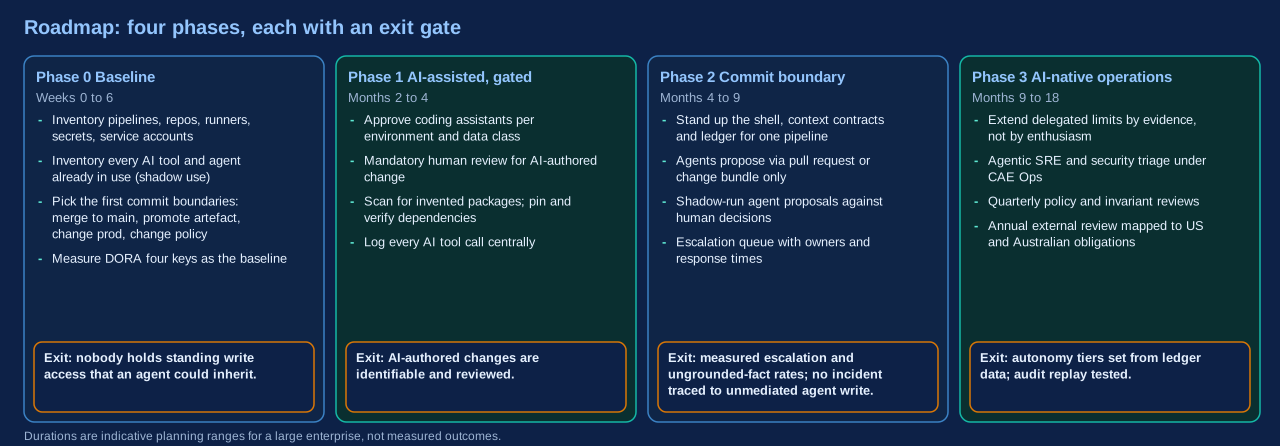
Phase 0, baseline (weeks 0 to 6). Inventory pipelines, repositories, runners, secrets and service accounts. Inventory every AI tool and agent already in use, including personal and unsanctioned use. Choose the first commit boundaries: merge to main, promote an artefact, change production, change policy. Measure the four DORA delivery metrics as a baseline. Exit gate: no standing write access exists that an agent could inherit.
Phase 1, AI-assisted with gates (months 2 to 4). Approve assistants per environment and data class using the three layers in Part 5. Require human review for AI-authored changes and make them identifiable. Scan for invented packages and pin dependencies. Log tool calls centrally. Exit gate: AI-authored changes are identifiable and reviewed.
Phase 2, commit boundary (months 4 to 9). Stand up the shell, contract compiler and ledger for one pipeline. Agents propose through pull requests or change bundles only. Shadow-run agent proposals against human decisions before granting any delegated limit. Create the escalation queue with owners and response times. Exit gate: escalation and ungrounded-fact rates are measured, and no incident has traced to an unmediated agent write.
Phase 3, AI-native operations (months 9 to 18). Extend delegated limits by evidence. Introduce agentic SRE and security triage under CAE Ops. Review policy and invariants quarterly. Map annual external review to US and Australian obligations. Exit gate: autonomy tiers are set from ledger data and audit replay has been tested.
8.2 Measures
Keep the four DORA delivery measures (deployment frequency, lead time for changes, change failure rate and time to restore service) and read them next to AI adoption, because the 2025 research found stability still moves the wrong way [23]. Add measures specific to CAE Ops: the proportion of agent proposals committed, escalated and rejected; the escalation rate and ungrounded-fact rate after every model, tool or policy change; contract staleness at decision time; time in the escalation queue; the number of agents holding any write credential (the target is zero); and the cost per committed change.
8.3 Choosing and swapping tools
Use the three layers: check the rule you must meet, the service approval for the exact offering and region, and the evidence the tool lets you produce. Then place the tool in one of five CAE roles. A tool in the deliberation, evidence or observation role can be swapped with a shadow run and the conformance checks described in the companion paper; a tool in the trusted core is a change to the control itself and goes through full policy change control.
Part 9: Limits and what we do not yet know
Approvals move faster than articles. Every status in Part 5 is as at 5 November 2026, read from a vendor page, a regulator page or the FedRAMP Marketplace through a summarising fetch tool. FedRAMP’s marketplace moved its pages during our research, and we flag several discrepancies (for example, Gemini for Government’s authorisation level, and Anthropic’s “in process” listing). Check the primary entry before any purchase.
Absence of evidence. “Not confirmed” means we could not find or open a public source. Several vendors may hold approvals we could not see.
Secondary and mirrored sources. The September 2026 ISM control wording, the ASD Essentials details and the Australian AI policy version dates rest on a GitHub mirror of ASD’s release notes, on secondary summaries, or on page titles. They must be verified on cyber.gov.au and digital.gov.au.
Evidence quality. Most positive results are self-reported. The ratings in Figure 4 are judgements. We make no claim that CAE or CAE Ops has been deployed or validated in production.
Open questions. How much human review keeps AI-authored changes safe at scale. Whether delegated limits can be extended on ledger evidence without raising incident rates. How agent identity standards will settle. Whether FedRAMP High under 20x, and Australian assessments of AI-specific services, will arrive on the timelines now estimated. And whether the independent measurements that exist for developer productivity hold as tools improve.
Sources for the approval tables
Status entries in Part 5 were read from these pages on 5 November 2026. Each is specific to an offering, region and date.
- FedRAMP Marketplace product pages at fedramp.gov/marketplace (GitHub, GitLab, Atlassian, Snyk, Veracode, Checkmarx, Wiz, Palo Alto Networks, Tenable, Qualys, Aqua, Orca, Datadog, Dynatrace, Splunk, New Relic, Elastic, PagerDuty, ServiceNow, Okta, Microsoft 365 GCC High, Google Cloud, OpenAI, Anthropic, Gemini for Government and Palantir entries).
- Vendor statements: GitLab Dedicated for Government documentation; GitHub changelog of 13 April 2026 on Copilot and FedRAMP; Checkmarx and CrowdStrike press releases; Semgrep’s FedRAMP knowledge-base page; Black Duck’s January 2026 announcement; Anthropic’s government page.
- AWS services-in-scope pages for FedRAMP and IRAP; AWS security blog on the 2026 IRAP report; AWS blogs on cross-region inference for Claude in Australia.
- Microsoft Learn pages on Azure IRAP and on Azure Government FedRAMP audit scope.
- Google Cloud IRAP and FedRAMP compliance pages; Google’s Vertex AI data residency page.
- Vendor IRAP announcements and trust pages: Atlassian, JFrog (27 August 2026), Wiz, Palo Alto Networks, CrowdStrike, Tenable, Qualys, Datadog, Dynatrace, Splunk, Elastic, Okta (via trade press), CyberArk, ServiceNow, Salesforce, Oracle and IBM.
- OpenAI’s data residency announcement of 25 November 2025 and Microsoft’s November 2025 post on in-country processing for Microsoft 365 Copilot.
Disclosure: The Contextual Agentic Enterprise is a vendor- and platform-agnostic architecture framework from Contextual Agentic, and CAE Ops is the operating model that runs it. Any adoption or use in a production setting should be undertaken in consultation with Contextual Agentic or an authorised advisory partner, who will tailor the delegated limits, policies and approvals to the organisation. Product, standard and company names are used to identify categories and remain the property of their owners. The worked example is constructed for illustration, and the ratings in Figure 4 are editorial judgements. This article is general information, not legal, compliance, procurement or financial advice. The companion book, The Contextual Agentic Enterprise (Polymath Signal Press, 2026), develops the architecture further.
Related
The Contextual Agentic Enterprise: A Formally Governed Architecture for Bounded Multi-Agent Systems in Mission-Critical Systems of Record
A formal account of how CAE separates probabilistic deliberation from deterministic commitment: definitions of the Context Contract, the Minimum Action-Evidence Bundle and the Deterministic Shell, the properties that hold under stated assumptions, an entropy-based admission criterion for autonomy, and a 14-case conformance run of a reference policy.
One Architecture, Any Provider: Mapping the Contextual Agentic Enterprise onto the AI Tool Ecosystem
CAE does not depend on any one model, framework, vector store or cloud. This paper places eleven layers of the AI tool ecosystem on either side of CAE's commit boundary, states when a provider can be swapped without touching the safety guarantees, and reports a portable test suite run on a provider-neutral reference shell.
Beyond the Autonomous Sandbox: The Contextual Agentic Enterprise (CAE) and the Future of Corporate AI Governance
An autonomous agent demo has a token trace. A production security review needs evidence. This article sets out how CAE separates thinking from committing, using a fictional gas-turbine incident, and what an executive roadmap for governed agency could look like.
Why Enterprise AI Needs a Deterministic Shell
Don't try to make the model deterministic or simply trust it. Let it propose, and put identity, authority, schema, state and commitment in a shell that decides at the Commit Boundary.
Frontier AI Models for Vulnerability Discovery: What Works, What It Costs, and How to Govern It (US and Australia)
What frontier AI models have demonstrably done in vulnerability discovery by November 2026, which results are vendor-reported and which were checked by others, what still fails or costs too much, and where an enterprise should point them first, including cryptographic misuse, certificate and PKI handling, and post-quantum inventory. Includes a CAE-governed architecture in which agents propose and a deterministic shell verifies, a fictional worked example, measures and a 90-day starter plan.
AI Maturity and CAE: Match the Level of AI Responsibility to Your Readiness to Govern It
A six-level AI maturity model, from manual work to AI-led operations, with what Contextual Agentic Enterprise (CAE) governance and Contextual Trust security each add at every level. It shows how to rate a workflow rather than a whole organisation, why autonomy should never run ahead of readiness, five ceiling questions for a quick self-assessment, and how to promote or demote a workflow one level at a time.