Bring the Agent to the Meeting, Not to the Decision
Almost everyone uses AI alone; almost nobody uses it with their team. Before, during and after a meeting it can coach, challenge and analyse. It can't be the decider, and the record should say who was.
Written as at 16 August 2026.
teamworkai-adoptionleadershipdecision-recordsplaybook
Try this at your next leadership offsite. Ask the room who uses AI several times a day at work: nearly every hand goes up. Ask who uses it with their team, in meetings and workshops: most hands come down. Then ask whose days are mostly meetings.
Gabriele Rosani and Elisa Farri describe running exactly that exercise with 200 senior managers, in a recent Harvard Business Review article, and getting exactly that result. They cite Capgemini research finding that only 7% of managers and leaders actively use AI in team settings. AI has arrived in the enterprise one person, one screen and one task at a time, while most of the work that matters still happens in groups.
Their article is a practical guide to closing that gap, and I recommend it. Here I want to add what the enterprise architecture view contributes: what goes into the meeting with the AI, what comes out, and the one role the AI must never be given.
The arc of teamwork
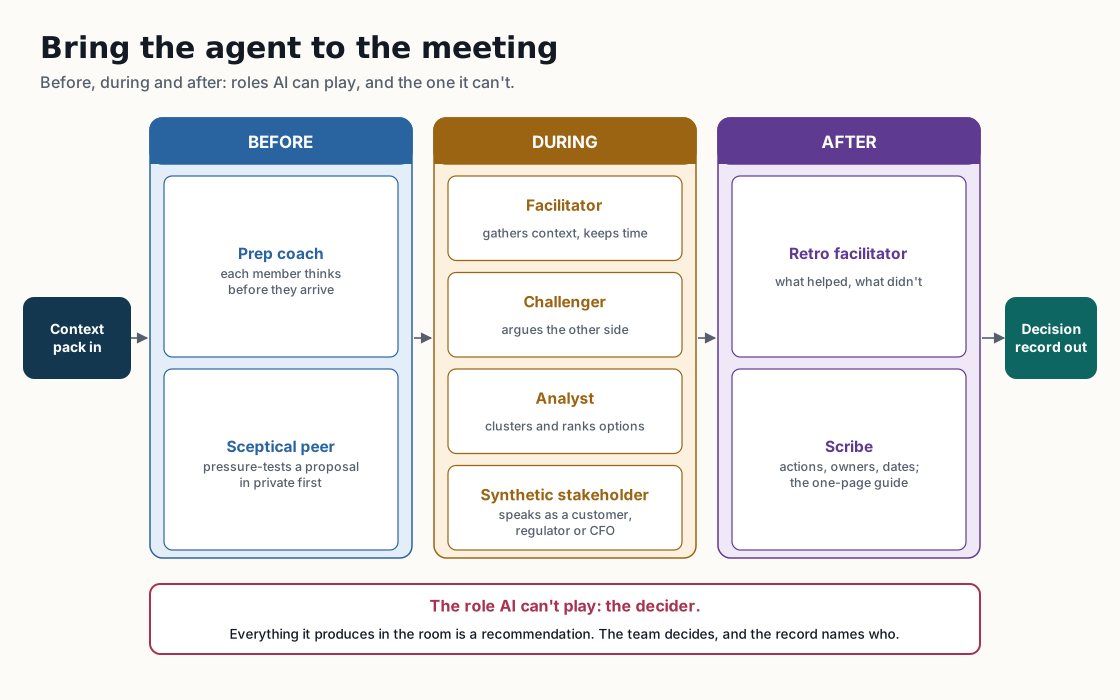
Rosani and Farri make the point that teamwork doesn’t only happen in the room: it starts with preparation and ends with follow-up. Their examples map well onto three phases.
Before. Pre-reads are skimmed and pre-work is usually template-filling. AI can turn preparation into thinking. One of their examples is a CFO who gave each leader a prompt that coached them to translate an abstract culture shift into concrete behaviours, so everyone arrived with specifics. Another team gave each participant an AI acting as a sceptical peer to pressure-test their recommendations in private before a quarterly review.
During. Group discussions converge too early, stay inside familiar assumptions and defer to the most senior voice. The authors describe an AI moving through a sequence of roles in a breakout: gathering context as a facilitator, challenging from the CEO’s perspective, clustering and ranking as an analyst, then helping shape the pitch. A synthetic stakeholder, the AI speaking as a described customer, regulator or finance director, is one of the cheapest ways to bring a missing perspective into the room.
After. Teams skip retrospectives because the next thing is already urgent. An AI facilitator can run a structured one in half an hour and turn the lessons into a one-page guide for the next time.
Their two conditions for making any of this work are intentionality (the leader decides deliberately to change how the team works, and keeps doing it) and craft (roles, steps and prompts designed in advance rather than an AI dropped into the conversation on the fly). Their cautionary example is a team that asked an AI for extra ideas at the end of a brainstorm with no context and no designed prompt, got nothing useful, and concluded that the technology wasn’t ready. It was the craft that wasn’t ready.
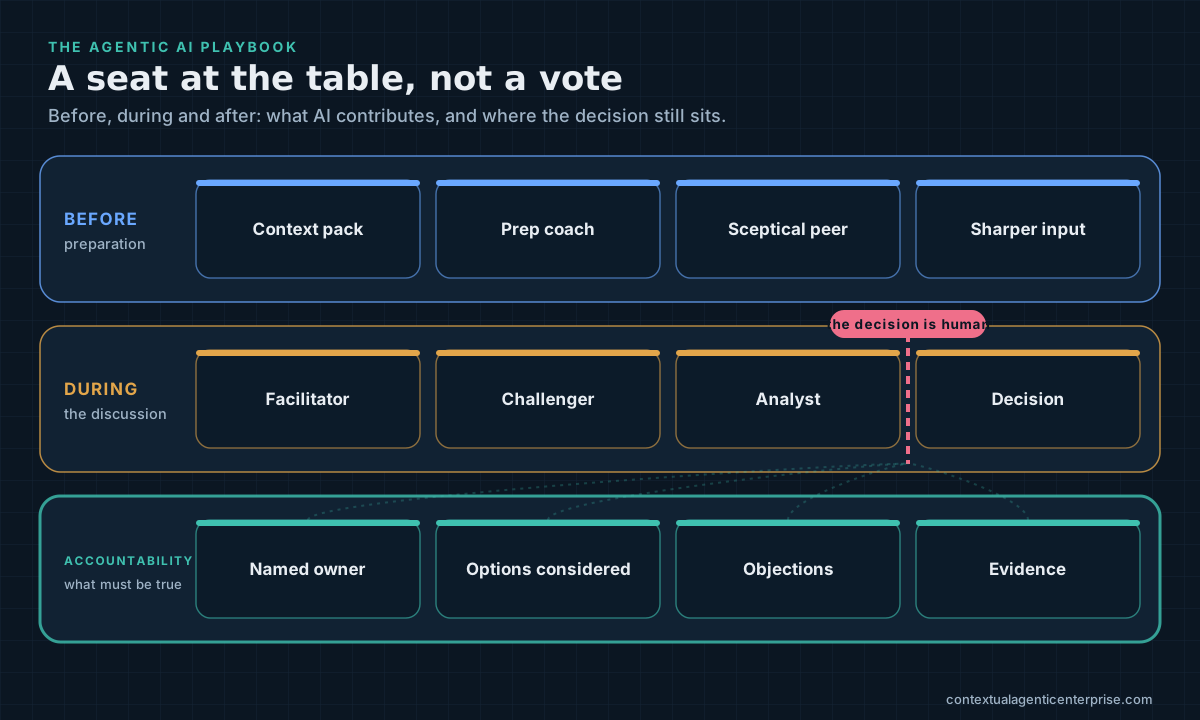
What goes in: a context pack
Craft, in architectural terms, is mostly context. An AI in a meeting is only as useful as what it knows about the decision in front of it, and “what it knows” is usually whatever someone pasted into a chat window five minutes before.
Treat it the way you would treat a briefing for a new senior colleague joining the meeting. Assemble a context pack:
- the decision to be made, stated in one sentence;
- the options already on the table;
- the facts that matter, with sources: figures, constraints, prior decisions;
- what is out of scope, so the AI doesn’t drift;
- which roles you want the AI to play, and in what order;
- the data classification of everything in the pack, so nothing goes into a tool that shouldn’t hold it.
A context pack takes an hour to prepare the first time and ten minutes after that. It is the difference between an AI that produces generic observations and one that challenges this plan. It also means the AI’s contribution can be reproduced and checked later, because you know exactly what it was given.
What comes out: a decision record
Meetings produce two things: decisions and the reasons for them. The first is usually captured, in minutes or an email. The second is usually lost.
When AI has been in the room, this matters more, not less. Six months from now someone will ask why the team chose option B. If the honest answer is “the AI’s analysis ranked it first”, you have a governance problem: nobody can reconstruct the analysis or say who agreed with it.
So close the arc with a decision record: the decision, the owner, the options considered, the evidence used (including what the AI contributed and from which context pack), the objections raised and how each was handled. The AI is an excellent scribe for this; it just shouldn’t be the author of the conclusion.
The role AI can’t play
In every one of the roles in the figure — coach, peer, facilitator, challenger, analyst, synthetic stakeholder, scribe — the AI produces a recommendation. None of them is the decider, and that is deliberate.
It’s tempting in a meeting to let a well-argued AI ranking settle a disagreement. It feels objective and it saves an awkward conversation. But the AI’s ranking reflects its context pack, its prompt and its model, none of which the room has examined. A decision made that way has no owner, and a decision with no owner will not be defended when it gets hard or corrected when it turns out wrong.
This is the same principle as the commit boundary for agents that act on systems: the AI proposes, and something accountable commits. In a meeting, that something is a named person, and the decision record says who.
What to do this quarter
Team leads: pick one recurring meeting, such as a quarterly review or a project gate, and redesign it once with AI in two roles: a sceptical peer before the meeting and a challenger during it. Prepare a context pack. Close with a decision record. Then run it the same way next time; the HBR authors are right that one experiment isn’t enough.
Transformation leads: start measuring team use of AI, not just individual use. “How many of our recurring decision meetings use AI in a designed role?” is a better adoption metric than licences activated.
Risk and data teams: publish a simple rule for what may go into a meeting context pack, by data classification and by tool, so teams can prepare one without having to ask.
The prize is not faster meetings. It’s better-prepared people, harder questions asked earlier, and decisions that someone owns and can explain.
References
- Rosani, G. and Farri, E. (2026) 'AI Can Enhance Every Stage of Teamwork—Under Two Conditions', Harvard Business Review, 7 September. https://hbr.org/2026/09/ai-can-enhance-every-stage-of-teamwork-under-two-conditions
- Capgemini Research Institute (2026) Generative AI in decision-making, research brief. https://www.capgemini.com/wp-content/uploads/2026/01/Final-Web-Version-Research-Brief-Gen-AI-in-Decision-Making.pdf
- The Contextual Agentic Enterprise, Chapters 5 and 16.
Related
Safety by Proxy: What an Anonymous AI Memo Tells a Leader
When people use AI to voice objections they won't raise in the room, the memo is a measurement of your culture. The response is a better route for dissent, and a record that keeps it.
Context Is Not a Prompt: Introducing the Context Contract
Most context failures are not retrieval misses. They are correct material given to the wrong purpose. A Context Contract declares, versions and tests what an agent may know.
Evidence-First Decision Records: Reconstructing What the Agent Knew
A model's explanation is not an audit record, and logs are not a reconstruction. An Evidence-First Decision Record keeps claims, evidence and versions retrievable long after everything has changed.