Safety by Proxy: What an Anonymous AI Memo Tells a Leader
When people use AI to voice objections they won't raise in the room, the memo is a measurement of your culture. The response is a better route for dissent, and a record that keeps it.
Written as at 15 August 2026.
psychological-safetyleadershipdecision-recordsai-adoptionplaybook
Illustrative scenario: a fictional composite written to make the point concrete. It does not describe a real organisation, and its figures are not reported outcomes.
Picture a leader who has spent six months building the case for a regional expansion. The data supports it, the executive team has approved it, and the plan is announced to the team. Two days later a document starts circulating. Someone asked an AI tool for the strongest case for the expansion and the strongest case against, and forwarded the result without a name. The case against lists a crowded market, a customer base smaller than the plan assumes, and partnerships that haven’t been signed. The leader had seen every one of those risks. Now they are in writing, in circulation, and nobody will say who started it.
A scenario much like this opens a thoughtful September piece in Harvard Business Review, which gives the phenomenon a name: safety by proxy. People use AI’s perceived neutrality to surface a concern they don’t feel safe raising themselves. The authors are clear that it is a substitution, not a solution, and that the workaround is worth reading as a signal about what your culture has not yet made safe to say.
I want to take their idea one step further, into the machinery of how decisions are made and recorded, because that is where a leader can actually change the outcome.
Four ways the proxy shows up
The HBR authors describe four patterns, and they are worth knowing because each calls for a different response.
- Workaround. Where speaking up feels costly, the concern enters the room through the AI and the person stays out of sight. The authors cite a 2026 study of board directors in which AI’s perceived neutrality let criticism surface that would otherwise have been suppressed.
- Equaliser. Where safety is uneven, AI helps the people with the least of it: a newer colleague, someone working in a second language, an expert outside their own field. It helps them put a concern precisely and neutrally.
- Testing space. Where a culture is improving but not there yet, people rehearse an argument with AI before risking it in public.
- Mirror. Power suppresses honest input; that is one of the oldest findings in management research. A leader who asks AI for the strongest objections to their own plan gets input their position makes hard to hear from people.
The first is a warning. The second and third are useful and worth encouraging. The fourth is a discipline every leader should adopt.
Two routes for the same concern
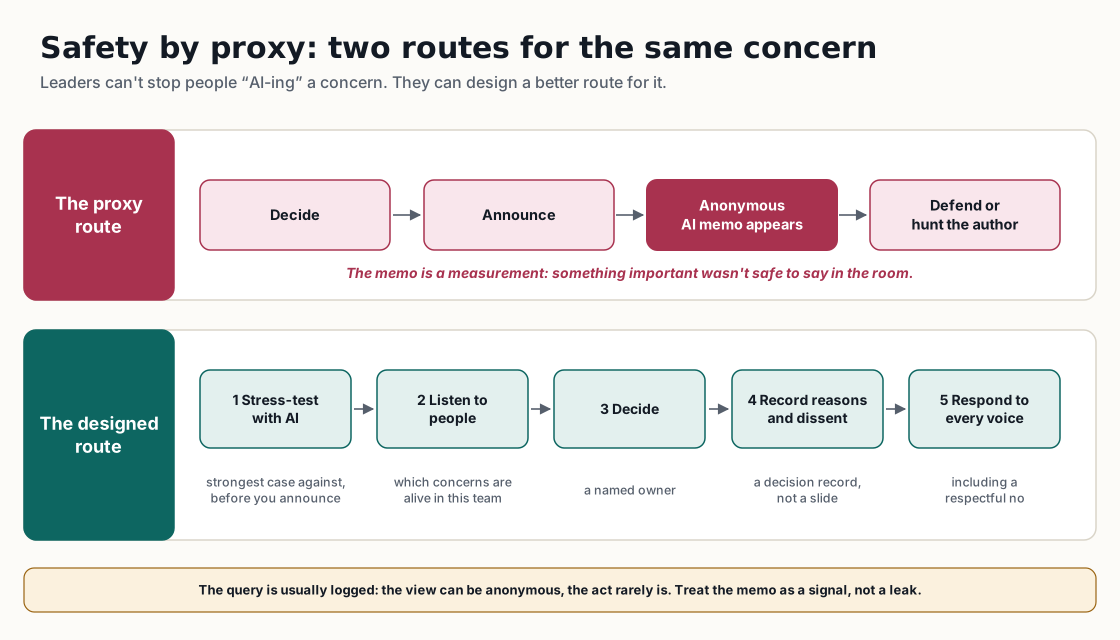
The top lane is the sequence most organisations still run: decide, announce, react. In that sequence, an anonymous AI memo is the only channel left for dissent that arrives after the decision. The leader’s choice is then to defend the decision or to hunt for the author, and either response confirms the conditions that produced the memo.
The bottom lane is the sequence the HBR authors recommend, and I would add one step to it.
1. Stress-test with AI before you announce. Ask the questions your team would ask: What is the strongest case against? Which assumptions haven’t been tested? What would a sceptical customer, regulator or CFO say? Give the AI your real context, because a generic tool surfaces generic risks.
2. Listen to people. AI can name categories of concern. Only conversation tells you which ones are alive in this team, and why. Go in to hear, not to persuade.
3. Decide, with a named owner. A decision made after steps 1 and 2 is better informed, and it is still a human decision with a person accountable for it.
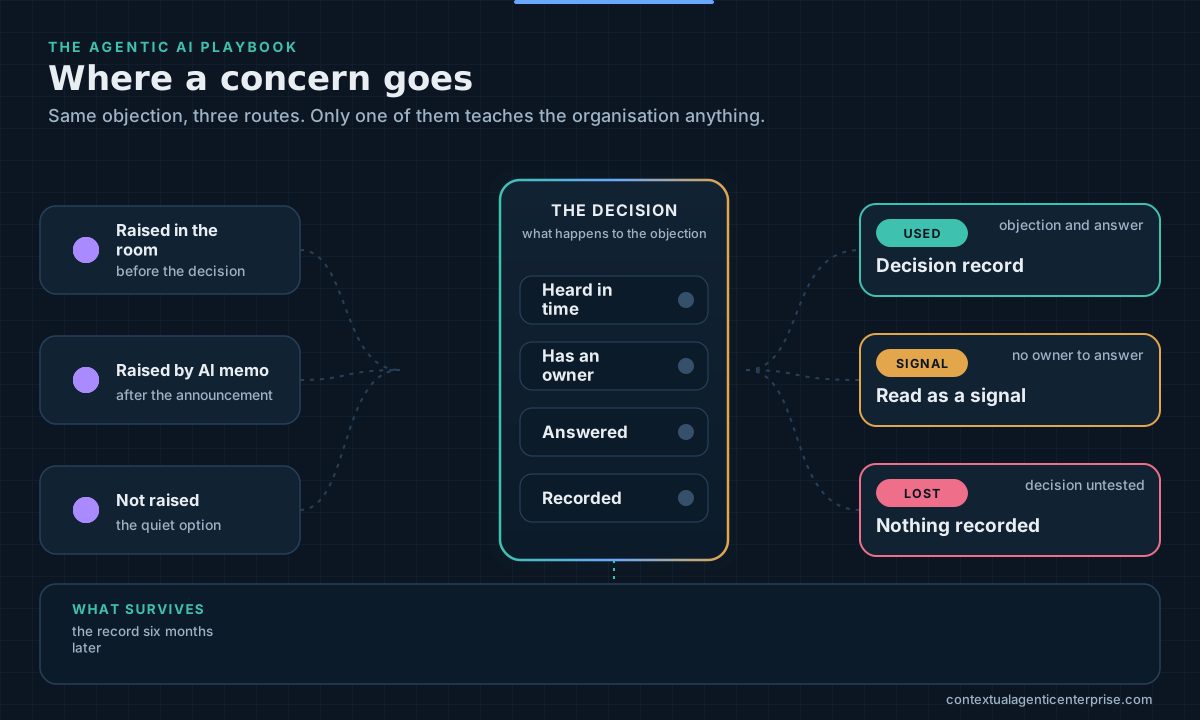
4. Record the reasons and the dissent. This is the step I would add. Write the decision down as a decision record, not a slide: what was decided, the options considered, the evidence used, the objections raised (including the AI-generated ones) and why each was accepted or set aside. In the book I call this an evidence-first decision record. The objections section is the important part: it’s where dissent becomes part of the organisation’s memory rather than a document forwarded without a name.
5. Respond to every voice. Acknowledge each concern, explain the reasoning, or change course. A respectful “no, and here is why” still builds safety, provided nobody is made to feel foolish for asking.
Why the record matters
Recording dissent sounds bureaucratic. In practice it changes three things.
It makes objection normal. When every significant decision record has an “objections considered” section, raising one is simply part of the process, not an act of disloyalty. A concern that has a place to go doesn’t need a proxy.
It separates the idea from the author. A written objection can be judged on its merits, which is the thing the anonymous memo was trying to achieve. The HBR authors also warn that the apparent neutrality of AI can be used to dress up self-interested resistance. A decision record handles that too: the objection is evaluated and answered in writing, whoever raised it.
It lets you learn. Six months later you can check which objections turned out to be right. That is the most useful feedback loop a leadership team can have, and it only works if the objections were written down at the time.
The act isn’t anonymous
One detail in the HBR piece deserves attention from anyone who runs an enterprise AI platform. Most platforms log who ran a query. The view in the memo may reach the room without a name, but the act of producing it usually leaves a trace in the system.
That creates a temptation, and it should be resisted in writing. If leaders can use AI platform logs to identify the author of an uncomfortable memo, people will stop using the proxy. They will also stop raising concerns at all, and you will have closed the one channel that was telling you something. Make it explicit policy that AI usage logs are for security and operations, not for tracing the source of dissent, and tell people you have done so.
What to do this quarter
Leaders: for your next significant decision, run the designed route. Ask AI for the strongest case against before you announce, hold one conversation to listen before you decide, and publish the decision record with its objections section.
HR and people teams: add a question to your engagement survey: “In the last three months, have you used AI to raise a concern you did not feel able to raise directly?” The trend matters more than the number.
Platform owners: write down who may access AI usage logs and for what, and exclude identifying the author of workplace concerns.
The HBR authors end by noting that AI’s perceived neutrality won’t last; as AI becomes part of how organisations work, people will stop seeing it as a neutral voice. The proxy is a temporary channel. A culture where concerns have a proper route, and a record that keeps them, is something you can build while it lasts.
References
- Harvard Business Review (2026) 'What Leaders Need to Know About AI and Psychological Safety', September. https://hbr.org/2026/09/what-leaders-need-to-know-about-ai-and-psychological-safety
- Edmondson, A. (1999) 'Psychological Safety and Learning Behavior in Work Teams', Administrative Science Quarterly, 44(2), pp. 350-383. https://doi.org/10.2307/2666999
- The Contextual Agentic Enterprise, Chapter 16.
Related
Evidence-First Decision Records: Reconstructing What the Agent Knew
A model's explanation is not an audit record, and logs are not a reconstruction. An Evidence-First Decision Record keeps claims, evidence and versions retrievable long after everything has changed.
Bring the Agent to the Meeting, Not to the Decision
Almost everyone uses AI alone; almost nobody uses it with their team. Before, during and after a meeting it can coach, challenge and analyse. It can't be the decider, and the record should say who was.
The Agentic AI Playbook: Five Rungs from Model to Governed Enterprise
LLM, RAG, agent, agentic system: every popular diagram stops at four rungs. The enterprise needs a fifth, where authority is checked before anything changes.