When an AI Stack Becomes an Action
A component stack tells you what runs. Follow one proposed action through context, authority, commitment and evidence to learn whether the system can act responsibly.
Written as at 7 November 2026.
agentic-aienterprise-architectureai-governanceagent-reliability
An architecture diagram can name every model, database and tool in an agent system. It can still leave one question unanswered: what lets the agent change a business record?
That question matters at the moment an answer becomes an action. A model may suggest a refund, an access change or a supplier payment. The system then needs to know who requested it, which rules apply, who may approve it, what exactly will change, and how the result can be checked.
The ten-layer CAE stack maps the jobs in a production system. This note follows one decision across those jobs. It is an action path, rather than another list of components.
The proposal must carry its context
Illustrative scenario: a fictional composite written to make the point concrete. It does not describe a real organisation, and its figures are not reported outcomes.
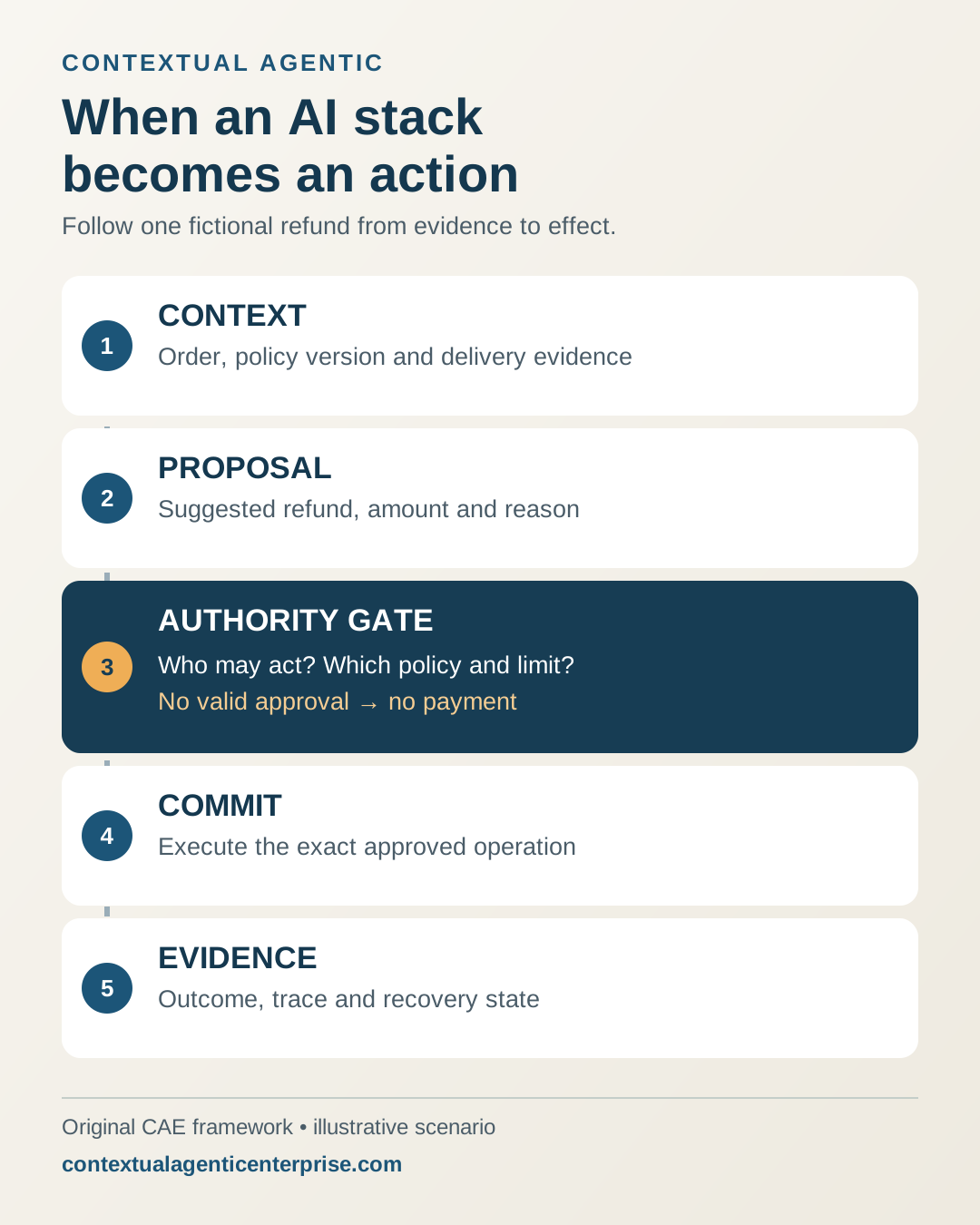
A customer asks for a refund after a delayed delivery. A support agent retrieves the order, current policy and delivery evidence. It drafts a proposed amount and reason. The retrieved policy is context for the proposal; it is not permission to pay.
The proposal should carry references to the order, the policy version, the evidence used and the identity of the person on whose behalf the agent is working. If a source is stale or disputed, the system should show that condition before an approver acts. This is a design recommendation, not a claim that every current platform implements it.
Authority must be checked at the action boundary
The Contextual Agentic Enterprise uses the Commit Boundary to name the point where a proposal would create an externally observable effect. Before the refund crosses it, a deterministic service checks the requested action, the acting principal, applicable policy, amount limit and any required approval. The model may explain the proposal; it does not grant its own authority.
This is consistent with OWASP’s excessive-agency guidance, which distinguishes excessive tool functionality, permissions and autonomy. It also recommends keeping actions within the user’s authorisation and the least privilege needed. A broad API credential attached to the agent would not answer who approved this particular refund.
For a low-risk case, a policy might permit an automatic decision within a narrow, auditable envelope. A disputed order, a changed bank destination or a higher amount might require a human reviewer. The actual thresholds and legal requirements depend on the organisation; the diagram does not prescribe them.
Commitment needs a result, including failure
Once authorised, the payment service executes the exact approved operation. The system needs a stable operation identifier so a retry does not silently pay twice. It should record whether the action succeeded, failed or needs reconciliation. If execution partially completes, the next step is an explicit recovery path, not another model guess.
The evidence record should join the proposal, policy and approval versions, tool call, target record and final outcome. OpenTelemetry’s GenAI attribute registry identifies tool-call metadata that can help trace agent operations, but a trace alone is not the business authorisation record. Sensitive inputs and outputs need appropriate handling before they are logged.
Measure accepted work, not the size of the stack
A useful review would ask how many proposed actions were accepted, escalated, rejected, reversed or left unresolved. It would also examine whether reviewers could reconstruct why a consequential action happened. These are proposed measures, not reported results or a universal scorecard.
The diagram deliberately omits model selection, orchestration brands and infrastructure products. Those choices still matter, but they cannot substitute for an action contract. Start with one business action and trace it end to end. If the team cannot explain who may commit it and how a failed attempt is recovered, adding another agent will not close that gap.
The book’s preview and sample provide a broader path into the Contextual Agentic Enterprise architecture and operating model.
This article is part of CAE Field Notes, a series accompanying the book, The Contextual Agentic Enterprise.
References
- OWASP Gen AI Security Project. LLM06:2025 Excessive Agency. https://genai.owasp.org/llmrisk/llm062025-excessive-agency/
- OWASP Cheat Sheet Series. AI Agent Security Cheat Sheet. https://cheatsheetseries.owasp.org/cheatsheets/AI_Agent_Security_Cheat_Sheet.html
- OpenTelemetry. Generative AI semantic conventions. https://opentelemetry.io/docs/specs/semconv/registry/attributes/gen-ai/
Related
The Ten Layers Behind Every Multi-Agent System
A multi-agent demo has three boxes. Production has ten layers, each owning one job and failing in one familiar way. Most incidents start in a layer nobody owned.
From Agentic AI to the Contextual Agentic Enterprise: How the Components Work Together
A research article on how business ownership, identity, knowledge, context assembly, agents, orchestration, policy, operational systems, evidence and improvement interact, followed through one fictional claim, the Commit Boundary, an uncertain response and a governed improvement loop. CAE is the author's proposed synthesis, distinct from Agentic Context Engineering (ACE).
What Survives a Model Swap: Keeping the Shell, Replaying the Decisions
Models behind an agent are retired on published schedules, and a newer one does not behave like the old one. This note sorts an estate into what carries over, what is re-tested, what is rebuilt and what is rented, and shows how to replay past decisions through a new core before cutover. Includes a fictional example, an original animated diagram and a companion simulator with invented numbers.